
Last updated on August 25th, 2026 at 01:05 pm
The Powertrain Control Module in a 1993 Mitsubishi Mirage manages fuel injection, ignition timing, and transmission shift logic. Failure can lead to erratic engine behavior, poor fuel economy, or a complete loss of power.
If your 1993 Mitsubishi Mirage is showing signs of engine trouble—such as a hard start, stalling, or sudden loss of power—you may be dealing with a failing Powertrain Control Module. The PCM is the brain of your vehicle’s engine and transmission systems, and when it stops communicating correctly, the entire drivetrain can suffer. This article explains the role of the PCM in this specific model, outlines where it sits, and walks you through the steps needed to replace it. You’ll learn how to identify symptoms, what to expect during the replacement process, and why a VIN‑programmed unit from Flagship One can save you time and hassle. With clear guidance, you’ll be better equipped to decide whether a repair or a refurbished replacement is the right choice for your Mirage.
1993 Mitsubishi Mirage
OEM programmed replacements — plug & play, no dealer visit.
Find yours by year, make & model →
Free shipping · Lifetime warranty
In the 1993 Mitsubishi Mirage, the Powertrain Control Module controls fuel delivery, ignition timing, and shift logic for the transmission. When the PCM fails, the engine can run lean or rich, misfire, or stall, and the transmission may shift incorrectly or not at all. The module communicates with the Engine Control Module and other vehicle systems to maintain optimal performance. Replacement of this module often involves a relearn procedure to re‑establish proper communication between the PCM, the Engine Control Module, and the transmission. 1993 Mitsubishi Mirage PCM replacement for the correct application.
The PCM is mounted in the engine compartment on the passenger side of the vehicle, directly behind the air intake. To replace it, the technician must first disconnect the battery, remove the engine cover, and then access the module by loosening the mounting bolts. The book time for removal is 0.8 hours, and the relearn step takes an additional 0.5 hours. When the replacement unit is installed, the technician will re‑torque all connections according to the manufacturer’s specifications.
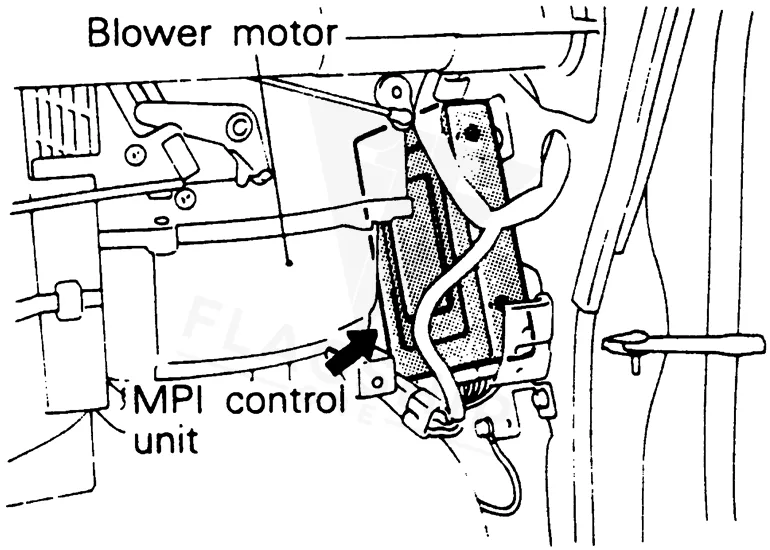
Work with the ignition off, and treat the module as static-sensitive: avoid touching the connector pins at any point.
| Operation | Configuration | Book Time |
|---|---|---|
| Powertrain Control Module R&R | All configurations | 0.8 hr |
| Powertrain Control Module Relearn | All configurations | 0.5 hr |
| Engine Control Module Relearn | All configurations | 0.5 hr |
| Engine Control Module R&R | All configurations | 0.7 hr |
After the new PCM is installed, the factory requires a relearn of the engine and transmission systems. Because Flagship One units arrive VIN‑programmed, the relearn step is already completed, so the technician can skip the manual programming steps. This eliminates the need for a separate diagnostic tool or software session. VIN‑programmed replacement unit for the correct application.
Common signs that the PCM in a 1993 Mitsubishi Mirage may be failing include a hard start, stalling while idling, or intermittent misfires that trigger the engine to shut down unexpectedly. Drivers may also notice a loss of power during acceleration or irregular shifting. When a PCM fault is present, the diagnostic scan tool may display a dead or non‑responsive module, or it may return a generic engine control code such as Powertrain Control Module Failure.
If you notice a hard start, stalling, or sudden loss of power while driving, the PCM may be the culprit. A diagnostic scan that shows a dead or unresponsive module is another strong indicator.
The book time for removal is 0.8 hours, and the relearn step takes 0.5 hours. With a VIN‑programmed unit, the total time can be close to an hour.
Yes. The relearn procedure synchronizes the new PCM with the Engine Control Module and transmission, ensuring all systems communicate correctly.
Refurbished units are available, but they may require additional diagnostics and programming. A VIN‑programmed unit from Flagship One is pre‑configured for your vehicle.
Disconnect the battery, protect the engine cover, and use the correct torque specifications for all mounting bolts to avoid damaging the PCM or surrounding components.
Whether you opt for a professional repair or a refurbished replacement, understanding the PCM’s role in your 1993 Mitsubishi Mirage helps you make an informed decision. A VIN‑programmed unit from Flagship One can reduce downtime and eliminate extra programming steps, allowing you to return to the road faster.
Flagship One stocks a refurbished, VIN-programmed PCM for the 1993 Mitsubishi Mirage with a lifetime warranty, free shipping and no core charge. The full Mitsubishi Mirage module lineup covers other engine configurations as well.
If your 1993 Mitsubishi Mirage is experiencing starting or performance issues, the PCM may be the root cause. Replacing this module with a VIN‑programmed unit can restore reliable operation and save you time. Consider your options and take action before minor symptoms turn into major problems.