
Last updated on August 25th, 2026 at 01:56 pm
In the 1992 Mitsubishi Mirage the Powertrain Control Module and Engine Control Module manage fuel delivery, ignition timing, and emission controls. A malfunction can interrupt engine operation, cause rough idle, or prevent the vehicle from starting, often due to internal circuit failure or loss of communication with sensors.
When a 1992 Mitsubishi Mirage begins to exhibit no‑start conditions, rough idle, or intermittent power loss, the electronic control modules are a likely suspect. This guide walks you through the basics of the Powertrain Control Module (PCM) and Engine Control Module (ECM) in this model, explains where the units are located, outlines the steps required after replacement, and highlights practical ways to keep the modules healthy. By the end, you will understand what the modules do, how long a typical shop job takes, and why a VIN‑programmed replacement from Flagship One can simplify the process.
The PCM in the 1992 Mitsubishi Mirage serves as the central brain for engine and transmission management, interpreting sensor data to adjust fuel injection, ignition timing, and shift points. It also monitors emissions outputs to meet regulatory standards. The ECM works alongside the PCM, focusing on engine‑specific parameters such as idle speed and spark control. Together they ensure smooth operation across all driving conditions. Failure of either module may result in loss of power, erratic shifting, or complete engine shutdown. Understanding the role of these computers helps you diagnose issues before they become costly. replacement engine computers for the 1992 Mitsubishi Mirage are designed to match the original specifications while offering updated firmware reliability.
1992 Mitsubishi Mirage
OEM programmed replacements — plug & play, no dealer visit.
Find yours by year, make & model →
Free shipping · Lifetime warranty
The PCM is mounted in the engine compartment of the Mirage, positioned near the firewall for easy access. Removal involves disconnecting the electrical harness, unscrewing the mounting bolts, and gently extracting the unit. The shop manual lists a labor time of 0.5 hours for this task. The ECM resides in a similar location, often attached to the same bracket, and follows the same removal steps with an identical labor estimate. Installation reverses the process, ensuring connectors are seated fully and bolts are torqued to the manufacturer’s specification, which is included in the service guide. After both units are secured, a relearn procedure of 0.5 hours each is required to synchronize the new hardware with the vehicle’s sensors.
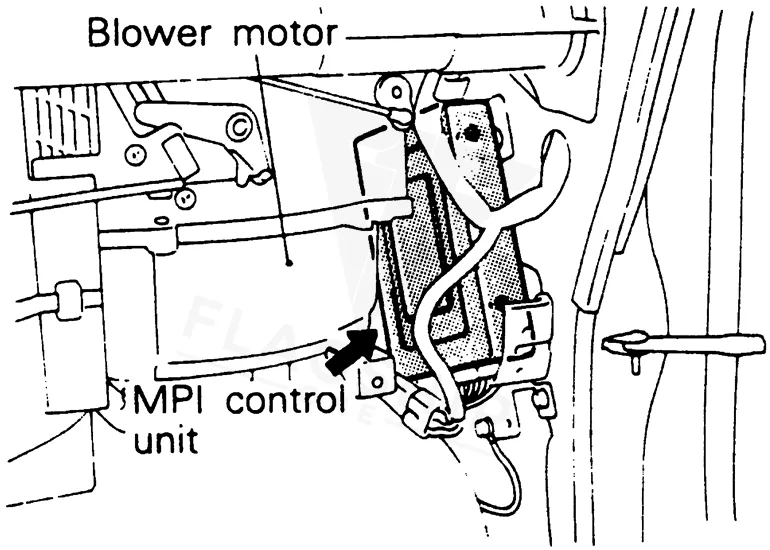
Work with the ignition off, and treat the module as static-sensitive: avoid touching the connector pins at any point.
| Operation | Configuration | Book Time |
|---|---|---|
| Powertrain Control Module R&R | All configurations | 0.5 hr |
| Powertrain Control Module Relearn | All configurations | 0.5 hr |
| Engine Control Module Relearn | All configurations | 0.5 hr |
| Engine Control Module R&R | All configurations | 0.5 hr |
Factory service procedures dictate that after installing a new PCM or ECM in a 1992 Mitsubishi Mirage, a relearn cycle must be performed to calibrate the module to the engine’s parameters. This involves a series of key‑on and engine‑running steps that the technician follows from the repair manual. Flagship One units arrive already VIN‑programmed, so the relearn process is the only step needed on the shop floor. a VIN‑programmed replacement unit eliminates the need for field coding and reduces the chance of programming errors.
When the PCM or ECM in a 1992 Mitsubishi Mirage begins to fail, owners may notice the engine refusing to start, stalling during idle, or experiencing irregular power delivery. Diagnostic scans often show loss of communication with the control modules, and the check engine light may flash intermittently. In some cases, the transmission may shift harshly or remain stuck in one gear because the PCM cannot command the shift solenoids. These symptoms typically point to a loss of internal module integrity rather than a simple sensor fault, prompting further inspection of the control units themselves.
Typical indicators include a no‑start condition, erratic idle, and loss of transmission shift control. A diagnostic scan may show communication errors with the PCM.
The shop manual estimates about half an hour for removal and installation, plus an additional 0.5 hour for the required relearn procedure.
Standard socket and wrench sets are sufficient. The key is to ensure the electrical connectors are fully seated and the mounting bolts are torqued to specification.
Yes, Flagship One units are programmed at the factory to match the vehicle’s VIN, so the only post‑install step is the relearn cycle outlined in the service manual.
Refurbished units that meet the original specifications can be reliable, but ensure they come with a warranty and have been tested for proper operation before installation.
When the PCM or ECM in your 1992 Mitsubishi Mirage fails, you can choose a brand‑new replacement or a refurbished unit that meets the original specifications. Both options require the same removal steps and post‑install relearn, but a VIN‑programmed unit from Flagship One removes the need for additional coding, saving time in the shop.
Flagship One stocks a refurbished, VIN-programmed PCM for the 1992 Mitsubishi Mirage with a lifetime warranty, free shipping and no core charge. The full Mitsubishi Mirage module lineup covers other engine configurations as well.
If your 1992 Mitsubishi Mirage shows the described symptoms, consider evaluating the PCM and ECM for replacement. A properly programmed unit can restore reliable performance, and routine maintenance helps prevent future issues.