
Last updated on August 25th, 2026 at 02:00 pm
The powertrain control module on your 1999 Mazda MX-5 Miata serves as the central computer managing engine fuel delivery, ignition timing, and emission controls. Failure typically stems from heat exposure, voltage spikes, or connector corrosion.
If your 1999 Mazda MX-5 Miata has developed starting difficulties, runs poorly, or triggers check engine lights related to powertrain electronics, the engine control module or powertrain control module may be the culprit. These computing units serve as the brain of your vehicle’s powertrain, continuously monitoring sensor inputs and adjusting fuel and ignition delivery to maintain smooth operation. Because the module processes data from multiple sources including the oxygen sensors, coolant temperature sensor, and throttle position sensor, any internal failure can cascade into drivability issues that affect power delivery and fuel economy. This guide walks you through understanding what these modules do in your specific vehicle, where they are located, the labor involved in replacement, and what programming steps the dealer procedure requires after installation. By understanding the factory service procedure and knowing that pre-programmed replacement units arrive ready to install, you can make informed decisions about repair options for your Miata.
The powertrain control module on your 1999 Mazda MX-5 Miata with the 1.8L engine acts as the primary computer responsible for managing the engine and automatic transmission functions. Unlike some vehicles that combine all computing functions into a single unit, the Miata separates these responsibilities between the engine control module handling pure engine functions and the powertrain control module that coordinates transmission shifting behavior. This architecture means that symptoms can sometimes be traced to one specific module rather than a unified system failure. The module receives input from numerous sensors throughout the engine bay and uses this data to calculate optimal air-fuel ratios, determine spark advance angles, and control idle speed. When the internal processor or memory within the module fails, the unit may lose its ability to store calibration data, communicate with the scan tool, or output proper signals to fuel injectors and ignition coils. Heat from the engine bay ranks as a primary accelerator of internal component degradation in these modules, particularly in convertibles where the electronics sit closer to the exhaust manifold and have less thermal isolation than enclosed vehicle architectures. Installing high-quality replacement Miata computers helps restore proper engine management without requiring extensive reprogramming at the dealership.
Flagship One keeps Mazda MX-5 Miata replacement engine computers in stock for exactly this failure pattern.
1999 Mazda MX-5 Miata
OEM programmed ECM for your 1999 Mazda MX-5 Miata — plug & play, no dealer visit.
Free shipping · Lifetime warranty
The engine control module on your 1999 Miata sits in the passenger footwell area behind the kick panel, mounted to the forward side of the firewall. Access requires removing the passenger-side floor carpet and the plastic kick panel that covers the mounting location. The module itself bolts to a metal bracket with multiple electrical connectors plugging into the harness on the engine side of the firewall. Removing the old unit involves disconnecting the battery ground terminal first as a safety measure, then releasing the connector locks and removing the mounting bolts. Installation reverses this process, ensuring all connector seals seat properly to prevent moisture intrusion. The book time for this operation ranges from 0.5 hours on models without an immobilizer system to 0.8 hours on vehicles equipped with the anti-theft immobilizer, reflecting the additional caution required when working with theft-deterrent wiring. Plan for the relearn procedure to add another 0.5 hours to the overall job, during which the new module must establish communication with the rest of the vehicle systems and store vehicle-specific calibration data.
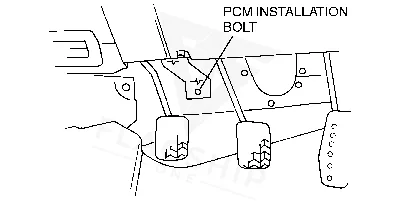
Work with the ignition off, and treat the module as static-sensitive: avoid touching the connector pins at any point.
| Operation | Configuration | Book Time |
|---|---|---|
| Powertrain Control Module R&R | Without Immobilize System | 0.5 hr |
| Powertrain Control Module R&R | With Immobilize System | 0.8 hr |
| Powertrain Control Module Relearn | All configurations | 0.5 hr |
| Engine Control Module R&R | Without Immobilize System | 0.5 hr |
| Engine Control Module R&R | With Immobilize System | 0.8 hr |
| Engine Control Module Relearn | All configurations | 0.5 hr |
After installing a replacement engine control module in your 1999 Miata, the factory service procedure requires a relearn process to establish proper communication between the new module and the vehicle’s other control units. This procedure involves connecting a scan tool to the diagnostic port and initiating a calibration reset that allows the new module to learn the specific characteristics of your engine and transmission. During this process, the module stores the vehicle identification number and performs checks on all connected sensors to ensure everything functions properly before releasing the vehicle for normal operation. The relearn step typically takes approximately 0.5 hours to complete and is a mandatory part of the repair when using a brand-new module from the dealer. However, when you purchase a replacement unit from Flagship One, the module arrives pre-programmed with your specific vehicle identification number already burned into its memory, which means the relearn procedure is significantly shortened or in many cases the vehicle accepts the module immediately upon startup without any dealer intervention. This pre-programming saves you the hassle of scheduling a dealership appointment after receiving your replacement unit and eliminates the wait time associated with the factory calibration process.
Every VIN-programmed replacement unit from Flagship One arrives with these steps already completed.
When the engine control module or powertrain control module fails on a 1999 Mazda MX-5 Miata, the symptoms often present in recognizable patterns that differ from simple sensor failures. A common failure mode involves the vehicle refusing to start entirely, with the engine cranking normally but no fuel injection occurring because the module fails to send the activation signal to the injectors. Another frequent symptom involves the check engine light illuminating followed by multiple diagnostic trouble codes setting simultaneously, particularly codes related to random misfire detection or fuel system monitoring. Some owners report that their Miata runs well at idle but develops a severe hesitation or stumbling complaint when accelerating under load, indicating the module may be failing to properly adjust fuel delivery for increased power demands. In cases where the module has suffered partial internal failure, the scan tool may fail to connect entirely or display communication errors when attempting to access the control module, which itself serves as a strong indicator that the module hardware has an internal fault. Transmission shifting complaints can also stem from powertrain control module issues, since this unit often controls shift firmness and shift points on automatic-equipped models. Any of these symptoms in your Miata warrant testing the control module circuit before replacing unrelated components, as the module represents the central processing point for so many engine functions.
Factory service bulletin K011/98 addresses the 1999 Miata transmission control module and specifies proper application of a protector pad to prevent heat-related damage to the TCM housing. This bulletin acknowledges that the transmission control module in these vehicles can suffer premature failure when exposed to excessive heat from the nearby exhaust components, and the factory pad helps mitigate this thermal exposure. Additionally, Mazda has published guidance regarding remanufactured ECU numbering changes that helps identify correct replacement units for specific model year applications, ensuring technicians select the proper part number when ordering replacement control modules.
| Bulletin | Subject | What It Addresses |
|---|---|---|
| — | K011/98 1999 Miata Transmission Control Module (TCM) Protector Pad Application | — |
| — | Mazda Tips: Remanufactured Ecu Numbering Change | — |
| — | 07 002/09 Multi Model Air Conditioning Musty / Mildew Odor | — |
No, you must match the part number to your specific vehicle configuration. Models with and without the immobilizer system use different modules, and using an incorrect part number may result in a no-start condition or trigger theft deterrent warnings.
A used unit may work if it matches your exact model year and immobilizer configuration, but you risk receiving a module with the same internal failure that caused the original unit to be removed. Additionally, used units will likely require dealer programming to accept your vehicle identification number.
In most cases, no. Flagship One programs each replacement unit with your specific VIN before shipping, which means the module is recognized by your vehicle immediately upon installation. You may need to perform a quick idle relearn procedure, but a full dealer programming session is typically not required.
Heat exposure ranks as the primary failure accelerator for these modules, particularly in convertibles where the electronics are mounted in the passenger footwell with direct exposure to engine bay temperatures. Voltage spikes from jump-starting or a faulty charging system can also cause internal processor damage.
The symptoms often overlap, but the 1999 Miata separates these functions. If your vehicle has starting issues with no injector operation and no diagnostic communication, the ECM is typically at fault. If the vehicle runs but has transmission shifting problems or gear-related codes, the PCM is more likely the culprit.
When your 1999 Mazda Miata requires a control module replacement, you have two primary paths forward: paying dealer prices for a new module plus programming labor, or choosing a professionally remanufactured replacement unit that arrives pre-programmed with your VIN. The remanufactured option typically costs significantly less while providing equivalent functionality, and the pre-programming saves you the hassle of scheduling dealer appointments and waiting for the calibration process. Whether you choose new or remanufactured, ensuring the replacement matches your immobilizer configuration is essential for a successful repair.
Flagship One stocks a refurbished, VIN-programmed PCM for the 1999 Mazda MX-5 Miata with a lifetime warranty, free shipping and no core charge. The full Mazda MX-5 Miata module lineup covers other engine configurations as well.
The 1999 Mazda MX-5 Miata relies on properly functioning engine and powertrain control modules to run smoothly and start reliably. Understanding the location, programming requirements, and common failure symptoms helps you make informed decisions about repair options for your vehicle. Whether you experience a no-start condition, multiple random diagnostic codes, or communication failures with your scan tool, addressing module issues promptly prevents secondary damage to other engine components. A quality replacement unit pre-programmed with your specific VIN gets your Miata back on the road efficiently.