
Last updated on August 25th, 2026 at 02:01 pm
The engine control module in a 1995 Mazda MX-5 Miata manages fuel delivery, ignition timing and sensor input. When the unit fails, the engine may refuse to start, run rough, or lose power, and diagnostic tools often cannot communicate with the system.
When a 1995 Mazda MX-5 Miata begins to exhibit erratic performance, the engine control module often becomes the suspect. This component acts as the brain of the powertrain, interpreting sensor data and directing fuel and spark. Understanding how the module functions, where it lives, and what steps are needed after a swap can save you time and money. This guide walks you through the module’s role, typical failure signs, replacement logistics, and how Flagship One’s pre‑programmed units simplify the process, giving you confidence that your Miata returns to reliable operation.
1995 Mazda MX-5 Miata
OEM programmed ECM for your 1995 Mazda MX-5 Miata — plug & play, no dealer visit.
Free shipping · Lifetime warranty
In the 1995 Mazda MX-5 Miata, the engine control module interprets inputs from the throttle position sensor, crankshaft position sensor, and a variety of temperature and pressure sensors. It calculates the precise amount of fuel to inject and the exact timing for spark ignition, ensuring smooth acceleration and efficient cruising. By constantly adjusting these parameters, the module helps the engine meet emissions standards and deliver the responsive feel that Miata drivers expect. When the module cannot process sensor data correctly, the engine may hesitate, stall, or fail to start, compromising drivability and safety. The reliability of this unit is essential because it directly influences fuel economy, emissions compliance, and overall power delivery. For owners seeking a direct replacement, replacement engine control modules for the 1995 Mazda MX-5 Miata provide a factory‑equivalent solution that fits the existing wiring harness and mounting points.
The engine control module in a 1995 Mazda MX-5 Miata is typically found tucked under the front console, and it may also be positioned behind the center console depending on the specific trim. Access generally requires removal of the console trim pieces, which involves disengaging fasteners and gently prying the panels away to expose the mounting bracket. Once visible, the module is secured with a handful of bolts that must be removed before the electrical connector can be unplugged. After disconnecting the harness, the unit can be lifted out of its cradle. Installation reverses this sequence: seat the new module, torque the mounting bolts to the factory specification, reconnect the harness, and reassemble the console components. The procedure is straightforward for a seasoned technician but may require careful handling of the trim to avoid damage.
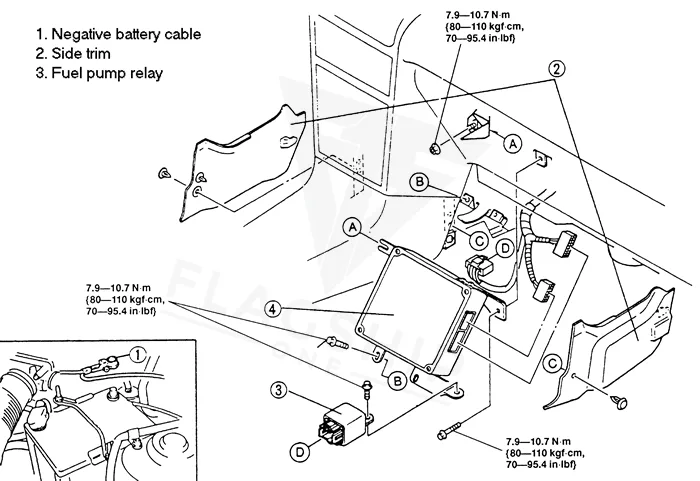
Work with the ignition off, and treat the module as static-sensitive: avoid touching the connector pins at any point.
After installing a new engine control module in a 1995 Mazda MX-5 Miata, the factory service routine calls for a calibration step that aligns the unit with the vehicle’s unique identification number and sensor calibrations. This process traditionally involves a dealer‑level scan tool to write the appropriate data into the module. With Flagship One, the replacement arrives as a VIN-programmed replacement unit that already contains the correct vehicle identification and baseline calibrations, eliminating the need for on‑site programming. The technician can therefore focus on mechanical installation and final verification, knowing the electronic parameters are pre‑set to match the Miata’s specifications.
When the engine control module begins to fail in a 1995 Mazda MX-5 Miata, owners often notice a sudden inability to start the engine, even though the battery is healthy. Intermittent stalling at idle or during light acceleration is another common sign, as the module may lose track of sensor inputs. Rough running, misfires, and a noticeable drop in power can also occur, especially when the vehicle is under load. In some cases, the diagnostic scan tool will be unable to establish communication with the control unit, leaving no clear fault codes to guide repair. These symptoms collectively point to a compromised module that requires attention.
Typical indicators include a no‑start condition, rough idle, stalling during acceleration, and loss of communication with diagnostic tools. These symptoms suggest the module is no longer processing sensor data correctly.
The replacement process involves removing console trim and securing bolts, which can be done with basic hand tools. However, proper handling of the electrical connector and ensuring the new unit is correctly seated are critical for success.
Factory replacement requires a scan tool to write vehicle‑specific data. Flagship One’s units arrive pre‑programmed with the VIN, so an additional programming step is not necessary.
Inspecting ground connections during regular maintenance, such as every service interval, helps prevent intermittent electrical issues that could affect the module.
A refurbished unit that has been tested and re‑programmed to match the vehicle’s VIN can be a reliable option, offering similar performance to a new part at a lower cost.
When the engine control module in your 1995 Mazda MX-5 Miata needs attention, you can choose between a brand‑new factory‑spec unit or a Flagship One refurbished replacement. Both approaches restore functionality, but a refurbished unit arrives pre‑programmed, reducing labor time and eliminating the need for on‑site coding. Evaluate your budget and service preferences to decide which path aligns best with your repair plan.
Flagship One stocks a refurbished, VIN-programmed ECM for the 1995 Mazda MX-5 Miata with a lifetime warranty, free shipping and no core charge. The full Mazda MX-5 Miata module lineup covers other engine configurations as well.
The engine control module is vital to the performance of a 1995 Mazda MX-5 Miata. Whether you opt for a new or refurbished replacement, addressing the issue promptly helps keep your Miata running smoothly and reliably. Consider a VIN‑programmed unit to simplify the installation and get back on the road with confidence.