
Last updated on August 25th, 2026 at 02:11 pm
The Engine Control Module (ECM) in your 2017 Kia Optima manages fuel injection, ignition timing, and emissions systems. Failures may cause erratic engine behavior, poor performance, or complete no-start conditions due to corrupted data or electrical faults.
If your 2017 Kia Optima has been experiencing unexplained stalling, rough idling, or a refusal to start, the Engine Control Module (ECM) may be the culprit. This small but critical component acts as the brain of your vehicle’s engine, coordinating fuel delivery, ignition timing, and emissions systems to ensure smooth operation. When the ECM fails, it can disrupt these processes, leading to frustrating and sometimes unpredictable behavior. Replacing the ECM isn’t just about swapping a part—it involves precise steps to ensure the new module communicates correctly with your Optima’s systems. Understanding the role of the ECM, where it’s located, and what’s required for replacement can save you time and prevent unnecessary headaches. Whether you’re diagnosing an issue or preparing for a repair, this guide will walk you through the essentials of ECM replacement for your 2017 Kia Optima, from labor times to programming requirements and common symptoms of failure.
The Engine Control Module (ECM) in your 2017 Kia Optima is responsible for managing the engine’s most critical functions. It continuously monitors data from sensors throughout the vehicle, such as the oxygen sensor, throttle position sensor, and crankshaft position sensor, to optimize fuel injection, ignition timing, and air-fuel ratios. This ensures your engine runs efficiently, meets emissions standards, and delivers the power you expect. Without a properly functioning ECM, your Optima may struggle with poor fuel economy, rough idling, or even fail to start. The module also plays a key role in diagnosing issues, storing trouble codes when something goes wrong. If the ECM itself fails, it can trigger a cascade of problems, from misfires to complete engine shutdowns. When replacement becomes necessary, opting for replacement engine computers for the Optima ensures compatibility and reliability, as these units are designed to meet the specific demands of your vehicle’s 2.4L engine.
2017 Kia Optima
OEM programmed ECM for your 2017 Kia Optima — plug & play, no dealer visit.
Free shipping · Lifetime warranty
In the 2017 Kia Optima, the ECM is positioned next to the air cleaner assembly, making it relatively accessible compared to some vehicles where the module is buried deep in the dashboard or under the hood. To replace it, a technician will typically start by disconnecting the battery to prevent electrical issues, then remove the air cleaner housing to gain clear access to the module. The ECM is secured with a few bolts or clips, and once those are removed, the wiring harness can be disconnected. Installation of the new module follows the reverse process: reconnect the wiring, secure the module in place, and reinstall the air cleaner assembly. Labor times for this procedure vary slightly depending on the exact steps required. A straightforward removal and replacement (R&R) of the ECM may take around 0.4 hours, while some procedures, particularly those labeled for gasoline engines, may require up to 0.6 hours. No specialized tools are typically needed beyond basic hand tools, but care must be taken to avoid damaging the wiring harness or connectors during the process.
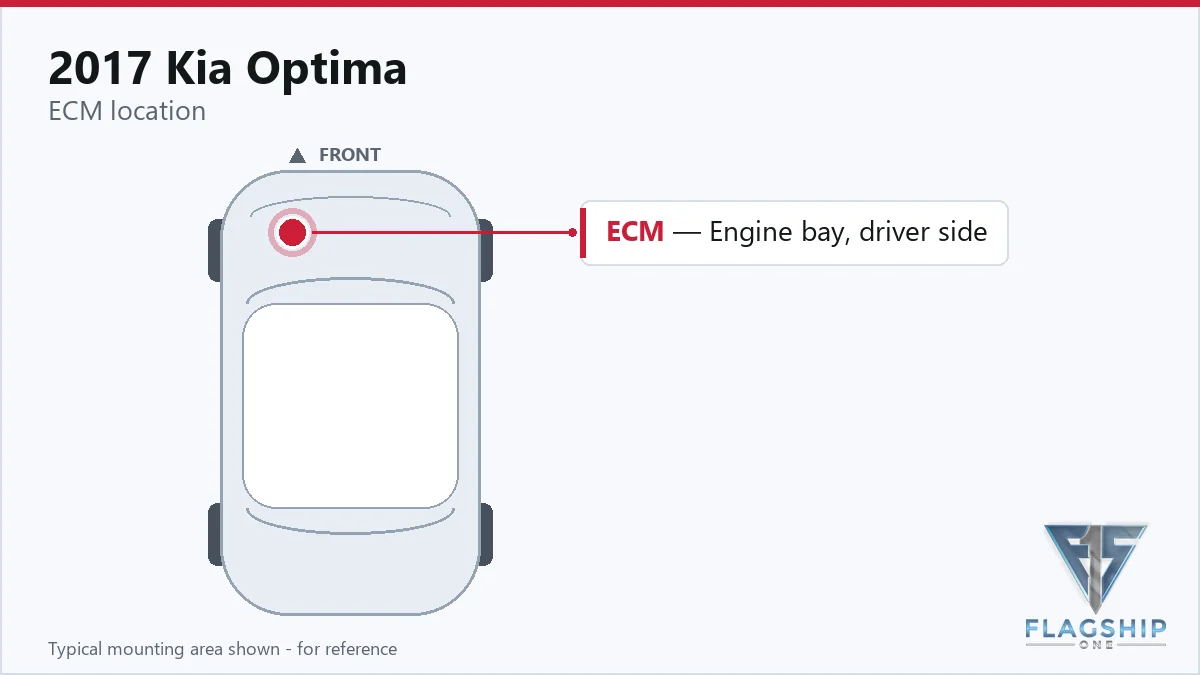
Work with the ignition off, and treat the module as static-sensitive: avoid touching the connector pins at any point.
| Operation | Configuration | Book Time |
|---|---|---|
| Engine Control Module Reset | All configurations | 0.3 hr |
| Engine Control Module R&R | GAS | 0.6 hr |
| Engine Control Module R&R | All configurations | 0.4 hr |
| Engine Control Module Relearn | All configurations | 0.5 hr |
| Powertrain Control Module R&R | GAS | 0.6 hr |
| Powertrain Control Module R&R | All configurations | 0.4 hr |
| Powertrain Control Module Relearn | All configurations | 0.5 hr |
After installing a new ECM in your 2017 Kia Optima, the factory procedure requires programming the vehicle’s VIN into the module to ensure it communicates correctly with the rest of the engine and transmission systems. This step is critical because the ECM relies on the VIN to access the correct calibration data for your specific vehicle. Without this programming, the engine may run poorly or not start at all. The relearn process, which syncs the ECM with the vehicle’s sensors and systems, typically adds another 0.5 hours of labor. However, if you choose a VIN-programmed replacement unit, this step is already completed before the module arrives. Flagship One units are pre-programmed with your Optima’s VIN, eliminating the need for additional programming at the shop. This not only saves time but also reduces the risk of errors during the installation process, ensuring your vehicle is back on the road faster and with fewer complications.
When the ECM in your 2017 Kia Optima begins to fail, the symptoms can range from subtle to severe, often mimicking other mechanical or electrical issues. One of the most common signs is a no-start condition, where the engine cranks but refuses to fire up. This may occur intermittently or become a persistent problem as the ECM’s internal circuits degrade. Stalling or rough idling is another frequent symptom, particularly when the module struggles to maintain consistent fuel delivery or ignition timing. You might also notice poor acceleration, hesitation, or a general lack of power, as the ECM fails to optimize the air-fuel mixture. In some cases, the check engine light will illuminate, and a scan tool may reveal communication errors or specific trouble codes. For example, a memory integrity fault in the ECM could indicate internal corruption, leading to erratic engine behavior. Other potential symptoms include misfires, which may feel like a stutter or jerk during acceleration, or even transmission shifting issues if the ECM isn’t properly communicating with the transmission control module. If your Optima suddenly enters a “limp mode,” where the engine limits RPMs to prevent damage, the ECM may be the root cause. It’s also worth noting that ECM failures can sometimes trigger multiple unrelated trouble codes, making diagnosis more challenging. If you experience any of these symptoms, it’s important to address them promptly to avoid further damage to your vehicle’s engine or transmission.
ECM failure often presents with a combination of symptoms, such as a no-start condition, stalling, or multiple unrelated trouble codes. If your Optima exhibits these issues alongside communication errors with a scan tool, the ECM may be the culprit. However, other components like sensors, wiring, or the fuel system can cause similar symptoms, so a thorough diagnosis is essential.
While the ECM is relatively accessible in the Optima, replacement involves more than just swapping the module. The new ECM must be programmed with your vehicle’s VIN, and a relearn procedure is required to sync it with the engine’s systems. Unless you have the tools and experience for programming, it’s best to have a professional handle the replacement.
Installing a used ECM from another vehicle may seem like a cost-effective solution, but it comes with risks. The module will still need to be reprogrammed with your Optima’s VIN, and there’s no guarantee the used ECM is free of internal faults. Additionally, mismatched calibration data could lead to poor engine performance or even damage over time.
The VIN programming step ensures the ECM uses the correct calibration data for your specific vehicle. This data includes engine timing maps, fuel delivery parameters, and emissions settings tailored to your Optima’s 2.4L engine. Without the correct VIN, the ECM may not function properly, leading to poor performance or a no-start condition.
The physical replacement of the ECM typically takes between 0.4 and 0.6 hours, depending on the procedure. However, the VIN programming and relearn process adds another 0.5 hours of labor. If you use a pre-programmed replacement unit, the programming step is eliminated, reducing the total time required.
If your 2017 Kia Optima is experiencing ECM-related issues, you have a few options to consider. A repair may be possible if the problem is limited to a specific circuit or connector, but this isn’t always the case with internal failures. Replacing the ECM with a new or refurbished unit is often the most reliable solution, particularly if the module is no longer communicating with the vehicle’s systems. For the 2.4L Optima, choosing a replacement unit that’s already programmed with your VIN can simplify the process and get you back on the road faster. Whether you’re dealing with a no-start condition or intermittent stalling, addressing the ECM promptly can prevent further complications down the line.
Flagship One stocks a refurbished, VIN-programmed PCM for the 2017 Kia Optima with a lifetime warranty, free shipping and no core charge. The full Kia Optima module lineup covers other engine configurations as well.
The Engine Control Module is a vital component in your 2017 Kia Optima, overseeing critical engine functions that keep your vehicle running smoothly. When it fails, the symptoms can be frustrating and disruptive, but understanding the replacement process and programming requirements can help you make informed decisions. Whether you opt for a repair or a replacement, addressing ECM issues promptly ensures your Optima remains reliable and efficient. With the right approach, you can restore your vehicle’s performance and avoid the pitfalls of a failing module.