
Last updated on August 25th, 2026 at 02:14 pm
The Powertrain Control Module and Engine Control Module in your 2016 Kia Optima manage critical engine and transmission operations. These processors monitor sensor data and adjust fuel delivery, ignition timing, and emissions systems. When internal circuitry fails, your vehicle may exhibit drivability issues or fail to start entirely.
When your 2016 Kia Optima develops a drivability concern that resists conventional repair, the root cause may lie within one of its onboard control modules. The Powertrain Control Module and Engine Control Module serve as the electronic brains of your vehicle, processing information from numerous sensors and commanding actuators to maintain proper engine operation. These modules operate continuously while you drive, making thousands of adjustments per second to optimize performance and efficiency. Understanding the replacement process, programming requirements, and what symptoms indicate module failure can help you make informed decisions about repairs. This guide covers the essential aspects of diagnosing potential control module issues, what the actual replacement procedure involves according to factory procedures, and how modern replacement units arrive ready for installation.
2016 Kia Optima
OEM programmed ECM for your 2016 Kia Optima — plug & play, no dealer visit.
Free shipping · Lifetime warranty
The Engine Control Module in your 2016 Kia Optima functions as the primary computer responsible for managing the engine operating envelope. This processor receives input from oxygen sensors, mass airflow sensors, throttle position sensors, and numerous other measurement devices throughout the engine bay. Using this data, the ECM calculates optimal fuel injector pulse widths, determines appropriate ignition timing advance, and controls emissions-related components such as the exhaust gas recirculation valve and evaporative emissions purge system. The Powertrain Control Module often handles transmission control duties in addition to certain engine management functions, creating an integrated approach to vehicle propulsion. Your 2016 Kia Optima relies on these processors to meet federal emissions standards while delivering acceptable performance and fuel economy. When internal electronics within these units degrade, the resulting symptoms can range from subtle driveability concerns to complete vehicle immobilization. Replacement engine computers for the 2016 Kia Optima must be matched to your specific vehicle configuration to ensure proper communication with all installed sensors and control devices.
Flagship One keeps Kia Optima replacement engine computers in stock for exactly this failure pattern.
The factory removal procedure positions the control module next to the air cleaner assembly, which means access occurs within the engine compartment rather than requiring interior disassembly. This placement provides technicians with relatively direct access compared to modules located beneath dashboard panels or inside the cabin. The air cleaner housing typically requires removal or repositioning to reveal the control module mounting location. Labor operations documented in official repair procedures include ECM reset at 0.3 hours, ECM removal and installation at 0.6 hours for gasoline applications, separate ECM removal and installation at 0.4 hours, and an ECM relearn procedure requiring 0.5 hours. Similar operations exist for the Powertrain Control Module, with R&R times of 0.6 hours for gasoline applications and 0.4 hours for standard replacement, plus a 0.5-hour relearn process. These times reflect the sequential nature of replacement procedures, where initial removal, new module installation, and subsequent relearn operations each represent distinct labor operations.
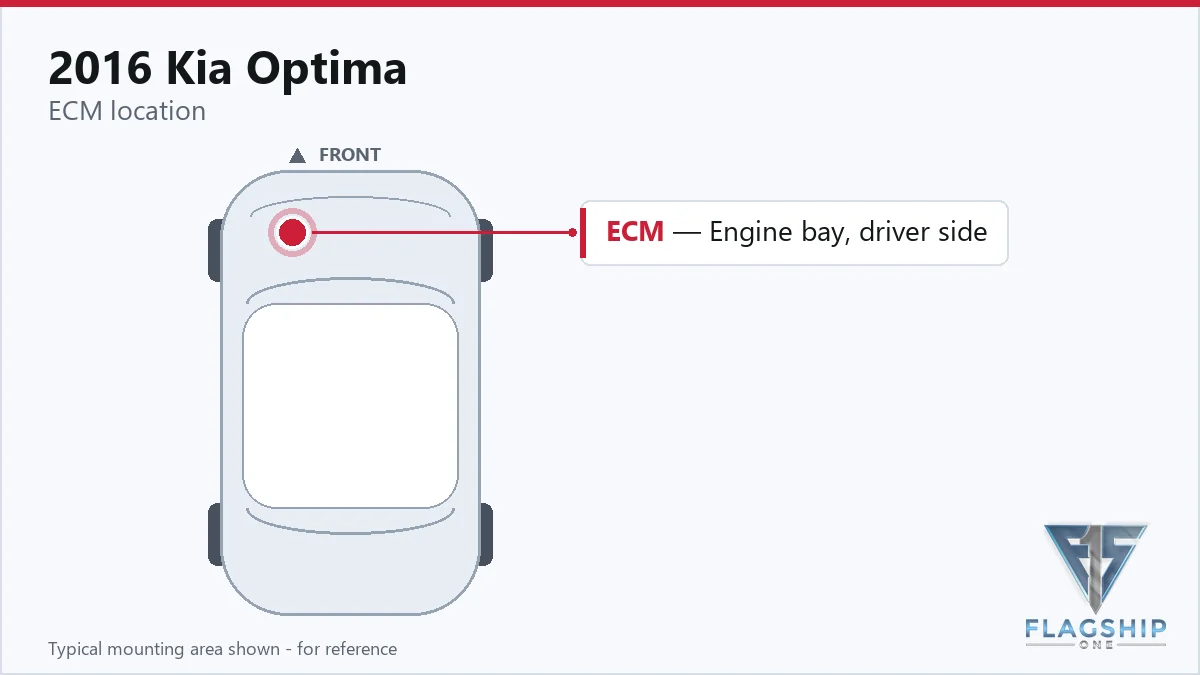
Work with the ignition off, and treat the module as static-sensitive: avoid touching the connector pins at any point.
| Operation | Configuration | Book Time |
|---|---|---|
| Engine Control Module Reset | All configurations | 0.3 hr |
| Engine Control Module R&R | GAS | 0.6 hr |
| Engine Control Module R&R | All configurations | 0.4 hr |
| Engine Control Module Relearn | All configurations | 0.5 hr |
| Powertrain Control Module R&R | GAS | 0.6 hr |
| Powertrain Control Module R&R | All configurations | 0.4 hr |
| Powertrain Control Module Relearn | All configurations | 0.5 hr |
Control module failures in the 2016 Kia Optima typically manifest through several recognizable patterns. No-start conditions occur when internal processing failures prevent the module from activating fuel pump relays or enabling the ignition system. Engine stalling during acceleration or deceleration suggests the module cannot properly adjust fuel delivery or throttle response based on changing conditions. Misfire codes stored in the module’s memory often appear when internal circuits fail to properly process crankshaft position signals or cylinder identification inputs. Scan tool communication failures can indicate complete module electrical failure, where diagnostic equipment cannot establish a data link with the powertrain control system. Transmission shifting complaints, including harsh engagements or failure to shift into higher gears, may result when the control module cannot properly manage hydraulic pressure or clutch apply sequences. The check engine light illumination frequently accompanies these symptoms, providing the initial indicator that prompts diagnosis of control module health.
Diagnostic trouble codes pointing to multiple systems simultaneously often indicate a central module problem rather than individual sensor failures. When scan tool communication becomes inconsistent or fails entirely, internal module electronics typically require attention. A qualified technician can perform module-specific tests to isolate control module health from external circuit issues.
Used control modules from other vehicles require programming to match your specific vehicle identification number before installation. Without proper programming, the module will not communicate with your vehicle’s network, and the engine may not start. Additionally, used modules carry unknown service history and potentially degraded internal components.
When the correct replacement module is installed and programmed properly, your vehicle should restore normal operation. The relearn procedure allows the new module to adapt to your specific engine’s characteristics, optimizing fuel delivery and timing for your particular vehicle.
The relearn process allows the new control module to establish baseline operating parameters specific to your 2016 Kia Optima’s engine. During this period, the module monitors sensor inputs and adjusts compensation values to achieve optimal drivability and emissions performance.
The control module location next to the air cleaner assembly provides relatively accessible mounting compared to some other vehicle platforms. Removal typically requires disconnecting electrical connectors, removing mounting fasteners, and maneuvering the module free from the engine compartment.
Control module replacement for the 2016 Kia Optima represents a significant repair decision that balances cost against vehicle longevity. Aftermarket replacement units from Flagship One arrive pre-programmed with your specific VIN, eliminating the programming hurdle that complicates many module replacements. Whether you pursue repair through a qualified independent shop or handle installation yourself, understanding the process helps set realistic expectations for what lies ahead.
Flagship One stocks a refurbished, VIN-programmed PCM for the 2016 Kia Optima with a lifetime warranty, free shipping and no core charge. The full Kia Optima module lineup covers other engine configurations as well.
The 2016 Kia Optima benefits from a well-documented control module replacement process accessible within the engine compartment. Recognizing the symptoms of potential module failure, understanding the programming requirements, and knowing what to expect during installation empower you to approach this repair with confidence. Flagship One provides VIN-programmed replacement units designed to install directly into your specific vehicle application.