
Last updated on August 25th, 2026 at 02:11 pm
The engine control module (ECM) in the 2016 Kia Sorento manages fuel delivery, ignition timing, and emissions systems. Failures may cause erratic engine behavior, poor performance, or complete stalling due to corrupted memory or electrical faults.
If your 2016 Kia Sorento has been stalling unexpectedly or refusing to start, the engine control module (ECM) may be the culprit. This small but critical computer oversees fuel injection, ignition timing, and emissions controls. When it fails, your vehicle may exhibit a range of performance issues, from rough idling to complete shutdowns. Understanding the role of the ECM, where it’s located, and what replacement involves can help you make informed decisions about repairs. You’ll also learn how programming requirements and factory service bulletins may apply to your situation, ensuring a smoother repair process.
The engine control module in the 2016 Kia Sorento acts as the brain of the engine, continuously adjusting fuel mixture, spark timing, and idle speed to optimize performance and efficiency. Without a properly functioning ECM, your vehicle may struggle to start, run roughly, or even enter a fail-safe mode that limits power. Over time, electrical surges, moisture intrusion, or internal component wear can degrade its performance. If replacement becomes necessary, replacement engine computers for the Sorento are designed to restore factory-level operation, though programming steps are often required to ensure compatibility with your vehicle’s systems.
2016 Kia Sorento
OEM programmed ECM for your 2016 Kia Sorento — plug & play, no dealer visit.
Free shipping · Lifetime warranty
The ECM in the 2016 Kia Sorento is positioned near the air cleaner assembly, making it relatively accessible for replacement. The factory procedure involves disconnecting the battery, removing the air intake components, and carefully unplugging the wiring harness from the module. Once exposed, the ECM is secured with bolts or nuts, which must be torqued to 9.8 to 11.8 N·m for bolts or 8.8 to 11.8 N·m for nuts to prevent loosening. Labor time for removal and reinstallation is typically 0.6 hours, while a relearn procedure may add another 0.5 hours to the process.
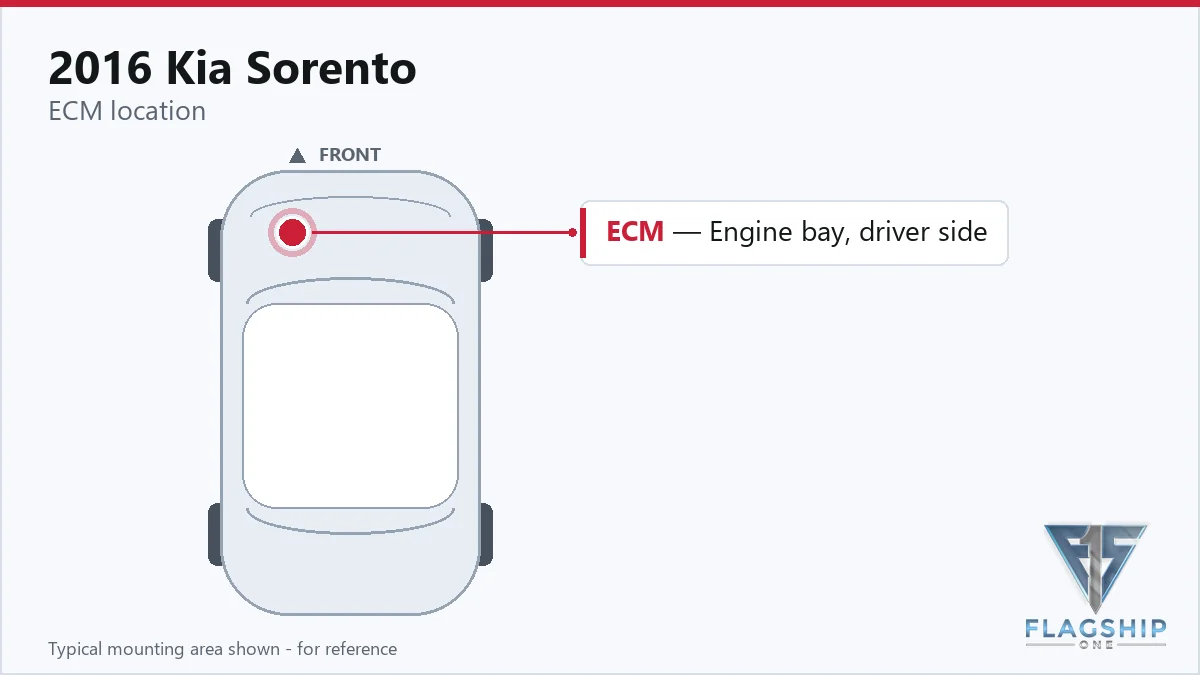
Work with the ignition off, and treat the module as static-sensitive: avoid touching the connector pins at any point.
| Operation | Configuration | Book Time |
|---|---|---|
| Powertrain Control Module R&R | All configurations | 0.6 hr |
| Powertrain Control Module Relearn | All configurations | 0.5 hr |
| Engine Control Module Reset | All configurations | 0.3 hr |
| Engine Control Module R&R | All configurations | 0.6 hr |
| Engine Control Module Relearn | All configurations | 0.5 hr |
After installing a new ECM in your 2016 Kia Sorento, the vehicle identification number (VIN) must be programmed into the module to ensure proper communication with the engine and transmission systems. This step is critical for avoiding drivability issues or stored trouble codes. A VIN-programmed replacement unit from Flagship One arrives pre-configured, eliminating the need for this additional programming step and allowing for a quicker return to the road.
A failing ECM in the 2016 Kia Sorento may cause a variety of symptoms, including intermittent stalling, rough idling, or a no-start condition. You might also notice poor acceleration, reduced fuel efficiency, or the check engine light illuminating. In some cases, the vehicle may enter a fail-safe mode, limiting engine power to prevent further damage. If the module’s internal memory is corrupted, you may see a control module read-only memory error, indicating a need for replacement or reprogramming.
The 2016 Kia Sorento’s ECM may generate specific trouble codes when internal faults are detected. These codes help pinpoint issues within the module itself, rather than broader engine or sensor problems.
| Code | Meaning | Full Guide |
|---|---|---|
| P0605 | Internal ROM error | Full P0605 guide → |
Kia has issued service bulletins for the 2016 Sorento addressing potential ECM-related concerns. Bulletin SC118 involves reprogramming the powertrain control module (PCM) logic for automatic transaxle performance. Another bulletin, ENG174, covers air intake hose replacement alongside an ECM software upgrade to resolve drivability issues. If your vehicle exhibits symptoms related to these systems, reviewing these bulletins with a technician may provide a cost-effective solution before considering module replacement.
| Bulletin | Subject | What It Addresses |
|---|---|---|
| — | CAMPAIGN • Automatic Transaxle • [SC118] Sorento (UMa) – PCM Logic Reprogramming (SC 118) | — |
| — | TSB • Engine Mechanical System • [ENG174] Service Action: Air Intake Hose Replacement and ECU U | — |
Common signs include stalling, rough idling, or a no-start condition. You may also see the check engine light with codes like P0605. A diagnostic scan can confirm whether the ECM is the source of the problem.
While the ECM is accessible near the air cleaner, replacement requires proper torque specifications and often a relearn procedure. If you’re not experienced with automotive electronics, professional installation is recommended.
Without VIN programming, the ECM may not communicate correctly with the engine or transmission, leading to drivability issues, stored codes, or even a no-start condition. Pre-programmed units avoid this step.
If your 2016 Kia Sorento is experiencing ECM-related issues, you have options for repair or replacement. While a dealership may offer a new module, a refurbished or pre-programmed unit can provide a cost-effective alternative. Understanding the labor, programming, and torque requirements ensures you’re prepared for a smooth installation process, whether you tackle it yourself or leave it to a professional.
Flagship One stocks a refurbished, VIN-programmed PCM for the 2016 Kia Sorento with a lifetime warranty, free shipping and no core charge. The full Kia Sorento module lineup covers other engine configurations as well.
The 2016 Kia Sorento relies on its ECM to maintain smooth engine operation, and addressing issues promptly can prevent further complications. Whether you’re dealing with stalling, no-start conditions, or stored trouble codes, knowing the replacement process and programming requirements helps you make informed decisions. With the right approach, your Sorento can return to reliable performance.