
Last updated on August 25th, 2026 at 02:11 pm
The engine control module in your 2014 Kia Sorento serves as the central computer governing fuel delivery, ignition timing, and emissions systems. This unit processes sensor data to maintain optimal engine operation under varying conditions. When internal circuitry fails, the module may lose communication, trigger multiple fault codes, or cause drivability problems ranging from rough idle to complete no-start conditions.
Replacing the engine computer on your 2014 Kia Sorento may become necessary when persistent drivability issues point toward the module itself rather than external sensors or wiring. The ECM or PCM (terms often used interchangeably in service literature) serves as the primary computer managing your engine and, in some configurations, the transmission. This guide walks you through what the replacement process involves, what programming steps the factory requires, and how pre-programmed replacement units from suppliers like Flagship One can simplify the repair. Understanding these procedures helps you have informed conversations with your repair shop or evaluate whether a DIY approach makes sense for your situation.
The ECM on the 2014 Sorento continuously monitors engine operating conditions through multiple sensors and adjusts fuel mixture, ignition timing, and emission control systems accordingly. This processing happens hundreds of times per second during driving, maintaining the balance between performance, economy, and emissions compliance. Your Sorento’s 2.4L engine relies heavily on this module to coordinate direct fuel injection systems and variable valve timing actuators. When the internal processor or circuitry inside the ECM malfunctions, the module may trigger protective measures that limit power output or prevent the engine from starting altogether. replacement engine computers for the Sorento must match the specific calibration for your 2.4L application to ensure proper communication with your vehicle’s network. A properly functioning ECM allows your engine to adapt seamlessly to temperature changes, altitude variations, and different driving demands without driver intervention.
2014 Kia Sorento
OEM programmed ECM for your 2014 Kia Sorento — plug & play, no dealer visit.
Free shipping · Lifetime warranty
The factory service procedure directs technicians to access the control module in the area near the air cleaner assembly, where it is mounted in an accessible location within the engine compartment. Removing the old module involves disconnecting the battery ground terminal first, then unplugging the electrical harness connector before removing the mounting fasteners. The replacement procedure reverses this process, with new bolts tightened to a specification between 9.8 and 11.8 N·m. Factory labor estimates allocate 0.6 hours for the actual removal and reinstallation work, with an additional 0.5 hours required for system relearn after the new module is installed. You should expect the total shop time to include these book hours, though actual time may vary depending on technician experience and any unexpected complications encountered during the job.
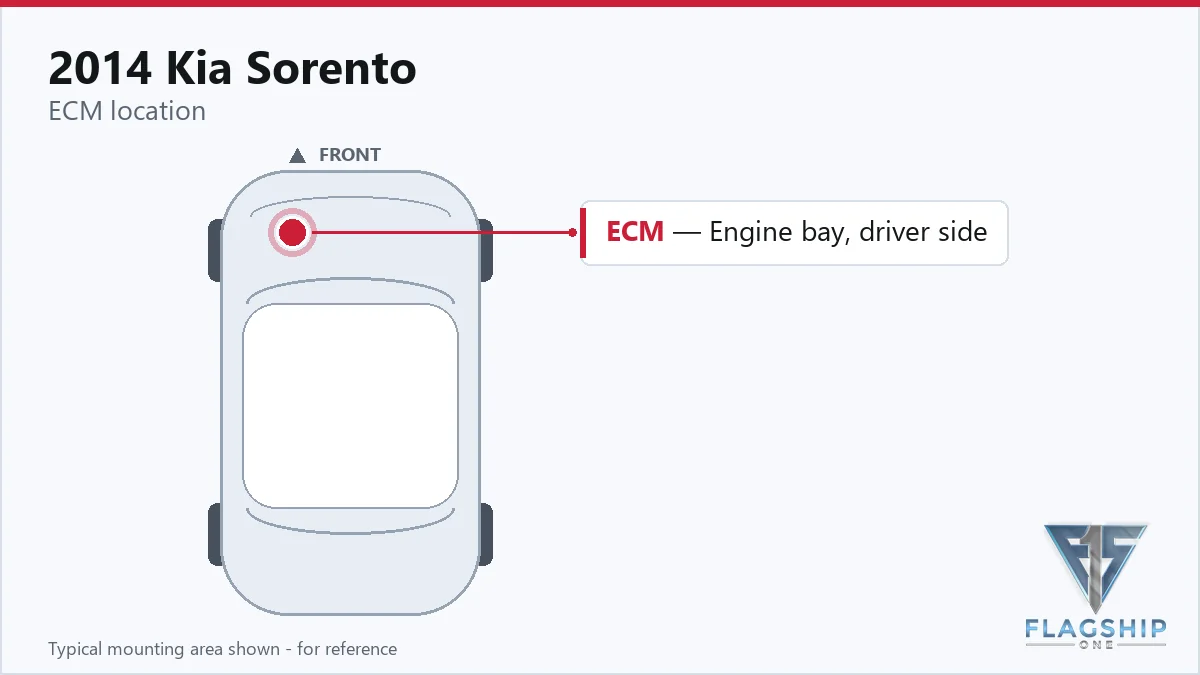
Work with the ignition off, and treat the module as static-sensitive: avoid touching the connector pins at any point.
| Operation | Configuration | Book Time |
|---|---|---|
| Powertrain Control Module R&R | All configurations | 0.6 hr |
| Powertrain Control Module Relearn | All configurations | 0.5 hr |
| Engine Control Module Reset | All configurations | 0.3 hr |
| Engine Control Module R&R | All configurations | 0.6 hr |
| Engine Control Module Relearn | All configurations | 0.5 hr |
After physically installing a replacement ECM in your Sorento, the factory procedure requires programming the vehicle identification number into the new module so it recognizes your specific vehicle. This step establishes proper communication between the engine computer and the immobilizer system, which prevents unauthorized engine starting. The relearn process also allows the new module to calibrate itself to your vehicle’s sensors and actuators. a VIN-programmed replacement unit arrives from Flagship One with this programming already completed, meaning your technician can focus on the mechanical installation rather than handling the programming procedure at the shop. This pre-programming typically reduces overall repair time and eliminates the need for specialized factory-level diagnostic equipment that some shops may not have readily available.
When the ECM on your Sorento begins to fail, you may notice the engine refusing to start or stalling shortly after startup, often without warning. Multiple misfire codes may appear simultaneously as the module loses ability to process sensor data correctly. Some owners report that their scan tool cannot establish communication with the engine computer, which points strongly toward an internal module problem rather than a simple sensor fault. Transmission shifting may become erratic or harsh if the module also handles transmission control functions. You may also experience illuminated warning lights, reduced fuel economy, or a noticeable lack of engine response under acceleration. A stored trouble code indicating internal control module memory fault specifically identifies an internal memory problem within the ECM itself, which typically cannot be resolved through sensor replacement or wiring repairs.
Module-internal trouble codes indicate problems originating within the control module circuitry rather than issues with external sensors or wiring. The 2014 Sorento may store such codes when the internal processor, memory, or other internal components develop faults. These codes often appear alongside drivability symptoms and may persist even after replacing related sensors. Proper diagnosis helps confirm whether the module itself requires replacement or if an underlying cause exists elsewhere in the electrical system.
| Code | Meaning | Full Guide |
|---|---|---|
| P0605 | Internal ROM error | Full P0605 guide → |
Factory service bulletins addressing ECM concerns have been published for various Sorento applications. TSB FUE028 applies to certain Sorento models equipped with the 3.3L GDI engine experiencing MIL illumination with codes P2096 and P2098, recommending an ECM upgrade. TSB ENG116 covers the XM and VQ 3.5L engines with MIL on and code P0638, though this bulletin has been closed and superseded. Campaign SC114 addresses MIL-on conditions with code P0087 in affected Sorento variants and recommends an ECM upgrade. These bulletins demonstrate that Kia has identified specific calibration issues requiring software updates before considering hardware replacement. Your service facility should check for applicable bulletins using your vehicle’s specific build date and engine type before proceeding with repairs.
| Bulletin | Subject | What It Addresses |
|---|---|---|
| — | TSB • Fuel System • [FUE028] ECM Upgrade Sorento (XMa) 3.3 GDI MIL ON WITH DTCs P2096, P2098 (F | — |
| — | TSB • Fuel System • [ENG116] ECM Upgrade XM/VQ 3.5L MIL On with DTC P0638 (ENG 116 – – CLOSED S | — |
| — | CAMPAIGN • Fuel System • [SC114r1] ECM Upgrade – MIL-On With DTC P0087 (SC 114) (REV 1) | — |
When multiple unrelated fault codes appear simultaneously, communication with the module fails on a scan tool, or symptoms persist after sensor and wiring verification, the ECM may be at fault. Professional diagnosis with live data analysis helps distinguish between external component failures and internal module problems.
A used module typically requires VIN programming to match your specific vehicle, and its service history remains unknown. Units from suppliers like Flagship One arrive pre-tested and pre-programmed with your VIN, offering more predictability than salvage yard options.
Improper programming can leave your Sorento unable to start, trigger security lockout conditions, or cause persistent drivability problems. Factory-level programming equipment and correct software calibration files are essential for successful installation.
Choosing between repair and replacement depends on your diagnostic findings and budget considerations. If your shop confirms internal ECM failure, a pre-programmed replacement unit may offer the most straightforward path back to reliable operation. Specialty suppliers typically provide modules calibrated for your specific model year and engine, often with shorter turnaround than dealership parts departments. When evaluating options, consider not just the component cost but also the programming requirements and any core charge policies that may apply.
Flagship One stocks a refurbished, VIN-programmed PCM for the 2014 Kia Sorento with a lifetime warranty, free shipping and no core charge. The full Kia Sorento module lineup covers other engine configurations as well.
The 2014 Kia Sorento relies on its engine control module to coordinate critical systems, and when that module fails, the vehicle may become inoperable or exhibit serious drivability concerns. Understanding the replacement location, torque specifications, and programming requirements prepares you for conversations with your repair facility. Pre-programmed replacement units from Flagship One arrive ready for installation, potentially reducing your total repair time. If you suspect your Sorento’s ECM requires attention, consult with a qualified technician to confirm the diagnosis before proceeding with any replacement.