
Last updated on August 25th, 2026 at 01:24 pm
The Engine Control Module (ECM) in your 2017 Hyundai Santa Fe 3.3L is the computer that manages fuel injection, ignition timing, and emissions. Failure can cause drivability issues, MIL illumination, and stored trouble codes like P0605. It is located near the air cleaner assembly.
If your 2017 Hyundai Santa Fe 3.3L has developed a check engine light, rough running, or a no-start condition, the Engine Control Module (ECM) may be at fault. The ECM is the central computer that controls fuel delivery, ignition timing, and emissions systems. When it fails, your vehicle may exhibit a range of symptoms from poor fuel economy to complete failure to start. This guide will help you understand what the ECM does in your Santa Fe, where it is located, what the replacement process involves, and what programming steps are required. You will also learn about common failure symptoms, relevant factory service bulletins, and how to protect the module from future issues. Whether you are a DIY mechanic or working with a shop, this information will help you make an informed decision about repairing or replacing the ECM in your 2017 Hyundai Santa Fe 3.3L.
The Engine Control Module (ECM) in your 2017 Hyundai Santa Fe 3.3L is a sophisticated computer that acts as the brain of the engine management system. It receives input from sensors such as the oxygen sensors, throttle position sensor, and crankshaft position sensor, then adjusts fuel injector pulse width, ignition timing, and idle speed to maintain optimal performance and emissions. The ECM also monitors system health and sets diagnostic trouble codes (DTCs) when it detects a fault. In this vehicle, the ECM is paired with a Powertrain Control Module (PCM) that integrates transmission control, but the ECM specifically handles engine functions. When the ECM fails, it can cause a variety of drivability issues, including stalling, misfiring, and illumination of the malfunction indicator lamp (MIL). If you need to replace the ECM, you will be looking for replacement engine computers for the 2017 Santa Fe that are compatible with your 3.3L engine. The ECM is a critical component, and using a properly programmed unit is essential for your vehicle to run correctly.
2017 Hyundai Santa Fe 3.3L
OEM programmed ECM for your 2017 Hyundai Santa Fe 3.3L — plug & play, no dealer visit.
Free shipping · Lifetime warranty
The ECM on your 2017 Hyundai Santa Fe 3.3L is located next to the air cleaner assembly, under the hood on the driver’s side. To access it, you typically need to remove the air cleaner housing and any nearby ductwork. The factory removal procedure involves disconnecting the battery, unplugging the electrical connectors, and removing the mounting nuts and bolts. The book time for ECM removal and replacement (R&R) is 0.6 hours. After installation, a relearn procedure is required, which adds 0.5 hours, and a reset procedure takes 0.3 hours. The installation torque for both the nuts and bolts is specified at 9.8 to 11.8 N·m. It is important to use a torque wrench to avoid damaging the module or its mounting points. The process is straightforward but requires care with the connectors and proper torque application.
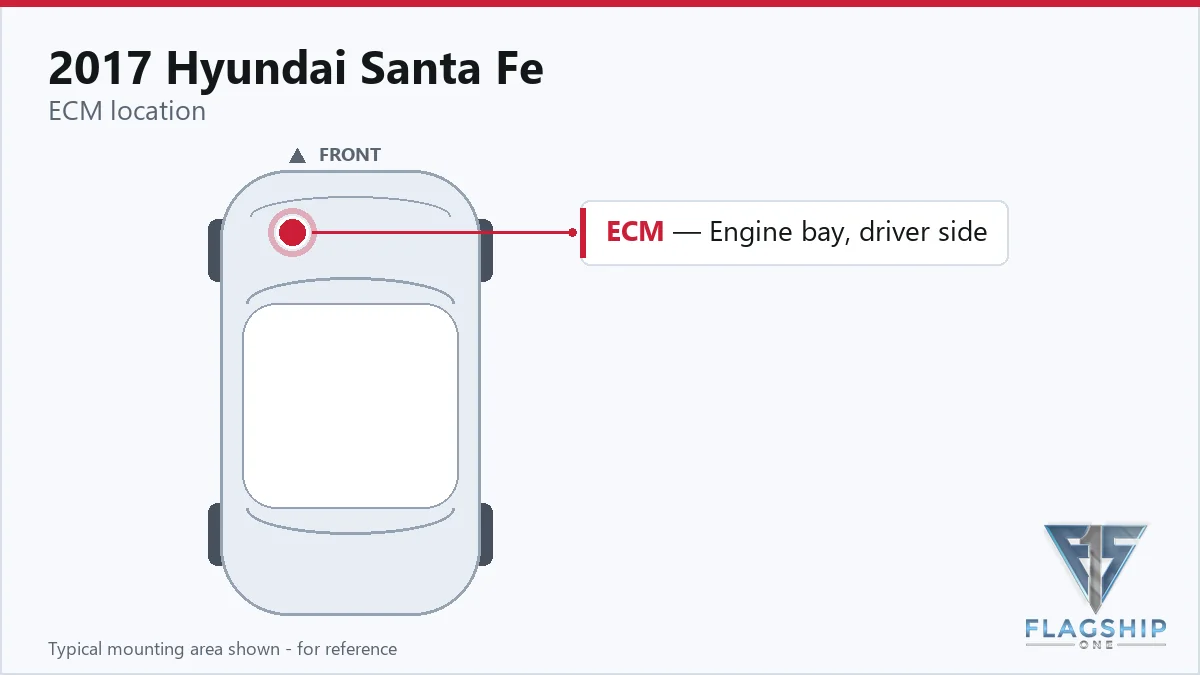
Work with the ignition off, and treat the module as static-sensitive: avoid touching the connector pins at any point.
| Operation | Configuration | Book Time |
|---|---|---|
| Engine Control Module R&R | All configurations | 0.6 hr |
| Engine Control Module Relearn | All configurations | 0.5 hr |
| Engine Control Module Reset | All configurations | 0.3 hr |
| Powertrain Control Module R&R | All configurations | 0.6 hr |
| Powertrain Control Module Relearn | All configurations | 0.5 hr |
After installing a new or replacement ECM in your 2017 Hyundai Santa Fe 3.3L, the factory procedure requires that the vehicle identification number (VIN) be programmed into the module. This step is critical because the ECM uses the VIN to match the vehicle’s specific calibration and immobilizer data. Without this programming, the engine may not start or may run poorly. The factory service bulletin 04-36-019 outlines the VIN writing procedure for control module replacement. Additionally, TSB 15-GI-001 describes the ECU update procedure using a tablet-based GDS mobile tool. However, when you purchase a VIN-programmed replacement unit from Flagship One, the VIN is already written to the module before shipping. This means you can install the unit and, in most cases, skip the VIN programming step, though a relearn procedure may still be needed to adapt the module to your vehicle’s specific sensors and actuators.
When the ECM begins to fail in your 2017 Hyundai Santa Fe 3.3L, you may notice a variety of symptoms. The most common is the illumination of the check engine light, often accompanied by a stored trouble code. One such code is internal control module fault P0605, which indicates a problem within the ECM itself. Other symptoms include intermittent stalling, rough idle, hesitation during acceleration, poor fuel economy, and difficulty starting. In some cases, the engine may crank but not start, or the transmission may shift erratically if the PCM is also affected. You might also experience a loss of communication with a scan tool, as the module may fail to respond. These symptoms can be intermittent at first, making diagnosis challenging. If you notice any of these issues, it is wise to have the ECM and related systems checked promptly to avoid being stranded.
The following module-internal trouble code is documented for the 2017 Hyundai Santa Fe 3.3L ECM. This code indicates a fault within the control module itself and often requires module replacement.
| Code | Meaning | Full Guide |
|---|---|---|
| P0605 | Internal ROM error | Full P0605 guide → |
Several factory service bulletins apply to the 2017 Hyundai Santa Fe 3.3L regarding the ECM. TSB 15-FL-001 addresses an ECM update for vehicles with the 3.3L engine that have the malfunction indicator lamp (MIL) on with diagnostic trouble codes P2096 or P2098, which relate to fuel system lean conditions. TSB 04-36-019 covers the VIN writing procedure during control module replacement for 2005 model year vehicles, but the principle applies to later models as well. TSB 15-GI-001 describes the ECU update procedure using a tablet-based GDS mobile tool, which may be used to apply software updates to the ECM. These bulletins provide guidance for technicians performing ECM-related repairs and updates.
| Bulletin | Subject | What It Addresses |
|---|---|---|
| — | TSB • Fuel System • [15-FL-001] ECM UPDATE – SANTA FE 3.3L MIL ON (DTC P2096/P2098) | — |
| 04-36-019 | TSB • Fuel System • [04-36-019] 2005MY ECM AND PCM VIN WRITING DURING CONTROL MODULE REPLACEMEN | — |
| — | TSB • General Information • [15-GI-001] ECU UPDATE PROCEDURE FOR TABLET-BASED GDS MOBILE | — |
When your 2017 Hyundai Santa Fe 3.3L needs an ECM replacement, you have options. You can have a shop repair the existing module, but that is often not cost-effective. A more reliable solution is to install a refurbished or new replacement unit. Flagship One offers VIN-programmed ECMs for your Santa Fe, so you can install the module and get back on the road without the extra programming step.
Flagship One stocks a refurbished, VIN-programmed PCM for the 2017 Hyundai Santa Fe with a lifetime warranty, free shipping and no core charge. The full Hyundai Santa Fe module lineup covers other engine configurations as well.
The ECM in your 2017 Hyundai Santa Fe 3.3L is a vital component that controls engine performance. Recognizing the symptoms of failure, understanding the replacement process, and knowing the programming requirements will help you make a smart repair decision. Whether you choose to have a shop handle the work or do it yourself, a properly programmed replacement ECM from Flagship One can restore your vehicle’s reliability.