
Last updated on August 25th, 2026 at 02:17 pm
The Engine Control Module (ECM) in the 2018 Chevrolet Bolt EV manages all engine‑related commands, including fuel delivery, ignition timing and emissions monitoring. When the ECM fails, the vehicle can lose power, trigger multiple diagnostic codes, and may not start. Faulty internal circuitry or corrupted software often cause these failures.
You may have discovered that your 2018 Chevrolet Bolt EV is experiencing intermittent power loss, a check‑engine light, or a complete no‑start condition. Those symptoms often point to the Engine Control Module, the computer that tells the electric powertrain how to operate. This guide explains what the ECM does in the Bolt, where it lives, how long a professional shop typically spends on removal and installation, and what factory procedures follow a swap. By the end, you will understand the labor involved, the programming requirement, and why a pre‑programmed replacement from Flagship One can simplify the repair while keeping your vehicle back on the road quickly.
The Engine Control Module in the 2018 Chevrolet Bolt EV serves as the central processor for the vehicle’s electric powertrain, interpreting sensor data and issuing commands to the motor, inverter and auxiliary systems. It controls torque output, manages regenerative braking, and ensures emissions compliance by monitoring battery temperature and state‑of‑charge. Because the Bolt relies on precise coordination between its high‑voltage components, a malfunctioning ECM can cause sudden power loss, limp‑mode operation, or a complete shutdown. The module also stores calibration data that the vehicle’s software uses to optimize efficiency. Understanding its role helps explain why the repair process includes both mechanical replacement and a software relearn step. The 2018 Chevrolet Bolt EV replacement engine computers are engineered to match the original specifications and retain all VIN‑specific calibrations.
The ECM is mounted in the engine compartment, secured by a bracket nut that must be torqued to 4.7Y (42 lb‑in) according to the factory caution. To replace the unit, a technician typically spends about 0.9 hours on removal and installation. The process begins with disconnecting the battery negative cable, then loosening the bracket nut and unplugging the ECM electrical connector. After the old module is removed, the new unit is positioned, the connector re‑engaged, and the bracket nut retightened to the specified torque. Finally, the battery negative cable is reconnected, completing the mechanical portion of the swap.
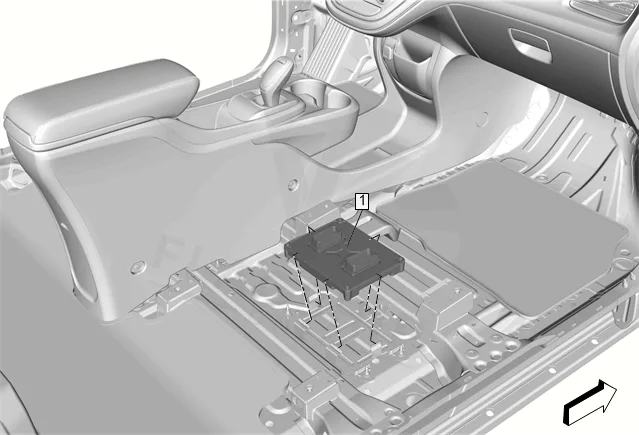
Work with the ignition off, and treat the module as static-sensitive: avoid touching the connector pins at any point.
| Operation | Configuration | Book Time |
|---|---|---|
| Powertrain Control Module R&R | All configurations | 0.9 hr |
| Powertrain Control Module Relearn | All configurations | 0.5 hr |
| Engine Control Module R&R | All configurations | 0.9 hr |
| Engine Control Module Relearn | All configurations | 0.5 hr |
| Engine Control Module Reset | All configurations | 0.3 hr |
2018 Chevrolet Bolt EV
OEM programmed ECM for your 2018 Chevrolet Bolt EV — plug & play, no dealer visit.
Free shipping · Lifetime warranty
Once the new ECM is physically installed, the factory procedure requires a relearn operation to synchronize the module with the vehicle’s existing systems. This includes a 0.5‑hour Powertrain Control Module Relearn and a 0.3‑hour ECM Reset to ensure proper communication with the battery management system. Flagship One supplies a a VIN-programmed replacement unit that arrives already calibrated to your vehicle’s VIN, so the relearn and reset steps are already completed, eliminating the need for additional on‑site programming.
When the ECM in a 2018 Chevrolet Bolt EV begins to fail, owners often notice a loss of drive power, stalling during acceleration, or the check‑engine light flashing. Diagnostic scans may return a range of codes, including internal control module error and other P060x series faults. In some cases, the vehicle may refuse to start because the ECM cannot communicate with the battery management system, leading to a dead scan‑tool connection. These symptoms typically appear gradually, but a sudden loss of power can also signal a catastrophic module failure.
The following diagnostic trouble codes are documented for the Engine Control Module in the 2018 Chevrolet Bolt EV. They help pinpoint internal processor or communication issues:
| Code | Meaning | Full Guide |
|---|---|---|
| P0601 | Internal memory checksum error | Full P0601 guide → |
| P0602 | Control module programming error | Full P0602 guide → |
| P0603 | Keep-alive memory (KAM) error | Full P0603 guide → |
| P0604 | Internal RAM error | Full P0604 guide → |
| P0606 | Module processor failure | Full P0606 guide → |
| P0607 | Module performance fault | Full P0607 guide → |
| P060A | Module-internal fault | — |
| P060B | Module-internal fault | — |
| P060C | Module-internal fault | — |
| P0610 | Module-internal fault | Full P0610 guide → |
| P062F | Internal EEPROM error | Full P062F guide → |
| P0630 | Module-internal fault | Full P0630 guide → |
Service Bulletin #16-NA-407 (dated Oct 4 2017) describes a condition where the Chassis Control Module and Hybrid Powertrain Control Module receive invalid data, resulting in DTC U0422. Service Bulletin #PIP5373B (dated Jun 11 2018) addresses programming errors that generate ECM codes E4491 and E4423. Both bulletins provide guidance on data validation and reprogramming procedures.
| Bulletin | Subject | What It Addresses |
|---|---|---|
| — | Information on Chassis Control Module (CCM) and Hybrid Powertrain Control Module (HPCM) Receive | — |
| — | Program ECM Error E4491/E4423 – (Jun 11, 2018) | — |
A typical shop will allocate roughly 0.9 hours for the removal and installation of the ECM, plus additional time for relearn procedures.
Yes, the factory caution specifies that the battery negative cable must be disconnected and reconnected after the module is secured.
The bracket nut should be tightened to 4.7Y, which is equivalent to 42 lb‑in of torque.
Flagship One units arrive VIN‑programmed, so the standard relearn and reset steps are already completed.
Codes in the P0601‑P0630 range, such as P0601, are commonly associated with internal ECM processor errors.
When the Engine Control Module fails, you can choose a professional repair with a refurbished unit or opt for a new Flagship One replacement that arrives pre‑programmed to your VIN. Both approaches restore the Bolt’s performance, but the pre‑programmed option saves the additional factory relearn time and reduces the risk of installation errors.
Flagship One stocks a refurbished, VIN-programmed PCM for the 2018 Chevrolet Bolt EV with a lifetime warranty, free shipping and no core charge. The full Chevrolet Bolt EV module lineup covers other engine configurations as well.
The 2018 Chevrolet Bolt EV relies on a correctly functioning Engine Control Module to deliver smooth, reliable electric driving. Whether you repair or replace the ECM, ensuring proper torque, connector security and post‑install programming will keep your vehicle performing as designed. Consider a VIN‑programmed Flagship One unit for a streamlined solution.