
Last updated on August 25th, 2026 at 02:17 pm
The Powertrain Control Module (PCM) in the 2015 Chevrolet City Express integrates engine and transmission control. It manages fuel injection, ignition timing, and shift patterns. Failure can cause no-start, stalling, poor performance, and trigger internal diagnostic trouble codes like P0601 through P1621.
If your 2015 Chevrolet City Express is experiencing intermittent stalling, a no-start condition, or check-engine light with codes that point to the control module, you are likely dealing with a failing Powertrain Control Module (PCM) or Engine Control Module (ECM). In this vehicle, the PCM and ECM are essentially the same unit—a single computer that governs both engine and transmission operation. Understanding what this module does, where it is located, and what replacement involves can save you time and money. This guide covers the common symptoms of module failure, the factory-recommended replacement and programming procedures, and how a pre-programmed unit from Flagship One eliminates the need for a dealer visit. You will also find the official labor times, relevant service bulletins, and a list of internal trouble codes that signal module failure. Whether you are a DIY owner or a professional technician, the information here will help you diagnose and resolve PCM/ECM issues on the 2015 City Express.
The 2015 Chevrolet City Express uses a combined Powertrain Control Module (PCM) that also serves as the Engine Control Module (ECM). This single computer controls fuel delivery, ignition timing, idle speed, variable valve timing, and transmission shift scheduling. It also monitors emissions systems and communicates with other modules over the CAN bus. Because the City Express is a compact cargo van often used for commercial duty, a reliable PCM is critical for uptime. When the module fails, the vehicle may not start, may run poorly, or may set internal diagnostic trouble codes that cannot be cleared by simply replacing sensors. The module is located in the engine bay, typically mounted near the battery or on the firewall. Replacement involves disconnecting the battery, removing electrical connectors, and unbolting the unit. The factory book time for removal and installation is 0.9 hours, with an additional 0.5 hours for the relearn procedure. For owners seeking a direct swap, replacement engine computers for the 2015 Chevrolet City Express are available that come pre-programmed with the correct VIN and calibration, avoiding the need for the EL-49642 SPS tool and the risk of triggering bulletin 17-NA-242’s prohibition on reprogramming with the current calibration.
2015 Chevrolet City Express
OEM programmed ECM for your 2015 Chevrolet City Express — plug & play, no dealer visit.
Free shipping · Lifetime warranty
The PCM/ECM on the 2015 Chevrolet City Express is located in the engine compartment, typically mounted on the driver-side inner fender or near the battery. Access requires removing the air cleaner housing or other components to reach the module. The factory labor allowance for removal and installation is 0.9 hours. The procedure begins with disconnecting the negative battery cable and waiting at least one minute for capacitors to discharge. Then unplug the two large electrical connectors, remove the mounting bolts, and lift the module out. Installation is the reverse, but the connectors must be fully seated and the module secured to prevent vibration damage. After installation, a relearn procedure is required, which adds 0.5 hours of labor. This relearn typically involves a specific drive cycle or scan tool command to synchronize the module with the vehicle’s security system and transmission adaptations.
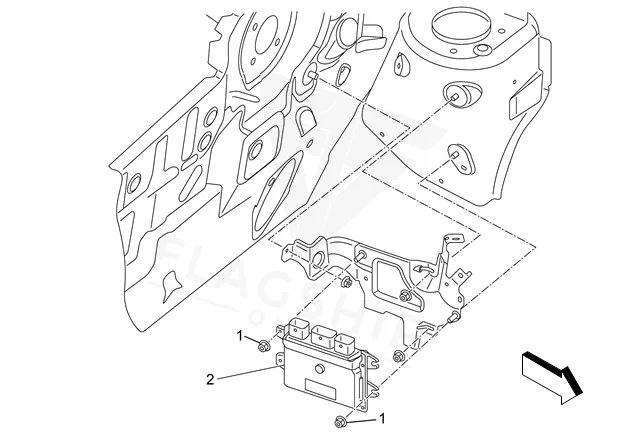
Work with the ignition off, and treat the module as static-sensitive: avoid touching the connector pins at any point.
| Operation | Configuration | Book Time |
|---|---|---|
| Engine Control Module R&R | All configurations | 0.9 hr |
| Engine Control Module Relearn | All configurations | 0.5 hr |
| Powertrain Control Module R&R | All configurations | 0.9 hr |
| Powertrain Control Module Relearn | All configurations | 0.5 hr |
After replacing the PCM/ECM on the 2015 Chevrolet City Express, the factory procedure requires reprogramming the module with the correct calibration using the EL-49642 SPS programming support tool. Service bulletin 17-NA-242 warns that reprogramming a module with its current calibration is prohibited and may cause issues. This means a new module from the dealer must be programmed with the vehicle’s VIN and options, which requires a subscription to GM’s SPS service and a compatible scan tool. However, a VIN-programmed replacement unit from Flagship One arrives with the correct calibration already loaded. This eliminates the need for the SPS tool, the 0.5-hour relearn step, and the risk of encountering the bulletin’s warning. The module is plug-and-play: install it, reconnect the battery, and start the engine. No further programming is needed.
A failing PCM/ECM in the 2015 Chevrolet City Express can produce a wide range of symptoms that mimic other component failures. The most common include a no-start condition where the engine cranks but does not fire, intermittent stalling while driving, and rough idle or misfire that does not follow a single cylinder. You may also notice the check-engine light illuminated with codes that are not related to a specific sensor, such as P0601 internal module error. Other signs include loss of communication with a scan tool (the tool cannot connect to the module), erratic transmission shifting, or the vehicle entering a reduced-power or limp-home mode. Because the PCM controls both engine and transmission, a fault can cause the transmission to shift harshly or fail to shift at all. In some cases, the fuel pump may not prime, or the cooling fan may run constantly. If you experience multiple seemingly unrelated electrical issues, the PCM should be a prime suspect. The internal trouble codes P0601 through P1621 are stored in the module’s memory and indicate a hardware or software fault within the computer itself, not a wiring or sensor problem.
The following diagnostic trouble codes are stored internally within the PCM/ECM of the 2015 Chevrolet City Express. They indicate module-level faults rather than sensor or circuit issues. These codes typically require module replacement or reprogramming to resolve.
Two factory service bulletins apply to the 2015 Chevrolet City Express PCM/ECM. Bulletin 17-NA-242, dated July 24, 2017, provides information on changes to the SPS (Service Programming System) that warn or prohibit reprogramming a module with its current calibration. This means that if you attempt to reprogram a module that already has the latest calibration, the system may block the procedure. Bulletin PIT5436A, dated November 24, 2014, is a diagnostic tip regarding OnStar WiFi enablement after VCIM (Vehicle Communication Interface Module) replacement or reprogramming. While not directly about the PCM, it highlights that module reprogramming events can affect other systems, and a post-reprogramming step may be needed to restore OnStar WiFi functionality.
| Bulletin | Subject | What It Addresses |
|---|---|---|
| — | Information on Changes to SPS that Warn/Prohibit Reprogramming a Module With Its Current Calibr | — |
| — | Diagnostic Tip: OnStar WIFI Enable After VCIM Replacement Or Reprogramming Event – (Nov 24, 201 | — |
When the PCM/ECM on your 2015 Chevrolet City Express fails, you have two main options: have a dealer replace and program a new module, or install a refurbished unit that is pre-programmed to your vehicle. The dealer route involves the cost of the module plus labor for removal, installation, and programming. A refurbished VIN-programmed unit from Flagship One offers a direct swap that skips the programming step, reducing downtime and total expense. For a commercial van like the City Express, minimizing downtime is often the priority.
Flagship One stocks a refurbished, VIN-programmed PCM for the 2015 Chevrolet City Express with a lifetime warranty, free shipping and no core charge. The full Chevrolet City Express module lineup covers other engine configurations as well.
The PCM/ECM is a critical component in the 2015 Chevrolet City Express, controlling both engine and transmission operation. Recognizing the symptoms of module failure and understanding the replacement process can help you make an informed repair decision. Whether you choose dealer service or a pre-programmed replacement, addressing internal trouble codes promptly will keep your van on the road. Flagship One offers VIN-programmed units that simplify the repair.