
Last updated on August 25th, 2026 at 02:41 pm
The Engine Control Module (ECM) on your 1992 Buick Century is the central computer that manages the 2.5L engine’s fuel injection, ignition timing, and emissions systems. It processes sensor inputs and adjusts powertrain operation in real time. Internal failure of this module typically results in no-start conditions, stalling, or severe drivability issues that prevent normal vehicle operation.
If your 1992 Buick Century with the 2.5L engine won’t start, runs poorly, or displays unusual symptoms despite other repairs, the Engine Control Module (ECM) — also called the Powertrain Control Module (PCM) — may be the culprit. This guide explains what the module does, where it’s located, what replacement involves, and how programming works. You’ll learn the typical symptoms of ECM failure, the factory service procedure, and why a VIN-programmed replacement can simplify your repair. Whether you’re diagnosing a no-start condition or planning a replacement, this information helps you understand the process and make informed decisions about your vehicle’s repair.
1992 Buick Century
OEM programmed ECM for your 1992 Buick Century — plug & play, no dealer visit.
Free shipping · Lifetime warranty
The Engine Control Module on your 1992 Buick Century serves as the brain of the powertrain. It receives input from numerous sensors throughout the engine and transaxle, then adjusts fuel delivery, ignition timing, and other functions to maintain smooth operation. Inside the ECM sits a removable PROM (Programmable Read-Only Memory) chip that contains calibration data specific to your vehicle’s weight, engine displacement, transaxle type, and axle ratio. This is why replacement modules must be programmed to your vehicle’s specifications — the PROM holds the unique configuration your Century needs to run correctly. replacement engine computers for the Buick Century If the internal circuitry of the ECM fails, the module stops processing sensor data properly, which causes drivability problems throughout the vehicle.
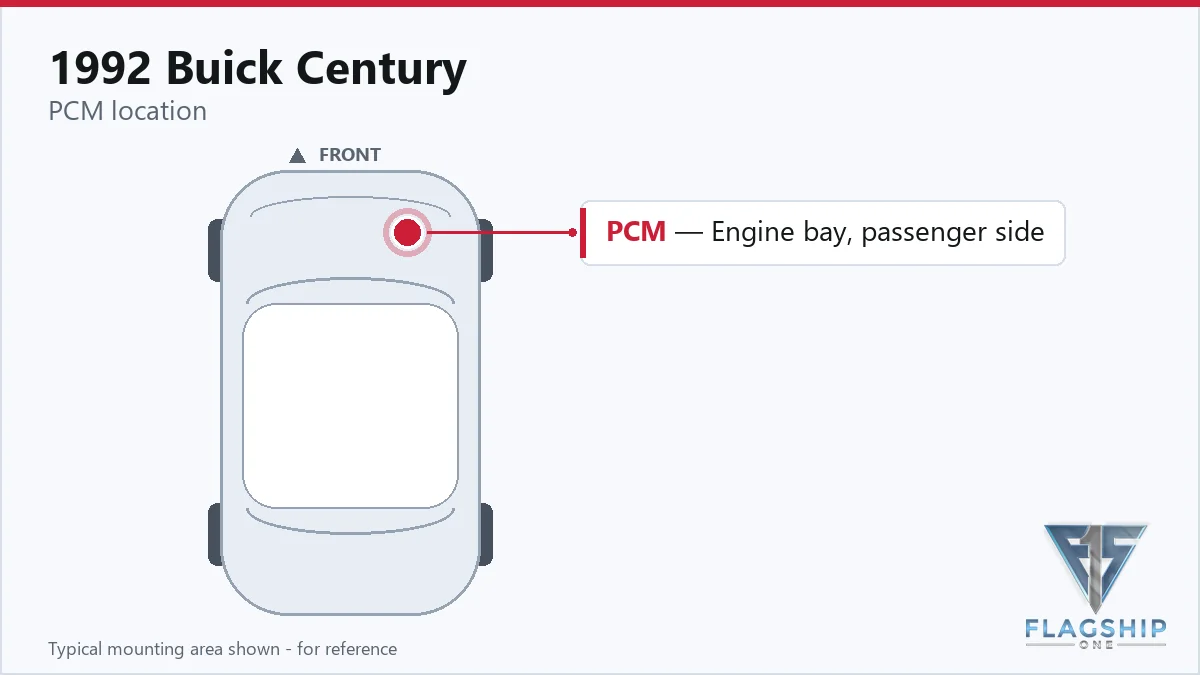
The ECM on the 1992 Buick Century is typically located in the passenger compartment, mounted behind the right side kick panel or under the dashboard on the passenger side. Access requires removing interior trim panels to reach the unit. The replacement procedure involves disconnecting the battery, removing the mounting hardware, unplugging the electrical harness, and installing the new module. Book time for ECM R&R is 1.4 hours according to labor guides. After installation, you’ll need to reconnect the harness, secure the new module, and reassemble the interior panels. The transaxle range sensor may require adjustment as part of the reinstallation process on this vehicle.
| Operation | Configuration | Book Time |
|---|---|---|
| Engine Control Module R&R | All configurations | 1.4 hr |
| Powertrain Control Module Relearn | All configurations | 0.5 hr |
| Powertrain Control Module R&R | All configurations | 1.4 hr |
After replacing the ECM on your 1992 Buick Century, the factory procedure requires a relearn procedure to allow the new module to adapt to your vehicle’s specific sensors and components. This relearn process takes approximately 0.5 hours of book time. During this procedure, the module monitors operating conditions and adjusts its calibration to match your engine and transaxle. Flagship One sends replacement units that arrive VIN-programmed, meaning the module is pre-configured with your vehicle’s specific calibration data before it reaches you. This eliminates the need for most of the factory programming steps that would otherwise be required at a dealership or repair facility.
Every VIN-programmed replacement unit from Flagship One arrives with these steps already completed.
When the ECM fails on a 1992 Buick Century, the most common symptoms include a no-start condition where the engine cranks but won’t run, intermittent stalling while driving, and rough idle that feels uneven. You may also experience hesitation or stumbling during acceleration, and the transmission may shift harshly or unpredictably because the module controls transaxle functions as well. In many cases, scan tools cannot communicate with the ECM at all, which is a strong indicator of internal module failure rather than a simple sensor issue. These symptoms often appear suddenly after periods of normal operation, as the internal circuitry degrades over time.
A used ECM may work if it comes from an identical vehicle with the same engine, transaxle, and axle ratio. However, you would still need to have it programmed to your VIN, and there’s no way to verify the module’s internal condition before purchase.
If your vehicle won’t start and you’ve verified that the battery, starter, and ignition system are working, ECM failure is likely. A scan tool that cannot communicate with the module is a strong indicator of internal ECM failure.
The factory procedure requires a relearn procedure after replacement. Units from Flagship One arrive VIN-programmed with your vehicle’s specific calibration, which eliminates most of the programming steps that would otherwise require dealership equipment.
If your 1992 Buick Century requires an ECM replacement, you have two main paths: a genuine new or refurbished unit from a dealership, or a professionally remanufactured replacement from Flagship One that arrives ready to install. Dealership parts often come at a premium and may require additional programming fees. A quality remanufactured unit that is VIN-programmed to your vehicle can save significant time and cost while providing reliable operation. Consider your budget, warranty preferences, and how quickly you need your vehicle back on the road when making your decision.
Flagship One stocks a refurbished, VIN-programmed PCM for the 1992 Buick Century with a lifetime warranty, free shipping and no core charge. The full Buick Century module lineup covers other engine configurations as well.
The Engine Control Module is a critical component of your 1992 Buick Century, managing both engine and transaxle functions through integrated circuitry and vehicle-specific calibration data. When internal failure occurs, the symptoms can be severe enough to leave your vehicle stranded. Understanding the replacement process, programming requirements, and your options helps you make an informed repair decision. For a solution that arrives ready to install with your VIN already programmed, explore what Flagship One offers for your specific vehicle.