
Last updated on August 25th, 2026 at 02:41 pm
The Engine Control Module (ECM) in your 1990 Buick Century is the central computer managing fuel delivery, ignition timing, and emissions systems. It contains a removable PROM chip that stores vehicle-specific calibration data including weight, engine, transaxle, and axle ratio information.
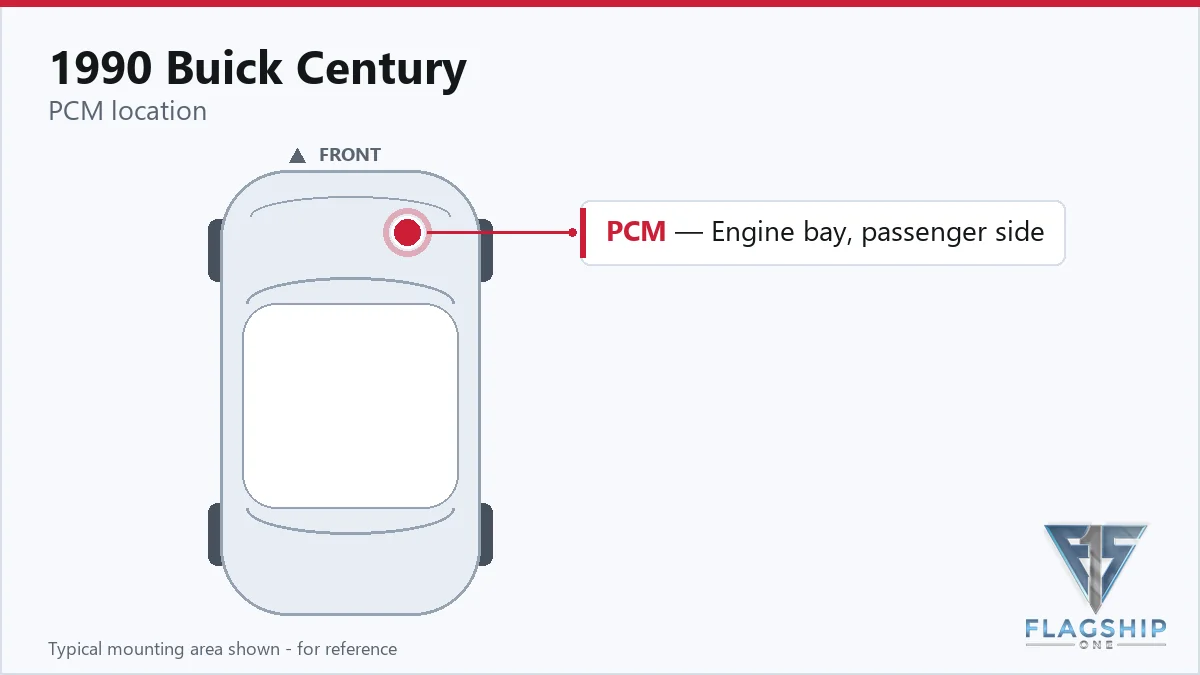
If your 1990 Buick Century with the 2.5L engine is experiencing hard starting, unexpected stalling, or erratic shifting behavior, the Engine Control Module (ECM) — also referred to as the PCM (Powertrain Control Module) on some applications — is a prime suspect. This vehicle uses a single integrated computer that manages both engine and transaxle operations, a common architecture in GM products from this era. Unlike modern vehicles with standardized OBD-II diagnostics, the 1990 Century relies on manufacturer-specific trouble codes and procedures. Understanding what the ECM does, where it is mounted, and how replacement differs from newer vehicles will help you make informed repair decisions. This guide covers the function of the control module, the role of its internal PROM chip, typical failure symptoms, and what to expect when installing a replacement unit.
1990 Buick Century
OEM programmed ECM for your 1990 Buick Century — plug & play, no dealer visit.
Free shipping · Lifetime warranty
The ECM on your 1990 Buick Century serves as the brain of the engine and transaxle management system. It receives input from various sensors throughout the engine compartment — including the coolant temperature sensor, throttle position sensor, oxygen sensor, and vehicle speed sensor — then processes this information to control fuel injector pulse width, ignition timing advance, idle air control, and transaxle shift points. This vehicle’s ECM also manages the emissions control system, ensuring the vehicle meets the standards applicable at the time of production.
Critically, this ECM contains a removable Programmable Read-Only Memory (PROM) chip. The PROM stores calibration data unique to your specific vehicle, including gross vehicle weight rating, engine displacement, transaxle type, final drive axle ratio, and tire size specifications. When the ECM processes sensor inputs, it references this PROM data to determine appropriate operating parameters. If the PROM becomes corrupted or the ECM itself fails, the vehicle may run poorly or not start at all because the calibration information is unavailable or incorrect. Unlike some later GM vehicles where the PROM could be transferred to a new ECM, many applications require a matched ECM-PROM combination or a unit with the correct data pre-installed. Finding replacement engine computers for the 1990 Buick Century requires sourcing a unit that already contains the proper calibration data for your specific vehicle configuration.
Flagship One keeps Buick Century replacement engine computers in stock for exactly this failure pattern.
After replacing the ECM on your 1990 Buick Century, the factory procedure requires a dealer or qualified shop to perform a reprogramming or relearn procedure using GM-specific diagnostic equipment. This process programs the replacement unit with the correct VIN and ensures the ECM recognizes all vehicle-specific sensors and systems. Without this step, the vehicle may run poorly or not start because the replacement ECM lacks the proper calibration data for your configuration.
However, when you purchase a replacement ECM from Flagship One, the unit arrives VIN-programmed with the correct calibration data already installed. This means a VIN-programmed replacement unit can typically be installed directly without requiring a dealer programming visit, saving both time and the cost of dealer programming fees. The unit will recognize your vehicle’s sensors and systems immediately upon installation. After installation, you may need to perform a basic idle relearn procedure by allowing the engine to idle for several minutes with all accessories off, but complex dealer programming is not required.
Every VIN-programmed replacement unit from Flagship One arrives with these steps already completed.
When the ECM or its internal PROM fails on this vehicle, the symptoms often appear suddenly and can be confusing because multiple systems are affected simultaneously. A no-start condition is common — the engine may crank normally but receive no fuel or spark because the ECM is not outputting the necessary control signals. Some owners report that the vehicle starts and runs for a few seconds before dying, indicating intermittent ECM communication with fuel injectors or ignition coils.
Stalling is another frequent complaint, particularly at idle or during low-speed maneuvers. The engine may run roughly at idle, surge unexpectedly, or stall completely when coming to a stop. Misfire codes may be stored in the ECM memory even though spark plugs and wires test good, because the ECM is not properly controlling fuel delivery or ignition timing. In some cases, the scan tool may not communicate with the ECM at all, which is itself a strong indicator of internal ECM failure. Transaxle shifting may become erratic or the vehicle may stay in a single gear, as the ECM controls shift points. If you encounter a situation where diagnostic equipment cannot establish communication with the engine computer, this often points to a memory corruption issue requiring replacement.
Not necessarily. The ECM must have the correct PROM calibration data for your specific vehicle configuration, including engine size, transaxle type, and axle ratio. An ECM from a different configuration may cause running problems or no-start. Sourcing a unit programmed for your specific VIN is essential.
On this vehicle, the PROM is contained within the ECM housing and is not designed for user removal or transfer. Attempting to remove and transplant the PROM risks damaging the chip or losing calibration data. Replacement units come with the correct data pre-installed.
Lack of scan tool communication typically indicates an internal ECM failure, particularly in the processor or memory circuits. This is a common failure mode on these older units. The ECM may still be receiving power, but the diagnostic communication circuit has failed.
The factory procedure does require programming, but Flagship One replacement units arrive VIN-programmed with the correct calibration data for your vehicle. This eliminates the need for dealer programming in most cases. You may need to perform a basic idle relearn procedure.
While a weak battery typically won’t damage the ECM directly, chronic low voltage during starting and running can cause the ECM to operate outside its designed parameters. This can lead to erratic behavior over time. Maintaining a healthy charging system is good preventive practice.
Flagship One stocks a refurbished, VIN-programmed ECM for the 1990 Buick Century with a lifetime warranty, free shipping and no core charge. The full Buick Century module lineup covers other engine configurations as well.
The ECM in your 1990 Buick Century is a critical component that manages engine and transaxle functions through inputs from numerous sensors. When this computer fails, symptoms range from no-start to erratic shifting, and proper diagnosis is essential before replacing the unit. Whether you choose dealer replacement or a VIN-programmed unit from Flagship One, addressing ECM failure promptly restores reliable operation to your Century.