
Last updated on August 25th, 2026 at 02:45 pm
The Engine Control Module in the 1992 BMW 7 Series manages fuel delivery, ignition timing, and emission controls. When the module fails, the vehicle may lose power, trigger warning lights, or refuse to start, as the computer can no longer command essential engine functions.
When a 1992 BMW 7 Series begins to illuminate the check engine light or stores fault codes in the DME, many owners wonder whether the engine control module is at fault. The module, often called the DME or ECM, is the brain that tells the engine how much fuel to spray, when to fire the spark plugs, and how to meet emissions standards. In this guide you will see how the module works in this specific model, what symptoms point to a failure, and the steps required to replace it safely. By the end, you should understand the labor involved, the precautions the factory mandates, and why a VIN‑programmed replacement from Flagship One can simplify the process.
The Engine Control Module in the 1992 BMW 7 Series acts as the central processor for engine management, interpreting sensor data to control fuel injection, ignition timing, and emission systems. It communicates with the Powertrain Control Module to coordinate drivetrain functions, ensuring smooth acceleration and proper gear shifts. Because the vehicle predates OBD‑II, the module stores proprietary fault codes rather than standard P‑codes. A malfunctioning ECM can cause loss of power, erratic idle, or a complete no‑start condition, making it a critical component for reliable operation. Understanding its role helps you appreciate why a proper replacement and verification step, such as a replacement engine computers for the 1992 BMW 7 Series during service, is essential for maintaining performance.
1992 BMW 7 Series
OEM programmed ECM for your 1992 BMW 7 Series — plug & play, no dealer visit.
Free shipping · Lifetime warranty
The Engine Control Module in the 1992 BMW 7 Series is mounted within the engine compartment, typically attached to the firewall or near the intake manifold. Access requires disconnecting the battery and ensuring the ignition is off, as mandated by the factory caution. The module should be placed on a static‑dissipative mat before removal to protect its electronics. When removing, carefully bend up the six securing tabs to free the unit. The labor book time for removing and reinstalling the ECM is listed as 0.5 hours, reflecting the straightforward nature of the task. Once the new module is positioned, the tabs are re‑engaged, and the connector is secured. The Powertrain Control Module follows the same 0.5‑hour labor estimate, and a separate 0.5‑hour relearn step may be required after both modules are in place.
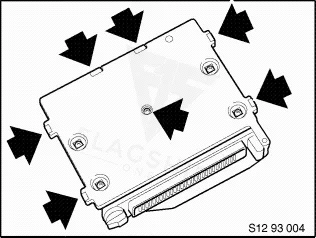
Work with the ignition off, and treat the module as static-sensitive: avoid touching the connector pins at any point.
| Operation | Configuration | Book Time |
|---|---|---|
| Engine Control Module R&R | All configurations | 0.5 hr |
| Powertrain Control Module R&R | All configurations | 0.5 hr |
| Powertrain Control Module Relearn | All configurations | 0.5 hr |
After installing a new Engine Control Module in the 1992 BMW 7 Series, the factory procedure calls for a Powertrain Control Module relearn, which takes about 0.5 hours. This step ensures the new unit syncs with the vehicle’s existing sensors and calibrations. Flagship One units arrive VIN‑programmed, so the required coding is already completed before the part reaches your shop. Consequently, the only post‑install action you may need is the standard relearn process, which can be performed with a compatible scan tool. Using a a VIN‑programmed replacement unit eliminates the need for manual data entry, reducing the chance of errors and shortening shop time.
When the Engine Control Module begins to fail in a 1992 BMW 7 Series, you may notice the check engine light staying on, erratic idle, or a loss of power under load. The vehicle might also exhibit misfire‑like behavior, with occasional rough running or stalling, especially during cold starts. In some cases the DME will not communicate with a scan tool, preventing you from retrieving data. One of the common fault indicators for this model is the Processor Clock Signal Fault, which appears when the module’s internal timing is compromised. These symptoms often prompt owners to seek a diagnostic check, leading to the discovery of a faulty ECM.
| Bulletin | Subject | What It Addresses |
|---|---|---|
| — | Check Engine Light Illuminated, Faults Stored in DME/ECM | — |
| — | Engine Control Module Codes | — |
The factory book time for removing and reinstalling the ECM is listed as 0.5 hours. This reflects the relatively simple access and connector steps required.
A Powertrain Control Module relearn, taking about 0.5 hours, is recommended after replacement. Flagship One units come VIN‑programmed, so no additional coding is required.
Yes, as long as the ignition is off, the battery is disconnected, and you use a static mat, the replacement can be performed safely. However, the relearn step may still require a scan tool.
The P0601 code signals a processor clock signal fault within the DME, often pointing to a failing module or a communication issue.
Factory labor times list 0.5 hours for both the Engine Control Module and the Powertrain Control Module, indicating similar effort for each.
When your 1992 BMW 7 Series needs an ECM replacement, you can choose a new factory‑spec unit or a refurbished replacement that meets the same standards. Flagship One offers VIN‑programmed modules that remove the need for post‑install coding, helping you get back on the road faster while maintaining the vehicle’s original performance characteristics.
Flagship One stocks a refurbished, VIN-programmed PCM for the 1992 BMW 7 Series with a lifetime warranty, free shipping and no core charge. The full BMW 7 Series module lineup covers other engine configurations as well.
Replacing the Engine Control Module in a 1992 BMW 7 Series can restore proper engine management and clear persistent fault warnings. By following the factory cautions and using a VIN‑programmed unit, you simplify the process and ensure reliable operation. Consider a Flagship One replacement to avoid additional programming steps.