
Last updated on August 25th, 2026 at 02:45 pm
In the 1990 BMW 7 Series the Digital Motor Electronics (DME) control unit manages fuel delivery, ignition timing and sensor integration. Failure of the internal processor chip often leads to loss of engine control, causing no‑start conditions, rough idle, or intermittent power loss. Replacing the DME restores the vehicle’s electronic management system to factory specifications.
When a 1990 BMW 7 Series begins to hesitate, stalls, or refuses to start, the underlying issue often traces back to the engine’s electronic brain—the DME control unit. Understanding how this module operates and where it resides can save you time and prevent unnecessary part swaps. This guide walks you through the function of the DME, how to locate and replace it, and what factory steps are normally required after a new unit is installed. By the end, you’ll know what to expect during the repair and why a VIN‑programmed replacement from Flagship One may simplify the process.
Engine computer (ECM/PCM)
OEM programmed replacements — plug & play, no dealer visit.
Find yours by year, make & model →
Free shipping · Lifetime warranty
The Digital Motor Electronics (DME) in the 1990 BMW 7 Series acts as the central processor for the engine, interpreting sensor data and commanding fuel injectors, ignition coils and idle control. It continuously monitors inputs such as throttle position, coolant temperature and crankshaft speed to calculate the precise fuel and spark events needed for smooth operation. When the DME’s internal chip degrades, the calculations become unreliable, leading to stalling, rough running or a complete no‑start condition. Because the module directly controls emissions and performance, any fault can quickly affect drivability. The vehicle relies on the DME to keep the engine within design parameters, making its reliability essential for everyday use. replacement engine computer for 1990 BMW ensures that the replacement matches the original’s processing capabilities and communication protocols.
In the 1990 BMW 7 Series the DME control unit is positioned above the glove box, a location shared with certain 3 Series models. To access it, you first remove the glove‑box panel, then detach the mounting bolts that secure the unit to the vehicle’s chassis. Once the bolts are removed, the DME can be lifted out of its bracket and disconnected from the wiring harness. The removal process is straightforward but requires careful handling of the connector pins to avoid bending or breaking them. After the defective unit is taken out, the replacement is seated in the same location, bolted to the original mounting points, and the electrical connector is re‑engaged. No additional torque specifications were provided, so a standard hand‑tighten is sufficient, followed by a visual check that the unit sits flush against the mounting surface.
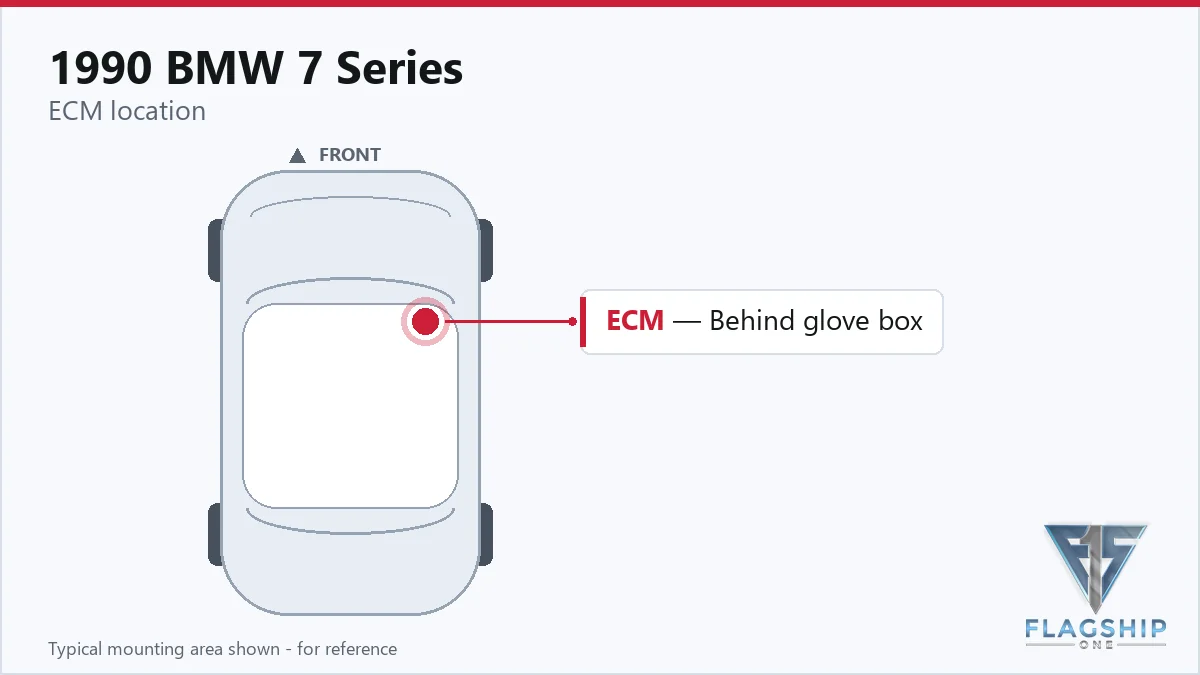
Work with the ignition off, and treat the module as static-sensitive: avoid touching the connector pins at any point.
Factory service procedures normally call for a calibration routine after installing a new DME, which includes initializing the unit’s memory, adapting fuel trims and verifying sensor alignment. With Flagship One’s offering, the replacement arrives already VIN‑programmed, so the calibration steps are completed at the factory. a VIN-programmed replacement unit eliminates the need for on‑site coding, allowing you to focus on the mechanical installation and final verification of operation.
A failing DME in the 1990 BMW 7 Series often reveals itself through a range of drivability issues. You may notice the engine cranking slowly or not starting at all, especially when the temperature drops. Intermittent stalling while cruising or during acceleration can occur as the processor loses its ability to calculate proper fuel delivery. Rough idle and occasional misfires are also typical, as the ignition timing may become erratic. In some cases, the instrument cluster may display warning lights related to engine management, and a scan tool might report a loss of communication with the control unit. These symptoms collectively point to an electronic fault within the DME rather than a mechanical problem.
Typical indications include a no‑start condition, frequent stalling, rough idle, and loss of communication with diagnostic tools. These symptoms suggest the DME’s internal processor may be failing.
Used units may lack the correct VIN programming and could retain previous vehicle data, which can cause compatibility issues. A new, VIN‑programmed unit is generally recommended.
Only basic hand tools are required to remove the mounting bolts and disconnect the wiring harness. No specialized equipment is necessary for the mechanical removal.
Factory procedures call for a calibration routine, but Flagship One’s VIN‑programmed replacements come pre‑calibrated, so no additional coding is needed on the shop floor.
The removal and installation steps are straightforward and can usually be completed within a couple of hours by a technician familiar with the vehicle’s interior layout.
When the DME in your 1990 BMW 7 Series fails, you can choose between repairing the existing unit or installing a refurbished replacement. A repaired module may require additional testing and re‑programming, while a Flagship One replacement arrives pre‑configured for your VIN, streamlining the install. Weigh the cost of refurbishment against the convenience of a ready‑to‑run unit to decide the best path for your repair schedule.
Flagship One stocks a refurbished, VIN-programmed ECM for the 1990 BMW 7 Series with a lifetime warranty, free shipping and no core charge. The full BMW 7 Series module lineup covers other engine configurations as well.
The DME control unit is vital to the performance of your 1990 BMW 7 Series. Whether you opt for a repair or a Flagship One replacement, ensuring the module is correctly installed and programmed will restore reliable engine operation. Consider the options and choose the solution that fits your timeline and budget.