
Last updated on August 25th, 2026 at 02:45 pm
The Engine Control Module in your 1991 BMW 7 Series manages fuel delivery, ignition timing, and emission controls through a centralized processor. When this module fails, your vehicle may experience hard starting, stalling, or complete loss of driveability. The DME unit mounted inside the passenger cabin houses critical circuitry that can degrade over decades of service.
Owning a 1991 BMW 7 Series means appreciating sophisticated German engineering from an era before standardized diagnostic systems. When the engine management computer fails on a vehicle of this age, the repair path may seem unclear. Your BMW uses a Digital Motor Electronics control unit that operates independently from today’s standardized OBD-II networks. Understanding how this module functions, where it lives in your vehicle, and what replacement involves will help you make informed decisions about repairs. This guide covers module operation, common failure patterns, and practical replacement considerations specific to your 1991 BMW 7 Series. Whether you are diagnosing a no-start condition or planning preventive maintenance, the information here gives you a solid foundation for moving forward.
The DME control unit in your 1991 BMW 7 Series serves as the brain of your vehicle’s engine management system. This module processes input from various sensors throughout the engine to calculate optimal fuel injector pulse widths and ignition advance angles in real time. Unlike modern systems that communicate through standardized protocols, your BMW’s Digital Motor Electronics operates on manufacturer-specific software architecture.
Your 1991 BMW 7 Series engine computer receives information about airflow, coolant temperature, throttle position, and oxygen levels to determine how much fuel to inject and when to fire each cylinder’s ignition coil. The module then adjusts these parameters continuously based on driving conditions, maintaining performance while managing emissions output.
Over decades of thermal cycling and electronic stress, the internal components within the DME housing can deteriorate. The main processor and memory chips may develop intermittent connections or suffer from degraded firmware storage. These failures often manifest as complete system shutdowns or erratic engine behavior that defies conventional diagnosis. When the main processor inside your DME fails, the entire engine management system becomes unresponsive, leaving your vehicle inoperable despite otherwise healthy mechanical systems. Replacing the entire control unit rather than attempting board-level repairs typically provides the most reliable long-term solution for your 1991 BMW 7 Series. You can explore replacement engine computers for the BMW 7 Series from suppliers who specialize in these vintage modules.
Flagship One keeps BMW 7 Series replacement engine computers in stock for exactly this failure pattern.
1991 BMW 7 Series
OEM programmed ECM for your 1991 BMW 7 Series — plug & play, no dealer visit.
Free shipping · Lifetime warranty
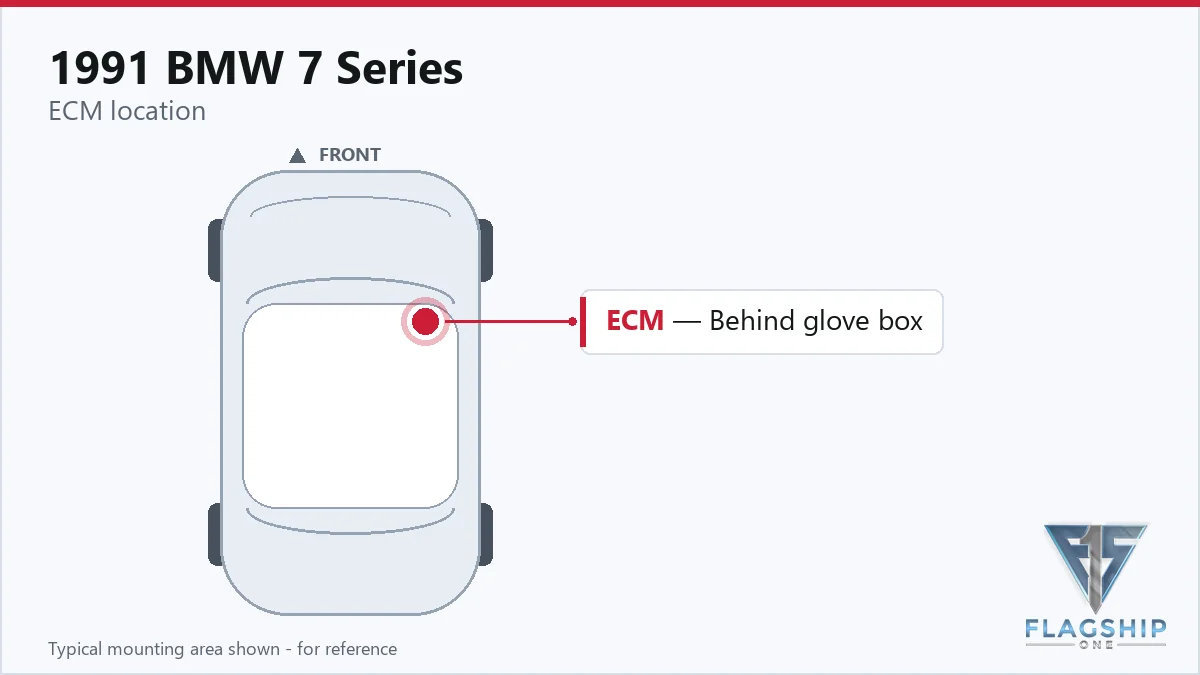
The DME control unit in your 1991 BMW 7 Series is located inside the passenger compartment, specifically mounted above the glove box area. This placement positions the module away from underhood heat sources while keeping it accessible for service procedures. Accessing the unit requires removing interior trim components to reach the mounting location.
The replacement procedure involves disconnecting the vehicle battery before beginning work, as the module remains connected to multiple engine sensors and power supplies. After removing the old unit, you must transfer any vehicle-specific mounting hardware to the replacement module. Routing and connecting the wiring harness requires careful attention to ensure all connections seat properly and seals remain intact.
The factory repair documentation outlines specific steps for this removal and installation process on models similar to your 1991 BMW 7 Series. Taking photographs before disconnection helps ensure correct reinstallation of all connectors and associated wiring. Ensuring proper ground connections at the module mounting point contributes to reliable long-term operation after the new unit is installed.
Work with the ignition off, and treat the module as static-sensitive: avoid touching the connector pins at any point.
After installing a replacement DME control unit in your 1991 BMW 7 Series, the factory service procedure requires connecting specialized diagnostic equipment to the vehicle. This equipment communicates with the new module to transfer vehicle-specific calibration data and ensure proper synchronization with your engine’s sensors. The programming process aligns the replacement unit’s software with your vehicle’s unique identification number and configuration.
Without completing this programming step, a replacement module will not function properly in your vehicle, even if it is otherwise identical to the original. Dealerships and some independent shops possess the required equipment and software to perform this procedure. The process involves entering the vehicle identification number into the programming system and allowing the equipment to download the correct operating parameters.
Ordering a pre-programmed replacement unit from Flagship One eliminates this post-installation step. These units arrive configured with your specific vehicle identification number already loaded, meaning you receive a VIN-programmed replacement unit ready for installation. This approach reduces overall repair time and removes the need to schedule separate programming appointments.
Every VIN-programmed replacement unit from Flagship One arrives with these steps already completed.
When the DME control unit in your 1991 BMW 7 Series begins to fail, the symptoms often develop gradually before reaching a point of complete failure. Your vehicle may experience intermittent starting difficulties where the engine cranks normally but fails to fire. These starting problems often worsen in hot weather when thermal stress on the module increases.
Stalling represents another common failure indicator, particularly at low speeds or when the engine is under load. Your BMW may run normally at idle but stumble and die when accelerating or maintaining steady highway speeds. These symptoms often correlate with failing processor circuits inside the module that intermittently lose communication with engine sensors.
Some vehicles develop fuel delivery problems that manifest as hard starting, rough idle, or hesitation during acceleration. The engine may run rich or lean depending on which circuits within the module have degraded. In complete failure scenarios, the engine will crank but not start at all, as the DME provides the critical signals needed for fuel injector operation and ignition.
Scan tool communication failures also indicate potential module problems. When diagnostic equipment cannot establish communication with your 1991 BMW 7 Series engine computer, the issue may originate in the module itself rather than in individual sensors. Additionally, you might notice check engine indicators appearing inconsistently or failing to illuminate despite observable driveability problems.
Diagnosis typically involves ruling out other potential causes such as sensors, fuel delivery, and ignition components. A technician may check for proper power and ground at the module, then attempt communication with diagnostic equipment. Complete module failure often results in no-start conditions with normal cranking, while partial failures can cause intermittent stalling or driveability issues.
Used modules from other vehicles require programming to match your specific vehicle identification number before they will function properly. Even if the module physically fits, the software calibration must match your engine configuration and vehicle specifications. Attempting to use an unprogrammed unit typically results in poor performance or no operation at all.
Moisture intrusion can cause immediate short circuits within the module’s internal circuitry or lead to gradual corrosion of components over time. If water exposure occurs, disconnect the battery immediately and allow the module to dry completely before testing. In many cases, water damage progresses to complete failure even after the module appears to dry out.
Intermittent failure patterns often indicate marginal circuit conditions within the DME module where components function when cool but fail when heated. The thermal mass of the module causes behavior that changes based on engine temperature, ambient conditions, and driving duration. These symptoms often worsen as the underlying condition deteriorates further.
Traditionally, dealership equipment was required for the programming procedure. However, ordering a pre-programmed replacement unit from Flagship One means the module arrives ready for installation without requiring dealer involvement. This approach allows independent shops and DIY mechanics to complete the repair without specialized programming equipment.
Choosing between repair and replacement for your 1991 BMW 7 Series DME control unit depends on the extent of damage and your budget priorities. Board-level repair may be possible for certain failures, though long-term reliability varies significantly. Refurbished exchange units offer a middle ground with typically lower cost than new, but they may arrive needing programming before installation. Pre-programmed new or refurbished units from Flagship One provide the most straightforward path to returning your vehicle to operation. Consider the vehicle’s overall condition and your intended usage when evaluating these options for your BMW.
Flagship One stocks a refurbished, VIN-programmed ECM for the 1991 BMW 7 Series with a lifetime warranty, free shipping and no core charge. The full BMW 7 Series module lineup covers other engine configurations as well.
The DME control unit remains a critical component in your 1991 BMW 7 Series, and its failure affects nearly every aspect of engine operation. Understanding its location, function, and replacement requirements helps you navigate the repair process with greater confidence. Whether you pursue a professional repair or source a replacement unit, the information in this guide supports better decision-making for your 1991 BMW 7 Series.