
Last updated on August 25th, 2026 at 11:55 am
The engine control module in your 2020 Toyota Avalon Hybrid manages the 2.5L hybrid powertrain, coordinating fuel injection, ignition timing, and regenerative braking systems. When internal processor faults like P0606 appear, the module may fail to communicate with scanners or prevent starting, often requiring replacement with a unit that includes proper VIN programming.
If your 2020 Toyota Avalon Hybrid has developed starting problems or your scan tool cannot communicate with the powertrain systems, the engine control module may need attention. This sophisticated computer manages the 2.5L hybrid engine, coordinating fuel delivery, ignition timing, and the interaction between the gasoline engine and electric motor. When this module fails, you may experience intermittent stalling, complete no-start conditions, or diagnostic trouble codes that point to internal processor faults. Understanding the replacement process helps you evaluate repair options and anticipate the work involved. The module resides in the engine compartment near the air filtration components, requiring specific disassembly steps to reach. Toyota specifies particular waiting periods before disconnecting battery cables to protect the electrical system, and the replacement requires careful attention to initialization procedures. This guide explains what the control module does in your specific vehicle, where technicians access it, and what steps follow installation. You will learn the symptoms that typically indicate module failure, the factory labor times involved, and why pre-programmed replacement units save time during service. Whether you are diagnosing communication errors or planning the repair, this information provides the technical context needed to move forward confidently with your 2020 Toyota Avalon Hybrid.
In your 2020 Toyota Avalon Hybrid, the engine control module serves as the central processor for the 2.5L hybrid powertrain, continuously calculating optimal fuel injection timing, ignition advance, and the seamless transition between gasoline and electric propulsion. This unit monitors inputs from oxygen sensors, throttle position sensors, crankshaft position sensors, and the hybrid system control computer to maintain efficiency and emissions compliance across varying driving conditions. The module processes these signals through complex algorithms that balance the instantaneous torque demands of the electric motor with the Atkinson-cycle engine’s power delivery characteristics. The module stores critical operating data including fuel trim values, learned idle speeds, transmission shift patterns, and hybrid battery management parameters specific to your vehicle’s configuration. When you turn the ignition switch, this computer executes startup sequences that coordinate the hybrid system readiness, high-voltage battery status checks, and engine cranking parameters. During normal operation, it adjusts injector pulse widths in milliseconds, manages the variable valve timing actuators, and regulates the electronic throttle body to balance power delivery with fuel economy. The computer also communicates continuously with the transmission control module and hybrid control computer to optimize the division of labor between the gasoline engine and electric motor. Failure of this component typically manifests as communication failures with diagnostic equipment, persistent internal fault codes, or complete inability to start the hybrid system. Unlike simpler sensors, the control module contains proprietary software that requires specific calibration for your vehicle identification number and equipment configuration. When replacement becomes necessary, technicians must install replacement engine computers for the Avalon that match your specific hybrid system architecture, ensuring compatibility with the integrated motor assist and battery management systems that define this powertrain.
2020 Toyota Avalon Hybrid
OEM programmed ECM for your 2020 Toyota Avalon Hybrid — plug & play, no dealer visit.
Free shipping · Lifetime warranty
Technicians access the control module in your 2020 Toyota Avalon Hybrid by working near the air cleaner housing. The factory procedure requires isolating the electrical system by removing the negative battery connection, though you must observe the specified waiting period before this step to allow system capacitors to discharge properly. This precaution applies to both the primary twelve-volt battery and the auxiliary battery in the hybrid system. Once the electrical system is safe, the service path continues with detaching the cool air intake duct seal, followed by the inlet air cleaner assembly. The complete air cleaner assembly with its attached hose must also come out to reveal the module mounting position. Published labor guides allocate 0.7 hours for the removal and replacement of the powertrain control module, while the engine control module replacement carries an identical 0.7 hour time allowance. The engine control module reset procedure requires 0.3 hours, and relearn procedures for either module type require 0.5 hours according to the factory time standards.
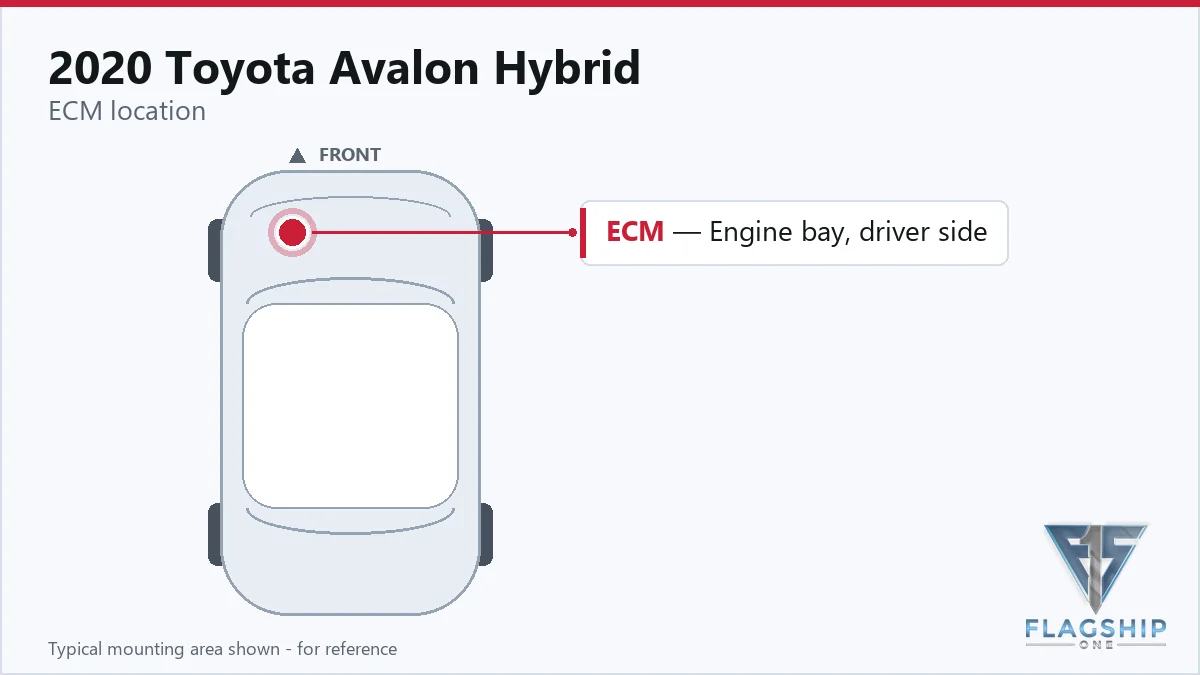
Work with the ignition off, and treat the module as static-sensitive: avoid touching the connector pins at any point.
| Operation | Configuration | Book Time |
|---|---|---|
| Powertrain Control Module R&R | All configurations | 0.7 hr |
| Powertrain Control Module Relearn | All configurations | 0.5 hr |
| Engine Control Module Relearn | All configurations | 0.5 hr |
| Engine Control Module R&R | All configurations | 0.7 hr |
| Engine Control Module Reset | All configurations | 0.3 hr |
After installing a new control module in your 2020 Toyota Avalon Hybrid, factory protocols require specific initialization procedures to establish communication with the hybrid control system and powertrain components. These post-installation steps include calibration adjustments, parameter registration, and system recognition that allow the module to identify the vehicle’s specific transmission characteristics, emission control equipment, and hybrid battery configuration. The published labor guides indicate that relearn procedures require 0.5 hours for both powertrain and engine control modules, while a simple reset requires 0.3 hours to complete the necessary software alignment. You may avoid these dealership programming delays by selecting a VIN-programmed replacement unit that arrives ready for your specific 2020 Toyota Avalon Hybrid. When you receive a module pre-configured with your vehicle identification number, the initialization procedures typically required after parts replacement are already complete. This preparation eliminates the need for the 0.5 hour relearn sequence and allows immediate communication with your scan tool upon installation. Your technician can proceed directly to clearing any historical codes and verifying system readiness rather than waiting for software downloads or parameter matching sessions that would otherwise extend the service appointment.
Control module failure in your 2020 Toyota Avalon Hybrid often begins with intermittent communication losses between your diagnostic scanner and the powertrain systems. You may notice the check engine light remains illuminated despite repairs to sensors or wiring, or the vehicle may enter limp mode with reduced power delivery during acceleration. Many drivers experience hard starting conditions where the 2.5L engine cranks but fails to catch, or the hybrid system refuses to initialize the ready mode necessary for electric operation. Internal processor faults typically generate specific diagnostic codes that indicate the module cannot execute its programmed instructions reliably. Your scan tool may display internal processor fault P0606 when the computer’s self-test routines detect calculation errors or memory corruption. Other indicators include random stalling at traffic lights, erratic idle speeds that fluctuate between high and low rpm, or transmission shifting that feels harsh or delayed because the module cannot process throttle position data correctly. In severe cases, the module may lose its adaptive memory for fuel trim values, causing the engine to run rich or lean until the system relearns operating parameters. You might also find that previously cleared codes return immediately after starting the engine, suggesting the module cannot retain new instructions. When communication completely fails, the vehicle may not crank at all, leaving you with a no-start condition that mimics a dead battery or starter failure but actually stems from the control module’s inability to authorize the starting sequence.
The 2020 Toyota Avalon Hybrid may store specific diagnostic codes indicating internal control module failures rather than external sensor or circuit problems. These codes point to processor malfunctions, memory errors, or communication breakdowns within the engine computer itself, helping technicians distinguish between wiring issues and actual module hardware failures.
| Code | Meaning | Full Guide |
|---|---|---|
| P0606 | Module processor failure | Full P0606 guide → |
The control module sits next to the air cleaner assembly in your 2020 Toyota Avalon Hybrid, requiring removal of the intake duct seal and air cleaner components to access it. Technicians must first isolate the electrical system by detaching the negative battery cable after observing the specified waiting period. This location places the module in the engine compartment where it receives cooling air but remains protected from direct splash.
Factory labor guides list 0.7 hours for the removal and replacement of either the powertrain control module or engine control module in your vehicle. Additional time requirements include 0.5 hours for relearn procedures and 0.3 hours for reset operations if those steps become necessary. These time standards assume normal working conditions without complications from corroded fasteners or damaged connectors.
Code P0606 indicates an internal processor fault within the engine control module of your 2020 Toyota Avalon Hybrid, suggesting the computer’s central processing unit has detected calculation errors or memory corruption. This code differs from circuit or sensor faults because it points to the module’s inability to perform self-monitoring routines correctly. You may see this code alongside starting problems or communication failures with diagnostic equipment.
Factory procedures typically require initialization, calibration, or registration steps after installing a new module in your 2020 Toyota Avalon Hybrid. However, if you install a unit that arrives pre-programmed with your vehicle identification number, these post-installation procedures may already be complete. This preparation allows your technician to proceed immediately with installation verification rather than performing lengthy software downloads.
Toyota specifies waiting periods after turning off the power switch before disconnecting the negative battery cable or auxiliary battery terminal to protect the electrical system. This delay allows capacitors in the hybrid system and control modules to discharge fully, preventing voltage spikes that could damage sensitive electronics. Observing this precaution helps preserve the integrity of the engine computer and other control modules during service.
When evaluating repair options for your 2020 Toyota Avalon Hybrid, consider whether you prefer a brand new module or a remanufactured unit that meets original specifications. Both choices may resolve the internal fault codes or communication issues affecting your vehicle, though pre-programmed options typically reduce installation time significantly. Your technician can advise whether your specific symptoms warrant complete replacement or if additional diagnostic steps might reveal contributing factors like wiring corrosion.
Flagship One stocks a refurbished, VIN-programmed PCM for the 2020 Toyota Avalon Hybrid with a lifetime warranty, free shipping and no core charge. The full Toyota Avalon Hybrid module lineup covers other engine configurations as well.
Understanding the location, labor requirements, and programming needs for your 2020 Toyota Avalon Hybrid engine computer helps you approach repairs with realistic expectations. Whether you face a P0606 code or complete communication failure, proper diagnosis and replacement with a correctly configured unit typically restores normal hybrid system operation. Consult with your technician about the specific initialization requirements for your vehicle to ensure lasting results.