
Last updated on August 25th, 2026 at 11:55 am
The engine control module in your 2019 Toyota Prius Prime manages fuel delivery, ignition timing, and hybrid powertrain coordination for the 1.8L system. When this unit fails, your vehicle may experience starting difficulties, drivability problems, or complete communication loss with diagnostic equipment.
When your 2019 Toyota Prius Prime begins exhibiting unusual drivability symptoms or fails to communicate with diagnostic scan tools, the engine control module may be at the root of the problem. This critical computing unit orchestrates the fuel injection, ignition timing, and hybrid system coordination that keep your 1.8L powertrain operating efficiently. A failing ECM often produces intermittent issues that gradually worsen, leaving drivers frustrated by unpredictable performance. Understanding how this module functions, where it sits in your vehicle, and what procedures Toyota requires after replacement helps you make informed repair decisions. The Prius Prime’s hybrid architecture adds complexity compared to conventional vehicles, meaning the ECM interacts closely with the motor generator control ECU and the high-voltage battery management system. Because of these interdependencies, certain service precautions apply that differ from non-hybrid models. Replacing the module involves specific factory-mandated steps, including relearn and reset procedures that restore proper calibration. Without these calibrations, your vehicle may not start or could operate with degraded efficiency. By familiarizing yourself with the documented symptoms, labor times, and post-install requirements, you can approach the repair with confidence and avoid unnecessary complications.
The engine control module in your 2019 Toyota Prius Prime serves as the central processor responsible for managing the 1.8L engine’s operation within the hybrid powertrain. It continuously reads input from dozens of sensors monitoring throttle position, coolant temperature, oxygen levels, manifold pressure, and crankshaft position, then adjusts fuel injector pulse width and ignition timing accordingly. Because the Prius Prime operates as a plug-in hybrid, the ECM also communicates with the motor generator control ECU and the high-voltage battery system to coordinate seamless transitions between electric and gasoline propulsion. When this module begins to fail, the consequences often extend beyond simple engine performance. Your vehicle may enter a reduced-power mode, display warning lights across the dash, or refuse to start entirely. In some cases, the ECM loses its ability to communicate with external diagnostic equipment, making it difficult for technicians to pinpoint the underlying fault. Internal processor failures can also generate specific diagnostic codes that point directly to the module itself rather than to individual sensors or actuators. For owners facing these issues, 2019 Prius Prime engine computers offer a direct path to restoring proper powertrain operation. A correctly matched replacement module carries the firmware and calibration data specific to your vehicle’s configuration, ensuring that fuel mapping, emissions logic, and hybrid coordination strategies all function as Toyota intended. Selecting a unit that arrives pre-programmed to your identification number eliminates several steps from the installation process and reduces the chance of post-install complications. Understanding what the module does and how it interacts with surrounding systems helps you evaluate whether replacement represents the right solution for your situation.
2019 Toyota Prius Prime
OEM programmed ECM for your 2019 Toyota Prius Prime — plug & play, no dealer visit.
Free shipping · Lifetime warranty
The engine control module replacement procedure for your 2019 Toyota Prius Prime begins with disconnecting the cable from the negative auxiliary battery terminal. Toyota notes that after turning the power switch off, a waiting period may be required before this cable is disconnected, so reviewing the battery disconnection notices beforehand is essential. Factory book time for removing and reinstalling the ECM is 0.8 hours. A separate relearn procedure requires 0.5 hours, while an ECM reset adds 0.3 hours. The powertrain control module carries identical labor times, with 0.8 hours for removal and reinstallation and 0.5 hours for the relearn process. One critical caution from Toyota advises that the vibration dampening connectors should remain raised until after the motor generator ECU kit has been fitted to the inverter and converter assembly. Additionally, Toyota warns against replacing the battery ECU assembly and the ECM at the same time, as the high-voltage battery learning values will be lost. If simultaneous replacement becomes necessary, Toyota provides a specific procedure to follow.
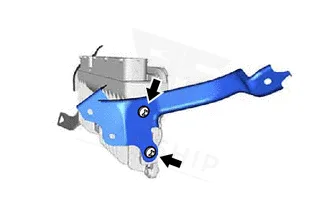
Work with the ignition off, and treat the module as static-sensitive: avoid touching the connector pins at any point.
| Operation | Configuration | Book Time |
|---|---|---|
| Powertrain Control Module R&R | All configurations | 0.8 hr |
| Powertrain Control Module Relearn | All configurations | 0.5 hr |
| Engine Control Module Relearn | All configurations | 0.5 hr |
| Engine Control Module R&R | All configurations | 0.8 hr |
| Engine Control Module Reset | All configurations | 0.3 hr |
After the ECM is removed and installed or replaced in your 2019 Toyota Prius Prime, Toyota mandates several post-installation procedures including adjustment, calibration, initialization, or registration. These steps ensure the replacement module communicates properly with the hybrid system and powertrain components. The factory documents a relearn procedure requiring 0.5 hours and an ECM reset requiring 0.3 hours, both of which must be completed before the vehicle returns to normal service. Without these calibrations, your Prius Prime may exhibit erratic idle behavior, poor fuel economy, or failure to start. The relearn process teaches the new module the specific characteristics of your engine and hybrid components, while the reset clears learned values that no longer apply to the replacement unit. When you choose a VIN-programmed replacement unit from Flagship One, the module arrives already coded to your vehicle’s identification number with the appropriate firmware and calibration data loaded. This preparation addresses the programming portion of the installation, though Toyota’s relearn and reset steps may still need to be performed by your technician to finalize the integration.
Several symptoms commonly point to engine control module failure in your 2019 Toyota Prius Prime. One frequent indicator is a no-start condition where the engine cranks but fails to fire, or the hybrid system refuses to engage. Stalling at idle or during deceleration may also occur when the ECM loses its ability to maintain stable fuel delivery calculations. Misfire codes can appear even when the ignition coils and spark plugs are in good condition, because a failing module may intermittently drop injector or coil commands. Your vehicle may also enter a limp-home mode that restricts speed and power, accompanied by multiple warning lights on the instrument panel. Dead scan-tool communication represents another telltale sign. When a technician connects diagnostic equipment and receives no response from the ECM, the module itself has likely lost internal power or suffered processor failure. Shifting irregularities in the hybrid transaxle can also surface, since the ECM shares data with the motor generator control ECU that influences power distribution. Diagnostic trouble code internal ECM processor fault is documented for this vehicle and specifically indicates a malfunction within the module’s internal circuitry rather than an external sensor or wiring problem. When this code appears alongside drivability complaints, replacing the module often resolves the issue. Intermittent symptoms that worsen with engine heat or vibration typically reinforce the diagnosis of an internal module failure.
The following diagnostic trouble code is documented as a module-internal fault for the 2019 Toyota Prius Prime. Unlike codes triggered by external sensors or wiring issues, this code originates within the engine control module itself and typically indicates that the unit requires replacement rather than component-level repair.
| Code | Meaning | Full Guide |
|---|---|---|
| P0606 | Module processor failure | Full P0606 guide → |
Toyota’s factory book time for ECM removal and reinstallation is 0.8 hours. A separate relearn procedure requires 0.5 hours, and an ECM reset adds 0.3 hours. Your technician may need additional time for diagnostics and access depending on the specific repair scenario.
Toyota advises against replacing both units simultaneously because the high-voltage battery learning values will be lost. If simultaneous replacement is necessary, Toyota provides a specific procedure to follow that minimizes this risk.
Code P0606 indicates an internal malfunction within the engine control module’s processor circuitry. This code typically points to the module itself rather than external sensors or wiring, and replacement often resolves the issue.
Yes, the cable from the negative auxiliary battery terminal must be disconnected before beginning the replacement. Toyota notes that a waiting period may be required after turning the power switch off, so reviewing the disconnection notices beforehand is important.
Flagship One units arrive VIN-programmed with the appropriate firmware and calibration data. However, Toyota’s relearn and reset procedures may still need to be performed by your technician to fully integrate the module with your vehicle’s hybrid system.
When your 2019 Toyota Prius Prime shows signs of ECM failure, you have options. A professional repair facility can diagnose the module and perform the replacement using factory procedures, or you can source a pre-programmed unit and have your trusted technician handle the installation. Because the Prius Prime’s hybrid architecture requires specific post-install calibrations, choosing a replacement that arrives already coded to your vehicle reduces complexity. Flagship One supplies engine computers matched to your identification number, helping streamline the repair process.
Flagship One stocks a refurbished, VIN-programmed PCM for the 2019 Toyota Prius Prime with a lifetime warranty, free shipping and no core charge. The full Toyota Prius Prime module lineup covers other engine configurations as well.
Your 2019 Toyota Prius Prime relies on a healthy engine control module to coordinate its hybrid powertrain efficiently. Recognizing the symptoms of module failure early and understanding the replacement process helps you avoid prolonged downtime. Whether you work with a repair shop or handle the installation yourself, a correctly programmed replacement module restores the performance and reliability you expect from your vehicle.