
Last updated on August 25th, 2026 at 11:55 am
The engine control module (ECM) in your 2018 Toyota Yaris manages fuel delivery, ignition timing, and emissions systems. A failure may cause erratic idling, stalling, or a no-start condition, often triggered by voltage spikes or internal faults.
If your 2018 Toyota Yaris has been stalling unexpectedly or throwing a check-engine light with no clear cause, the engine control module (ECM) may be the culprit. This small but critical computer oversees nearly every aspect of engine performance, from fuel injection to ignition timing. When it fails, symptoms can range from subtle drivability issues to a complete no-start condition. Replacing the ECM isn’t just about swapping a part—it involves careful disassembly, proper installation, and often, a relearn procedure to sync the new unit with your vehicle’s systems. Understanding the role of the ECM, where it’s located, and what to expect during replacement can help you make an informed decision, whether you’re tackling the job yourself or working with a shop. This guide covers the essentials: how the ECM functions in your Yaris, common failure signs, and the steps required to restore reliable operation.
The engine control module (ECM) in your 2018 Toyota Yaris acts as the brain of the engine, continuously monitoring sensors and adjusting fuel, air, and spark to optimize performance and emissions. It ensures smooth acceleration, efficient fuel consumption, and compliance with emissions standards. Without a functioning ECM, your Yaris may struggle to start, run erratically, or even fail to idle. The module also stores diagnostic trouble codes (DTCs) when it detects irregularities, which technicians use to pinpoint issues. Over time, voltage spikes, moisture intrusion, or internal component wear may compromise its operation. If replacement becomes necessary, replacement engine computers for the Yaris are available to restore factory-level functionality. These units must be programmed to your vehicle’s VIN to communicate properly with the transmission, body control modules, and other systems. A faulty ECM doesn’t just affect drivability—it can lead to increased emissions, poor fuel economy, and even catalytic converter damage if left unaddressed.
2018 Toyota Yaris
OEM programmed ECM for your 2018 Toyota Yaris — plug & play, no dealer visit.
Free shipping · Lifetime warranty
The ECM in your 2018 Toyota Yaris is mounted behind the cowl panel, near the base of the windshield. To access it, you’ll need to remove several components: the negative battery cable, the front wiper arm caps, both wiper arms and blades, and the left and right cowl side ventilator sub-assemblies. This disassembly is necessary because the module is tucked beneath the windshield’s lower edge, protected from the elements but not easily reachable. Once the cowl panel is removed, the ECM is visible and secured with a mounting bracket. Replacement labor is typically billed at 1.1 hours, as the process involves careful handling to avoid damaging clips or electrical connectors. After installation, the battery must be reconnected, and a relearn procedure may be required if the new ECM isn’t pre-programmed to your vehicle’s VIN.
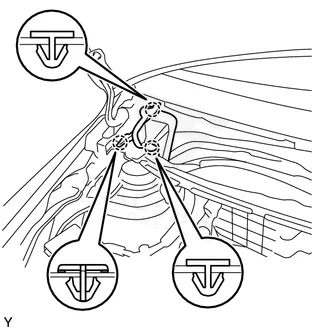
Work with the ignition off, and treat the module as static-sensitive: avoid touching the connector pins at any point.
| Operation | Configuration | Book Time |
|---|---|---|
| Engine Control Module Relearn | All configurations | 0.5 hr |
| Engine Control Module R&R | All configurations | 1.1 hr |
| Powertrain Control Module R&R | All configurations | 1.1 hr |
| Powertrain Control Module Relearn | All configurations | 0.5 hr |
After replacing the ECM in your 2018 Toyota Yaris, the factory procedure requires a relearn process to synchronize the new module with the vehicle’s systems. This typically involves using a scan tool to reset adaptive values, clear stored codes, and ensure proper communication with the transmission and other control modules. The process may take up to 0.5 hours of labor, depending on the tools and software used. However, a VIN-programmed replacement unit arrives pre-configured for your specific Yaris, eliminating the need for post-installation programming. This not only saves time but also reduces the risk of incomplete initialization, which can lead to drivability issues or recurring fault codes. If you’re installing the ECM yourself, confirm that the replacement is fully programmed to avoid additional steps or potential complications.
A failing ECM in your 2018 Toyota Yaris may produce a range of symptoms, some subtle and others more severe. One of the most common signs is a no-start condition, where the engine cranks but refuses to fire. You might also notice rough idling, hesitation during acceleration, or stalling at stoplights—symptoms that often mimic fuel or ignition system problems. In some cases, the vehicle may enter a “limp mode,” limiting power to prevent further damage. A check-engine light is almost always present, and scanning for codes may reveal an internal processor fault, which directly points to the ECM. Other potential codes include misfire-related or fuel-system faults, as the ECM’s failure can disrupt sensor readings and actuator commands. If your Yaris suddenly exhibits erratic shifting or fails to communicate with a scan tool, the ECM should be one of the first components checked. Ignoring these symptoms may lead to further drivability issues or even damage to other systems, such as the catalytic converter.
The 2018 Toyota Yaris ECM may store specific trouble codes when internal faults are detected. These codes help diagnose whether the module itself is the root cause of drivability issues. Below is the documented code for this vehicle’s ECM.
| Code | Meaning | Full Guide |
|---|---|---|
| P0606 | Module processor failure | Full P0606 guide → |
A stalling issue after battery replacement may indicate the ECM lost its adaptive memory, requiring a relearn procedure. This can happen if the battery was disconnected for an extended period. A scan tool may be needed to reset fuel trims and idle settings. If the problem persists, the ECM itself could be faulty or improperly programmed.
Driving with a P0606 code is possible, but not recommended. This code signals an internal ECM fault, which may cause erratic engine behavior, stalling, or a no-start condition. Continued driving could lead to further drivability issues or damage to other components. Addressing the code promptly is the safest course of action.
Distinguishing between an ECM failure and a sensor issue often requires diagnostic testing. If multiple unrelated codes appear (e.g., fuel system, ignition, and transmission faults), the ECM may be the culprit. A scan tool can check for communication errors with the module. If the ECM fails to respond or stores internal processor codes like P0606, replacement is likely needed.
Installing a used ECM without reprogramming it to your Yaris’s VIN may result in a no-start condition or drivability issues. The module must be synced with the vehicle’s immobilizer and other control systems. Without proper programming, the engine may crank but fail to start, or it may run poorly due to incorrect fuel and ignition maps.
Disconnecting the battery to reset the ECM is generally safe, but it may erase adaptive values like fuel trims and idle settings. After reconnecting the battery, the ECM will relearn these values over time, which may cause temporary rough idling or hesitation. If the ECM is faulty, this method won’t resolve the issue—replacement and programming will be necessary.
If your 2018 Toyota Yaris is experiencing ECM-related issues, you have options beyond costly dealer repairs. A refurbished replacement unit, pre-programmed to your vehicle’s VIN, can restore factory performance without the need for post-installation programming. This approach saves time and reduces the risk of incomplete initialization, which can lead to recurring problems. Whether you’re replacing the ECM yourself or working with a shop, choosing a unit designed for your Yaris ensures compatibility and reliability.
Flagship One stocks a refurbished, VIN-programmed PCM for the 2018 Toyota Yaris with a lifetime warranty, free shipping and no core charge. The full Toyota Yaris module lineup covers other engine configurations as well.
The engine control module in your 2018 Toyota Yaris plays a critical role in maintaining smooth, efficient operation. When it fails, symptoms like stalling, rough idling, or a no-start condition can disrupt your daily driving. Understanding the module’s function, location, and replacement process helps you make informed decisions, whether you’re diagnosing an issue or preparing for a repair. If replacement is necessary, opting for a VIN-programmed unit can simplify the process and get your Yaris back on the road with minimal downtime.