
Last updated on August 25th, 2026 at 11:56 am
The engine control module in your 2017 Toyota Corolla iM manages fuel delivery and ignition timing. When this computer fails, the vehicle may experience poor engine performance or an inability to start, as the module can no longer accurately process sensor data to regulate the 1.8L engine.
Dealing with an engine computer failure in your 2017 Toyota Corolla iM can be frustrating, often leading to unpredictable idling or a complete no-start condition. The engine control module, or ECM, acts as the brain of your powertrain, coordinating critical functions to ensure the 1.8L engine runs efficiently. Understanding how this component operates and the specific requirements for its replacement can help you manage the repair process more effectively. In this guide, you will find details regarding the physical location of the module, the labor involved in swapping the unit, and the necessary programming steps to get your vehicle back on the road. By reviewing these technical specifications, you can better understand the complexity of the installation and ensure that the replacement process follows the necessary safety precautions to avoid damaging other electronic systems during the service.
The engine control module is the primary computer responsible for monitoring various sensors and adjusting the engine’s operation in real-time. In your 2017 Toyota Corolla iM, it manages the air-fuel mixture and spark timing to optimize fuel economy and reduce emissions. If the internal circuitry fails, the vehicle may enter a limp mode or fail to communicate with diagnostic tools. Because this component is so central to operation, sourcing high-quality replacement 2017 Toyota Corolla iM computers is essential for maintaining reliability. This module processes data from the crankshaft and camshaft sensors to determine the exact moment to fire the spark plugs. When the computer malfunctions, it can trigger specific internal fault codes that indicate a failure within the module’s own processing logic rather than a failed external sensor. Ensuring the module is functioning correctly allows the vehicle to maintain a smooth idle and consistent power delivery across the RPM range.
2017 Toyota Corolla iM
OEM programmed ECM for your 2017 Toyota Corolla iM — plug & play, no dealer visit.
Free shipping · Lifetime warranty
The control module in your 2017 Toyota Corolla iM is situated adjacent to the air cleaner assembly. To access the unit, you must first disconnect the negative battery cable. The replacement process involves removing the air cleaner case sub-assembly, the air cleaner cap and hose, and the second cylinder head cover. According to factory book times, the removal and replacement of the Powertrain Control Module typically takes 0.6 hours, while the Engine Control Module R&R is also listed at 0.6 hours. If a reset is required, that process is estimated at 0.3 hours. It is important to follow the specific sequence of component removal to ensure the module can be extracted without damaging the surrounding wiring harness or the air intake system. Once the area is clear, the module can be unbolted and swapped with the new unit.
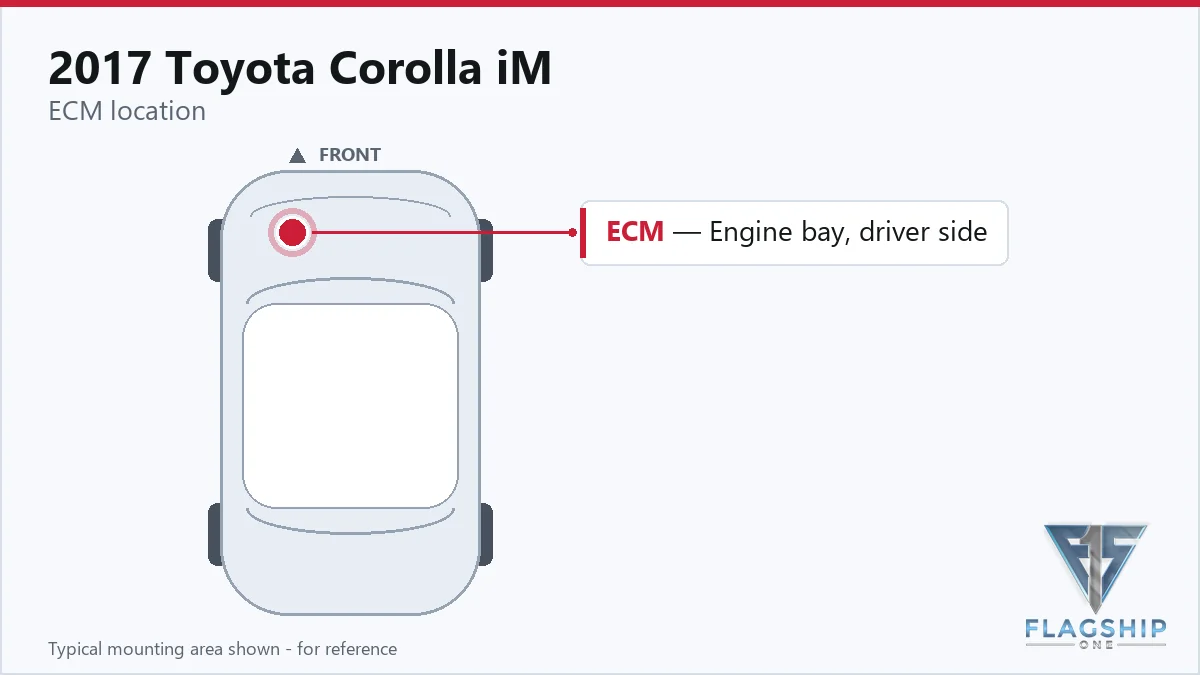
Work with the ignition off, and treat the module as static-sensitive: avoid touching the connector pins at any point.
| Operation | Configuration | Book Time |
|---|---|---|
| Powertrain Control Module R&R | All configurations | 0.6 hr |
| Powertrain Control Module Relearn | All configurations | 0.5 hr |
| Engine Control Module Relearn | All configurations | 0.5 hr |
| Engine Control Module R&R | All configurations | 0.6 hr |
| Engine Control Module Reset | All configurations | 0.3 hr |
Factory guidelines specify that you must perform a VIN registration when installing a new ECM. Additionally, some systems may require initialization after you reconnect the negative battery cable. The factory relearn process for the Powertrain Control Module is estimated at 0.5 hours, and the Engine Control Module relearn is also 0.5 hours. To simplify this, Flagship One provides a VIN-programmed replacement unit that arrives with the vehicle’s identification already configured. This eliminates the need for the complex VIN registration steps typically required by the dealership. By receiving a pre-programmed module, you can avoid the additional labor hours associated with the factory programming sequence and move directly to the installation and system verification phase.
A failing engine computer in your 2017 Toyota Corolla iM often manifests as a sudden no-start condition or erratic engine stalling. You may notice a significant loss of power or the engine idling roughly despite other components being in good health. In some cases, the vehicle may fail to communicate with a scan tool during diagnostics. Internal hardware failures often trigger specific diagnostic trouble codes; for example, you may see a internal control module error on your scanner. Other symptoms include random misfires that do not correspond to a specific cylinder or shifting irregularities if the module cannot properly coordinate with the transmission. These issues typically stem from internal circuit degradation or electrical shorts within the computer’s processor, leading to unreliable signals being sent to the fuel injectors and ignition coils.
The following internal trouble codes are specifically documented for the engine control module in the 2017 Toyota Corolla iM. These codes typically point to an internal failure within the computer’s own circuitry rather than a fault in an external sensor or actuator.
| Code | Meaning | Full Guide |
|---|---|---|
| P0601 | Internal memory checksum error | Full P0601 guide → |
| P0606 | Module processor failure | Full P0606 guide → |
Yes, the factory requires VIN registration and certain system initializations. Using a pre-programmed unit can bypass these requirements.
The module is positioned next to the air cleaner assembly. It requires the removal of several intake components for access.
The removal and installation process is typically listed at 0.6 hours. Additional time may be needed for relearn or reset procedures.
When deciding how to resolve a computer failure in your 2017 Toyota Corolla iM, you have several options. While some seek out refurbished units, a high-quality replacement ensures long-term reliability for your vehicle’s electronics. Choosing a unit that is already configured to your specific VIN reduces the risk of installation errors and eliminates the need for expensive dealership programming visits.
Flagship One stocks a refurbished, VIN-programmed PCM for the 2017 Toyota Corolla iM with a lifetime warranty, free shipping and no core charge. The full Toyota Corolla iM module lineup covers other engine configurations as well.
Maintaining the electronic health of your 2017 Toyota Corolla iM is essential for reliable daily driving. By understanding the role of the engine control module and the requirements for its replacement, you can ensure your vehicle returns to peak operating condition. If you are experiencing computer-related symptoms, consider a professionally programmed replacement to restore your vehicle’s performance.