
Last updated on August 25th, 2026 at 01:11 pm
The Engine Control Module (ECM) in your 2017 Infiniti Q50 manages fuel injection, ignition timing, and emissions systems. Failures may cause erratic engine behavior, poor performance, or complete no-start conditions, often triggered by electrical issues or internal faults.
If your 2017 Infiniti Q50 is experiencing unexplained stalling, a check engine light, or a no-start condition, the Engine Control Module (ECM) may be the culprit. This small but critical computer oversees everything from fuel delivery to ignition timing, ensuring your engine runs smoothly. When it fails, symptoms can range from subtle performance issues to complete engine shutdown. Replacing the ECM isn’t just about swapping a part—it involves precise labor, proper access, and often, a time-consuming relearn procedure. Understanding these steps helps you make informed decisions, whether you’re considering a repair or a replacement. With the right approach, you can restore your Q50’s reliability without unnecessary delays or costs.
The Engine Control Module (ECM) in your 2017 Infiniti Q50 acts as the brain of the engine, processing data from sensors to optimize performance, fuel efficiency, and emissions. It adjusts fuel injection timing, ignition spark, and idle speed in real time, ensuring smooth operation under all driving conditions. A failure in this module can disrupt these functions, leading to poor acceleration, rough idling, or even a vehicle that won’t start. Because the ECM is integrated with the replacement engine computers for the Q50, it’s essential to choose a unit that matches your vehicle’s specifications. The 2.0L engine in this model has a unique calibration, so compatibility is non-negotiable. Without a properly functioning ECM, your Q50 may struggle to meet emissions standards or deliver the power you expect.
2017 Infiniti Q50
OEM programmed ECM for your 2017 Infiniti Q50 — plug & play, no dealer visit.
Free shipping · Lifetime warranty
In the 2017 Infiniti Q50, the ECM is located next to the air cleaner assembly, making it relatively accessible compared to some vehicles where the module is buried under the dashboard or behind the firewall. Replacement involves disconnecting the battery, removing the air cleaner housing, and carefully unplugging the wiring harness from the module. The factory procedure specifies 1.4 hours of labor for the 2.0L engine, which includes removing the old unit, installing the new one, and securing all connections. While the location isn’t overly complex, precision is key—improper handling can damage the module or its connectors. After installation, the vehicle will require a relearn process, which adds additional time to the job.
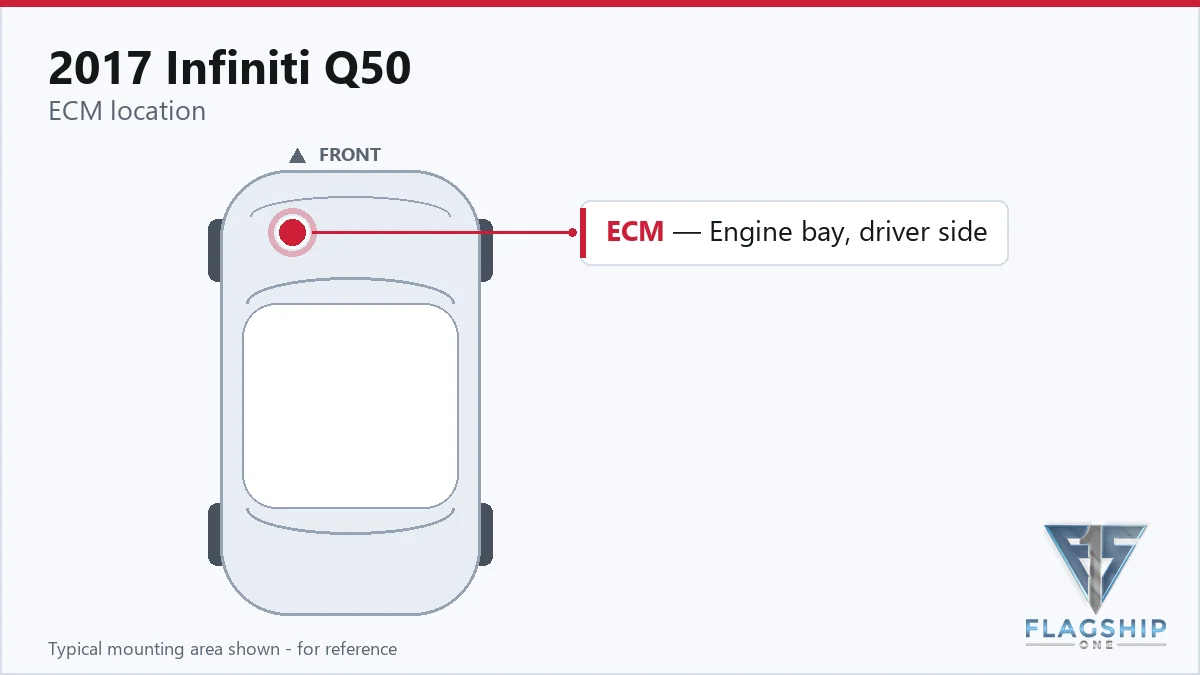
Work with the ignition off, and treat the module as static-sensitive: avoid touching the connector pins at any point.
| Operation | Configuration | Book Time |
|---|---|---|
| Engine Control Module Reset | All configurations | 0.3 hr |
| Engine Control Module Relearn | All configurations | 0.5 hr |
| Engine Control Module R&R | 3.5L | 2.1 hr |
| Engine Control Module R&R | 3.0L | 0.9 hr |
| Engine Control Module R&R | 2.0L | 1.4 hr |
| Powertrain Control Module Relearn | All configurations | 0.5 hr |
| Powertrain Control Module R&R | 2.0L | 1.4 hr |
| Powertrain Control Module R&R | 3.0L | 0.9 hr |
After replacing the ECM in your 2017 Infiniti Q50, the factory procedure requires a relearn process to synchronize the new module with the vehicle’s systems. This step typically takes 0.5 hours and involves using specialized diagnostic tools to reset adaptive values, calibrate sensors, and ensure proper communication with the transmission and other control modules. Without this step, your Q50 may experience shifting issues, poor fuel economy, or even a no-start condition. However, opting for a VIN-programmed replacement unit eliminates the need for this additional labor. These units arrive pre-configured to your vehicle’s specifications, allowing for plug-and-play installation. This not only saves time but also reduces the risk of errors during the programming process, ensuring a smoother transition to reliable operation.
When the ECM in your 2017 Infiniti Q50 begins to fail, symptoms can vary widely but often include noticeable drivability issues. You may experience intermittent stalling, especially at idle or during deceleration, as the module struggles to maintain stable engine operation. Rough idling or misfires are also common, as the ECM loses its ability to precisely control fuel and ignition timing. In some cases, the vehicle may refuse to start altogether, leaving you stranded. A check engine light is almost always present, and scanning the system may reveal codes like an internal control module fault. Other potential symptoms include poor acceleration, reduced fuel efficiency, or even transmission shifting problems, as the ECM communicates with the transmission control module. If you notice any of these issues, it’s worth having the ECM inspected, as ignoring them can lead to further damage or inconvenient breakdowns.
The 2017 Infiniti Q50’s ECM may log specific trouble codes when internal faults occur. These codes help pinpoint the issue, guiding diagnostics and repairs. Below are the documented module-internal trouble codes for this vehicle.
| Code | Meaning | Full Guide |
|---|---|---|
| P0605 | Internal ROM error | Full P0605 guide → |
Random stalling in your Q50 can often be traced to the ECM, especially if the module is failing to maintain stable engine operation. The ECM controls fuel injection and ignition timing, and if it malfunctions, the engine may cut out unexpectedly. Other symptoms, like rough idling or a check engine light, can help confirm the diagnosis.
If your Q50 is experiencing persistent no-start conditions, repeated stalling, or trouble codes like P0605, replacement is often the most reliable solution. While some ECM issues can be resolved with a reset or relearn, internal faults typically require a new module to restore proper function.
An ECM reset clears temporary data and restores default settings, which may resolve minor glitches. A relearn, however, is a more involved process that recalibrates the module to your vehicle’s specific parameters, ensuring proper communication with sensors and other systems. The relearn is required after replacing the ECM.
While the ECM in the Q50 is accessible, replacement involves more than just swapping the part. You’ll need to disconnect the battery, remove the air cleaner assembly, and ensure proper reconnection of the wiring harness. Additionally, the vehicle requires a relearn procedure afterward, which may require specialized tools. If you’re not comfortable with these steps, a professional technician is recommended.
A used ECM from another Q50 may physically fit, but it’s unlikely to work without reprogramming. Each ECM is calibrated to the specific vehicle’s VIN, and installing an unprogrammed unit can result in drivability issues or a no-start condition. For reliable performance, a VIN-programmed replacement unit is the best option.
If your 2017 Infiniti Q50 is showing signs of ECM failure, you have options. A repair may be possible for minor issues, but persistent problems often require a replacement. Opting for a pre-programmed ECM saves time and ensures compatibility, eliminating the need for post-install programming. Whether you choose a new or refurbished unit, addressing the issue promptly can restore your Q50’s performance and reliability.
Flagship One stocks a refurbished, VIN-programmed PCM for the 2017 Infiniti Q50 with a lifetime warranty, free shipping and no core charge. The full Infiniti Q50 module lineup covers other engine configurations as well.
The Engine Control Module in your 2017 Infiniti Q50 plays a critical role in maintaining smooth and efficient engine operation. When it fails, symptoms like stalling, misfires, or a no-start condition can disrupt your driving experience. Replacing the ECM involves careful labor and, in most cases, a relearn procedure to ensure proper function. By understanding the process and opting for a pre-programmed unit, you can minimize downtime and get back on the road with confidence.