
Last updated on August 25th, 2026 at 01:11 pm
The engine control module (ECM) in your 2016 Infiniti Q50 2.0L is the central computer that manages fuel injection, ignition timing, and emissions. When it fails, the vehicle may not start, run poorly, or trigger trouble code P0605. Replacement requires careful programming.
If you own a 2016 Infiniti Q50 with the 2.0L turbocharged engine, you may eventually face a situation where the engine control module (ECM) or powertrain control module (PCM) needs attention. This component is the brain of your vehicle’s engine management system, responsible for interpreting sensor data and commanding fuel delivery, spark timing, and boost control. When it begins to fail, symptoms can range from intermittent hesitation to a complete no-start condition. Understanding what the module does, where it is located, and what replacement involves can save you time and frustration. This guide covers the essential facts for the 2016 Q50 2.0L: the module’s role, common failure signs, the factory replacement procedure with book labor times, and the critical programming step that follows installation. You will also learn how Flagship One’s pre-programmed replacement units address that programming requirement, making the swap more straightforward. Whether you are a DIY owner or a professional technician, the information here is based on documented labor times and the vehicle’s design, not speculation.
The engine control module (ECM) in your 2016 Infiniti Q50 2.0L is a dedicated computer that continuously monitors and adjusts engine operation. It receives signals from sensors measuring airflow, coolant temperature, throttle position, and oxygen levels, then calculates the optimal fuel mixture and ignition timing for current driving conditions. In the Q50, the ECM also manages the turbocharger wastegate and variable valve timing, making it integral to both performance and fuel economy. When the module fails, the engine may run in a reduced-power limp mode or refuse to start altogether. The ECM is part of a broader category of replacement engine computers for the Q50 that includes units for other Infiniti models, but the 2.0L version has specific calibration. Because the module stores adaptive learning data for your particular engine, a replacement unit must be programmed with the vehicle’s VIN and immobilizer information to function correctly. Without that programming, the new module will not communicate with the anti-theft system or other control modules, leaving the car inoperable. Understanding this dependency helps you appreciate why a simple swap is not enough.
2016 Infiniti Q50 2.0L
OEM programmed ECM for your 2016 Infiniti Q50 2.0L — plug & play, no dealer visit.
Free shipping · Lifetime warranty
The factory removal procedure for the 2016 Infiniti Q50 2.0L places the engine control module next to the air cleaner assembly. To access it, you typically remove the air cleaner housing and any ductwork that obstructs the module. The module is mounted on a bracket and secured with bolts; disconnecting the electrical connectors requires care to avoid damaging the locking tabs. According to published labor times, replacing the ECM or PCM on the 2.0L engine carries a book time of 1.4 hours. After installation, a reset procedure takes 0.3 hours, and a full relearn or reprogramming step adds 0.5 hours. These times reflect the work of a trained technician using factory tools. The location near the air cleaner means the module is relatively accessible, but you must ensure the new unit is correctly seated and all connectors are fully locked before reassembling the intake system.
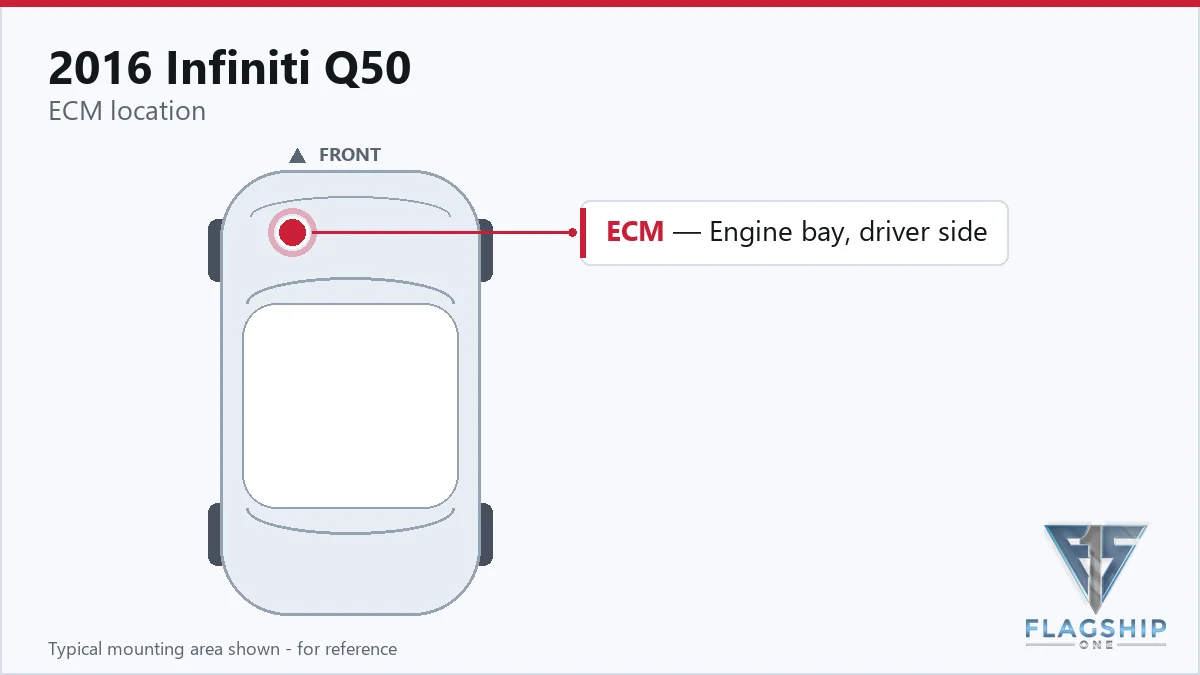
Work with the ignition off, and treat the module as static-sensitive: avoid touching the connector pins at any point.
| Operation | Configuration | Book Time |
|---|---|---|
| Engine Control Module Reset | All configurations | 0.3 hr |
| Engine Control Module Relearn | All configurations | 0.5 hr |
| Engine Control Module R&R | 3.5L | 2.1 hr |
| Engine Control Module R&R | 3.0L | 0.9 hr |
| Engine Control Module R&R | 2.0L | 1.4 hr |
| Powertrain Control Module Relearn | All configurations | 0.5 hr |
| Powertrain Control Module R&R | 2.0L | 1.4 hr |
| Powertrain Control Module R&R | 3.0L | 0.9 hr |
After installing a replacement ECM or PCM in the 2016 Infiniti Q50 2.0L, the factory procedure requires a VIN-specific programming step. This involves using a scan tool to write the vehicle’s identification number and immobilizer data into the new module, as well as performing a throttle position and idle air relearn. The book time for this relearn is 0.5 hours, and it is essential for the module to communicate with the body control module and start the engine. Flagship One offers a VIN-programmed replacement unit that arrives with the correct calibration already loaded. This means you can install the module and, in most cases, start the vehicle without the factory programming step. However, a basic idle relearn may still be recommended to match the module to your engine’s wear characteristics. The pre-programming eliminates the need for a dealer visit or specialized equipment, saving both time and expense.
When the ECM or PCM begins to fail in a 2016 Infiniti Q50 2.0L, you may notice several warning signs. The engine might crank but not start, or it may start and stall shortly after. Intermittent misfires, rough idle, or hesitation during acceleration are common, as the module loses its ability to accurately control fuel and spark. The check engine light will likely illuminate, and a scan may reveal trouble code internal control module fault. This code indicates a problem within the module itself, such as a corrupted memory or a failed processor. Other symptoms include the cooling fan running continuously, the transmission shifting erratically (since the PCM also manages shift points in some configurations), or a complete loss of communication with a scan tool. If you experience any of these issues, especially a no-start combined with a P0605 code, the module is a likely suspect. Prompt diagnosis can prevent being stranded.
The following trouble code is documented for the 2016 Infiniti Q50 2.0L engine control module. This code points to an internal module fault rather than a sensor or wiring issue.
| Code | Meaning | Full Guide |
|---|---|---|
| P0605 | Internal ROM error | Full P0605 guide → |
Common symptoms include a no-start condition, stalling, rough idle, hesitation, and the check engine light with code P0605. You may also notice the cooling fan running constantly or the transmission shifting oddly.
The engine control module is located next to the air cleaner assembly on the driver’s side of the engine bay. You need to remove the air cleaner housing to access it.
The book labor time for ECM replacement on the 2.0L engine is 1.4 hours. An additional 0.5 hours is allowed for the relearn procedure after installation.
A used ECM will need to be reprogrammed with your vehicle’s VIN and immobilizer data. Without that programming, the module will not communicate with the anti-theft system and the engine will not start.
Yes, Flagship One offers replacement units that arrive pre-programmed with the correct VIN and calibration. This eliminates the need for a dealer visit or specialized programming equipment.
When your 2016 Infiniti Q50 2.0L needs a new ECM or PCM, you have two main options: have a dealer or shop perform a full replacement with factory programming, or install a pre-programmed unit from Flagship One. The latter approach reduces downtime and avoids the cost of dealer programming labor. Given the 1.4-hour book time for the swap itself, a pre-programmed module makes the job a straightforward DIY or shop task.
Flagship One stocks a refurbished, VIN-programmed PCM for the 2016 Infiniti Q50 with a lifetime warranty, free shipping and no core charge. The full Infiniti Q50 module lineup covers other engine configurations as well.
The engine control module in your 2016 Infiniti Q50 2.0L is a sophisticated component that requires proper handling during replacement. Understanding its location, the labor involved, and the critical programming step helps you make an informed decision. Flagship One’s pre-programmed units simplify the process, letting you get back on the road with confidence.