
Last updated on August 25th, 2026 at 12:56 pm
The engine control module in the 2017 Audi S5 manages fuel delivery, ignition timing, and emissions. When this computer fails, the vehicle may experience erratic idling, poor fuel economy, or a complete loss of engine operation.
If your 2017 Audi S5 is experiencing unexplained stalling or failing to start, the engine computer may be the culprit. This central unit coordinates the complex interactions between the air intake, fuel system, and ignition. Understanding how these modules function and what happens when they fail helps you diagnose the problem more effectively. By reviewing the technical details of the PCM and ECM, you can determine if a hardware replacement is necessary to restore reliable operation to your vehicle.
The engine control module serves as the brain of the 2017 Audi S5, processing data from various sensors to optimize combustion. It ensures the 3.0L engine runs efficiently by adjusting timing and fuel mixtures in real-time. Because it handles critical safety and performance functions, sourcing high-quality replacement engine computers for the 2017 Audi S5 is essential for maintaining vehicle stability. A failure in this unit often disrupts the communication between the engine and the transmission, which can lead to degraded driveability or an immobilized vehicle.
The 2017 Audi S5 houses the control module within the plenum chamber, situated at the base of the windshield. Accessing this area requires following the factory removal steps to reach the unit. According to book times, the removal and replacement of the Engine Control Module for the S5 takes 1.0 hours. Similarly, the Powertrain Control Module R&R is listed at 1.0 hours. These figures represent the standard time for a technician to physically swap the hardware.
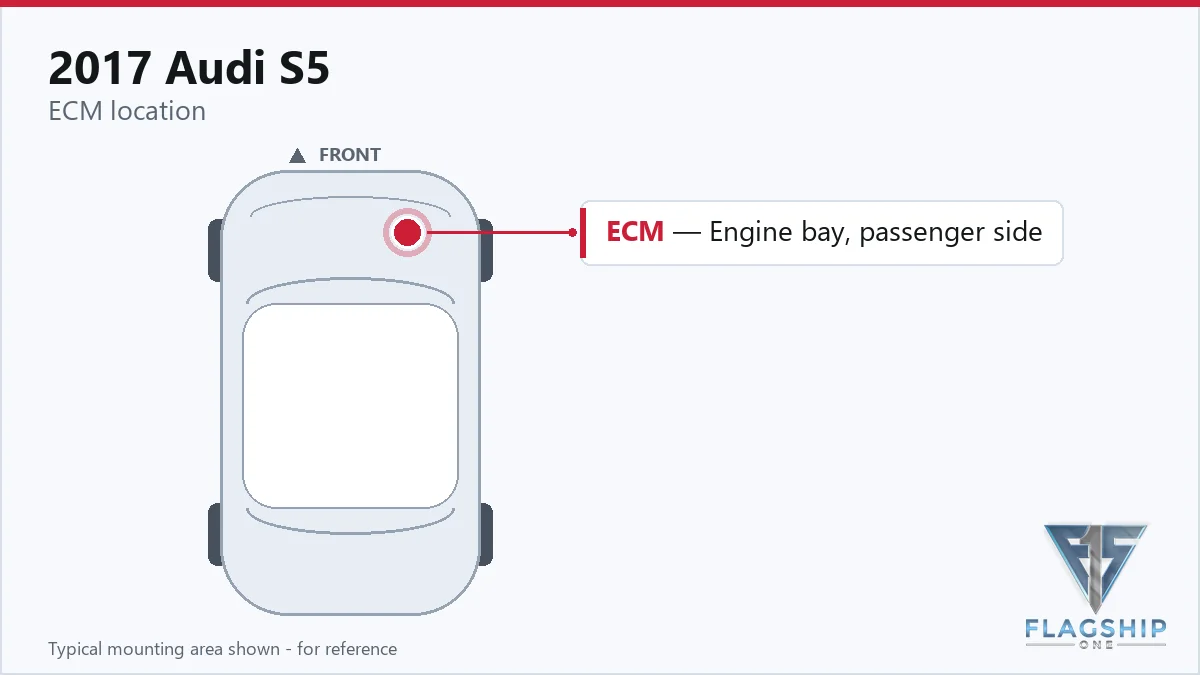
Work with the ignition off, and treat the module as static-sensitive: avoid touching the connector pins at any point.
| Operation | Configuration | Book Time |
|---|---|---|
| Engine Control Module Relearn | A5 Quattro | 0.5 hr |
| Engine Control Module Relearn | S5 | 0.5 hr |
| Engine Control Module R&R | A5 Quattro | 1.0 hr |
| Engine Control Module R&R | S5 | 1.0 hr |
| Powertrain Control Module R&R | A5 Quattro | 1.0 hr |
| Powertrain Control Module R&R | S5 | 1.0 hr |
| Powertrain Control Module Relearn | A5 Quattro | 0.5 hr |
| Powertrain Control Module Relearn | S5 | 0.5 hr |
2017 Audi S5
OEM programmed ECM for your 2017 Audi S5 — plug & play, no dealer visit.
Free shipping · Lifetime warranty
After a new module is installed, factory guidelines typically require a relearn process. For the 2017 Audi S5, the Engine Control Module Relearn is 0.5 hours, and the Powertrain Control Module Relearn is also 0.5 hours. Flagship One simplifies this by providing a VIN-programmed replacement unit that arrives ready for installation. This means the complex coding steps required by the manufacturer are already completed, reducing the time your vehicle spends in the shop.
A failing engine computer in the 2017 Audi S5 often manifests as a sudden no-start condition or random stalling while driving. You might notice the engine misfiring or an inability to communicate with the vehicle via a scan tool. In some cases, the computer may trigger an internal fault, such as an internal control module performance fault P0603, which indicates a processing error within the hardware. These issues can also cause erratic shifting or a complete loss of power, leaving the vehicle stranded.
The following list includes internal trouble codes specifically documented for the 2017 Audi S5 engine and powertrain modules.
| Code | Meaning | Full Guide |
|---|---|---|
| P0603 | Keep-alive memory (KAM) error | Full P0603 guide → |
| P0604 | Internal RAM error | Full P0604 guide → |
| P0605 | Internal ROM error | Full P0605 guide → |
| P0606 | Module processor failure | Full P0606 guide → |
| P0608 | Module-internal fault | Full P0608 guide → |
| P060A | Module-internal fault | — |
| P060B | Module-internal fault | — |
| P0613 | Module-internal fault | Full P0613 guide → |
| P062F | Internal EEPROM error | Full P062F guide → |
| P0667 | Module-internal fault | Full P0667 guide → |
| U0100 | Module-internal fault | Full U0100 guide → |
The module is found in the plenum chamber at the base of the windshield.
The book time for the removal and replacement of the S5 Engine Control Module is 1.0 hours.
While factory procedures list a 0.5 hour relearn, Flagship One units come pre-programmed to the VIN.
When deciding how to fix your 2017 Audi S5, you have options between new factory parts and refurbished replacements. Refurbished units provide a cost-effective alternative while maintaining the necessary technical specifications for the 3.0L engine. Choosing a unit that is already programmed to your vehicle’s VIN can significantly reduce labor costs and downtime.
Flagship One stocks a refurbished, VIN-programmed PCM for the 2017 Audi S5 with a lifetime warranty, free shipping and no core charge. The full Audi S5 module lineup covers other engine configurations as well.
Restoring the 2017 Audi S5 to peak performance often requires addressing faults within the engine control module. By understanding the location and programming requirements, you can ensure a smoother repair process. For those seeking a reliable solution, exploring pre-programmed module options is a practical next step.