
Last updated on August 25th, 2026 at 01:57 pm
The powertrain control module (PCM) in your 2014 Mazda 3 manages engine and transmission functions by processing sensor data. Failures may disrupt fuel delivery, ignition timing, or shift patterns, often leading to poor performance or a non-starting vehicle.
If your 2014 Mazda 3 is experiencing unexplained stalling, rough idling, or a no-start condition, the powertrain control module (PCM) may be at fault. This critical component oversees engine and transmission functions, ensuring smooth operation. When it fails, symptoms can range from subtle performance issues to complete drivability loss. Understanding the role of the PCM, its location, and the replacement process helps you make informed decisions. You’ll also learn how to recognize failure signs early and what steps to expect during a professional repair.
In your 2014 Mazda 3, the powertrain control module (PCM) acts as the brain for both the engine and transmission. It processes data from sensors to regulate fuel injection, ignition timing, and shift points, ensuring optimal performance and efficiency. A malfunctioning PCM may cause erratic behavior, such as poor acceleration or harsh shifting. Because it controls multiple systems, a failure can lead to a range of issues, from minor drivability concerns to a vehicle that won’t start. When replacement becomes necessary, choosing the correct replacement engine computers for the Mazda 3 ensures compatibility and restores proper function without additional programming hassles.
2014 Mazda 3
OEM programmed ECM for your 2014 Mazda 3 — plug & play, no dealer visit.
Free shipping · Lifetime warranty
The PCM in your 2014 Mazda 3 is located near the engine bay, typically mounted on the firewall or inner fender. Accessing it requires removing the plastic engine cover and possibly the air intake duct. Replacement involves disconnecting the battery, unplugging electrical connectors, and removing mounting bolts. According to factory labor estimates, removing and reinstalling the PCM takes about 0.9 hours. If an incorrect unit is installed, it may interfere with engine control, so verifying the part number is critical before installation.
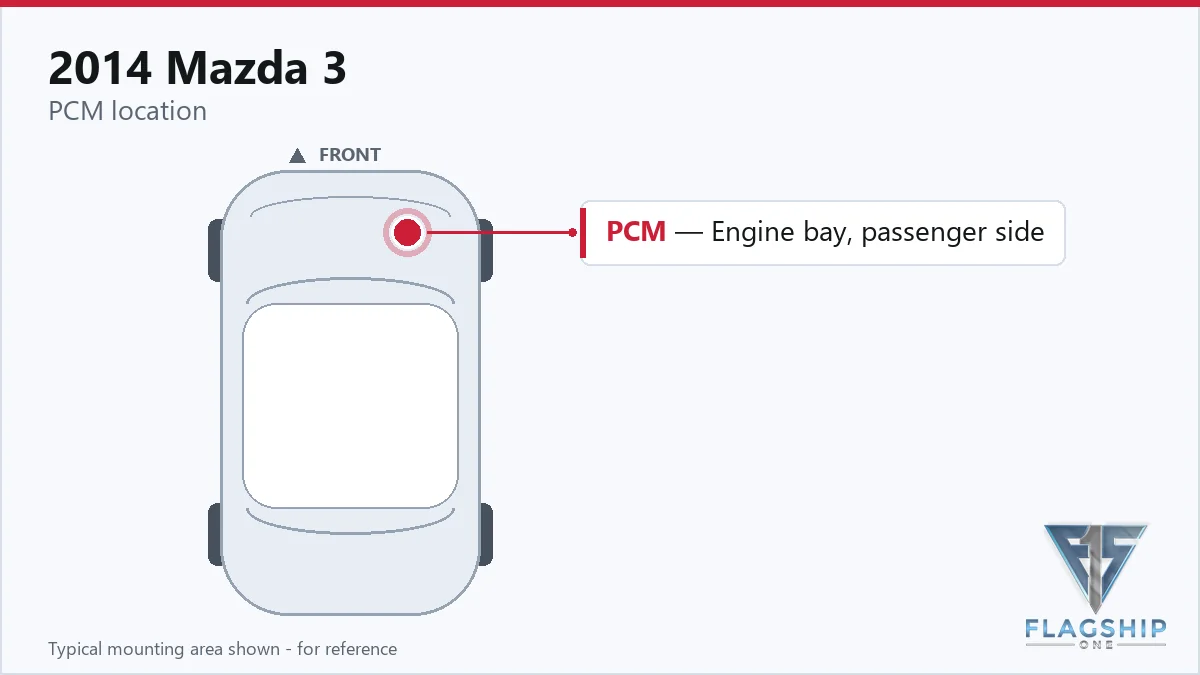
Work with the ignition off, and treat the module as static-sensitive: avoid touching the connector pins at any point.
| Operation | Configuration | Book Time |
|---|---|---|
| Powertrain Control Module R&R | All configurations | 0.9 hr |
| Engine Control Module Reset | All configurations | 0.3 hr |
| Engine Control Module R&R | All configurations | 0.9 hr |
| Engine Control Module Relearn | All configurations | 0.5 hr |
After replacing the PCM in your 2014 Mazda 3, the factory procedure requires a relearn process, which typically takes 0.5 hours. This step ensures the module synchronizes with the vehicle’s sensors and transmission. However, a VIN-programmed replacement unit from Flagship One arrives pre-configured, eliminating the need for additional programming. This saves time and reduces the risk of post-installation issues, allowing your vehicle to return to normal operation more quickly.
A failing PCM in your 2014 Mazda 3 may cause a variety of symptoms, including intermittent stalling, rough idling, or a no-start condition. You might also notice poor acceleration, transmission shifting problems, or the check engine light illuminating. Common trouble codes associated with PCM failure include internal control module memory checksum error, which indicates a potential internal fault. If your scan tool shows communication errors or multiple unrelated codes, the PCM may be the root cause.
When diagnosing a 2014 Mazda 3 for PCM-related issues, certain trouble codes may appear. These codes help pinpoint internal module faults and guide repairs.
| Code | Meaning | Full Guide |
|---|---|---|
| P0601 | Internal memory checksum error | Full P0601 guide → |
| P0606 | Module processor failure | Full P0606 guide → |
Mazda has issued service bulletins addressing specific drivability concerns in the 2014 Mazda 3. Bulletin 05-004/19 covers check engine and automatic transmission warning lights with codes such as P0842, P0847, P0872, P0877, P0780, or P1738 stored in the transmission control module. Another bulletin, 09-007/15, addresses the BSM OFF indicator flashing with code U3000:54. While these bulletins may not directly involve the PCM, they highlight related electrical or sensor issues that could affect overall vehicle performance.
| Bulletin | Subject | What It Addresses |
|---|---|---|
| — | Technical Service Bulletin > Transmission/Transaxle > On-Board Diagnostics > 05-004/19 – Check | — |
| — | Technical Service Bulletin > Body and Accessories > Instrumentation/Driver Info. > 09-007/15 – | — |
Common signs include a no-start condition, stalling, or multiple unrelated trouble codes. If your scan tool shows communication errors or codes like P0601, the PCM may be failing. A professional diagnosis can confirm whether replacement is necessary.
While physically replacing the PCM is straightforward, programming and relearn procedures require specialized tools. Without proper equipment, the vehicle may not start or run correctly. Professional installation ensures the module is correctly synchronized with your vehicle’s systems.
An incorrect PCM may cause engine control interference, leading to poor performance or a non-starting vehicle. Always verify the part number matches your vehicle’s specifications before installation to avoid compatibility issues.
If your 2014 Mazda 3 is experiencing PCM-related issues, you have options. A professional repair shop can diagnose and replace the module, though labor and programming costs can add up. Alternatively, a pre-programmed replacement unit ensures compatibility and reduces downtime. Understanding the process helps you choose the best solution for restoring reliable performance.
Flagship One stocks a refurbished, VIN-programmed PCM for the 2014 Mazda 3 with a lifetime warranty, free shipping and no core charge. The full Mazda 3 module lineup covers other engine configurations as well.
A failing PCM in your 2014 Mazda 3 can disrupt daily driving, but recognizing the symptoms early helps you address the issue before it worsens. Whether you opt for a professional repair or a pre-programmed replacement, ensuring the correct module is installed restores confidence in your vehicle’s performance. Keep your Mazda 3 running smoothly by staying proactive with maintenance and repairs.