
Last updated on August 25th, 2026 at 12:58 pm
The engine control module in your 2013 Audi A5 manages fuel delivery, ignition timing, and emissions systems. Internal failures may cause stalling, no-start conditions, or erratic engine behavior, often accompanied by stored trouble codes.
If your 2013 Audi A5 has been stalling, failing to start, or throwing cryptic engine codes, the issue may stem from the engine control module. This component acts as the brain of your vehicle’s powertrain, coordinating fuel, ignition, and emissions systems. When it malfunctions, drivability problems can range from subtle performance issues to complete engine shutdowns. Understanding its role, location, and replacement process can help you make informed decisions about repairs. Whether you’re diagnosing symptoms or considering a replacement, knowing what to expect from labor, programming, and troubleshooting will save time and frustration.
In your 2013 Audi A5, the engine control module (ECM) regulates critical functions like fuel injection, ignition timing, and throttle response. It ensures smooth operation by interpreting data from sensors and adjusting engine parameters in real time. A faulty module may disrupt these processes, leading to poor performance or even a no-start condition. If replacement becomes necessary, replacement engine computers for the Audi A5 are available to restore proper function. The module’s role is particularly important in turbocharged engines, where precise control over boost and fuel delivery is essential for reliability and efficiency.
The engine control module in your 2013 Audi A5 is located in the plenum chamber at the base of the windshield. Accessing it requires removing the windshield cowl panel and possibly other trim components to reach the module’s mounting position. Factory labor estimates allocate 1.0 hours for removal and reinstallation of the module. Once exposed, the unit can be unbolted and disconnected from its wiring harness. Reinstallation follows the reverse procedure, ensuring all connectors are securely fastened and the module is properly seated before reassembling the cowl panel.
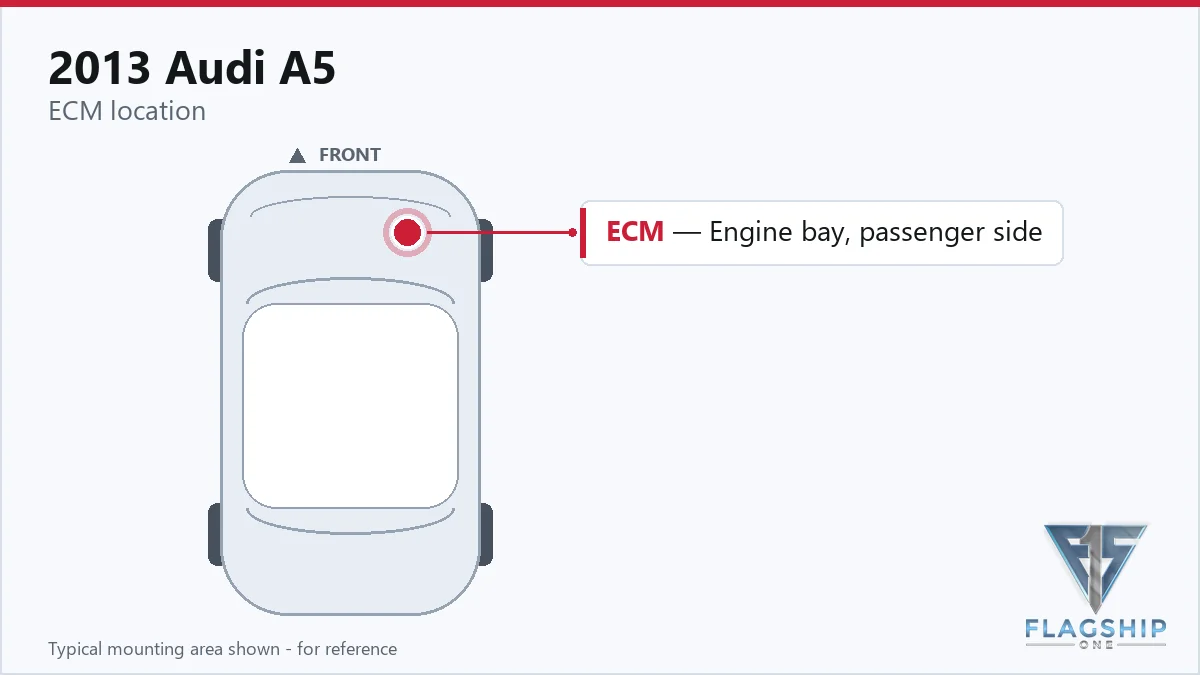
Work with the ignition off, and treat the module as static-sensitive: avoid touching the connector pins at any point.
| Operation | Configuration | Book Time |
|---|---|---|
| Engine Control Module Relearn | All configurations | 0.5 hr |
| Engine Control Module R&R | All configurations | 1.0 hr |
| Powertrain Control Module R&R | All configurations | 1.0 hr |
| Powertrain Control Module Relearn | All configurations | 0.5 hr |
2013 Audi A5
OEM programmed ECM for your 2013 Audi A5 — plug & play, no dealer visit.
Free shipping · Lifetime warranty
After replacing the engine control module in your 2013 Audi A5, the factory procedure typically requires a 0.5-hour relearn process to synchronize the new unit with the vehicle’s systems. This step ensures proper communication with sensors and other control modules. However, a VIN-programmed replacement unit from Flagship One arrives ready for installation, eliminating the need for additional programming. This saves time and reduces the risk of calibration errors during the repair process.
A failing engine control module in your 2013 Audi A5 may cause a range of symptoms, including intermittent stalling, rough idling, or a complete no-start condition. You might also notice poor throttle response, reduced fuel economy, or transmission shifting issues. On a scan tool, the vehicle may show communication errors or specific trouble codes like internal processor fault. These symptoms often appear gradually, making early diagnosis important to avoid unexpected breakdowns. If the module fails completely, the vehicle may not start at all, leaving you stranded until repairs are made.
The 2013 Audi A5 may store specific trouble codes when the engine control module experiences internal faults. These codes typically fall within the P0600 series and indicate issues with the module’s memory, processor, or communication circuits.
| Code | Meaning | Full Guide |
|---|---|---|
| P0603 | Keep-alive memory (KAM) error | Full P0603 guide → |
| P0604 | Internal RAM error | Full P0604 guide → |
| P0605 | Internal ROM error | Full P0605 guide → |
| P0606 | Module processor failure | Full P0606 guide → |
| P0608 | Module-internal fault | Full P0608 guide → |
| P060A | Module-internal fault | — |
| P060B | Module-internal fault | — |
| P0613 | Module-internal fault | Full P0613 guide → |
| P062F | Internal EEPROM error | Full P062F guide → |
| P0667 | Module-internal fault | Full P0667 guide → |
| U0100 | Module-internal fault | Full U0100 guide → |
P0600-series codes may appear if the battery was disconnected improperly or if voltage fluctuations occurred during replacement. The module may need a reset or relearn procedure to clear these codes. If the issue persists, the module itself could be faulty.
While the vehicle may still run with a P0606 code, it indicates an internal processor fault in the engine control module. Driving with this code may lead to erratic engine behavior or a no-start condition. It’s best to address the issue promptly to avoid further complications.
If the vehicle exhibits persistent symptoms like stalling, no-start conditions, or repeated P0600-series codes, the module itself may be faulty. A reset or relearn procedure can sometimes resolve temporary issues, but recurring problems typically require replacement.
If your 2013 Audi A5 is experiencing control module-related issues, you have options for repair. A dealership may recommend a new unit, which can be costly and time-consuming. Alternatively, a refurbished replacement from Flagship One arrives pre-programmed to your VIN, reducing installation time and ensuring compatibility with your vehicle’s systems.
Flagship One stocks a refurbished, VIN-programmed PCM for the 2013 Audi A5 with a lifetime warranty, free shipping and no core charge. The full Audi A5 module lineup covers other engine configurations as well.
The engine control module in your 2013 Audi A5 plays a critical role in maintaining smooth and reliable operation. If you’re facing persistent drivability issues or stored trouble codes, addressing the module promptly can restore performance and prevent further complications. Consider your repair options carefully to get your vehicle back on the road efficiently.