
Last updated on August 25th, 2026 at 12:59 pm
The powertrain control module (PCM) in your 2010 Audi A5 manages engine performance, fuel delivery, and transmission behavior. Failures may lead to erratic idling, reduced power, or complete engine shutdown, often triggered by electrical faults or internal corruption.
If your 2010 Audi A5 has been stalling unexpectedly, refusing to start, or throwing cryptic engine codes, the powertrain control module (PCM) may be the culprit. This critical component acts as the brain of your vehicle’s engine and transmission, coordinating fuel delivery, ignition timing, and shifting patterns. When it fails, the symptoms can range from subtle performance hiccups to complete drivability loss. Replacing the PCM isn’t just about swapping hardware—it involves precise programming to ensure seamless communication with other systems like the ABS and all-wheel drive modules. Understanding the process, from location to post-install steps, helps you make informed decisions about repairs. Whether you’re diagnosing an intermittent issue or preparing for a replacement, knowing what to expect can save time, frustration, and unnecessary costs. This guide covers the essentials of PCM and ECM replacement for your Audi A5, including labor times, programming requirements, and common failure signs.
The powertrain control module (PCM) in your 2010 Audi A5 serves as the central command unit for engine and transmission operations. It continuously monitors inputs from sensors—such as throttle position, oxygen levels, and crankshaft speed—to optimize fuel injection, ignition timing, and shift points. This ensures smooth acceleration, efficient fuel economy, and compliance with emissions standards. The PCM also communicates with other control modules, including the ABS system and the all-wheel drive (AWD) module, via the vehicle’s data bus. If the PCM malfunctions, it may disrupt these signals, leading to poor engine performance, erratic shifting, or even a no-start condition. In some cases, the module’s internal memory can become corrupted, triggering fault codes that illuminate the check engine light. Replacing the PCM isn’t just about installing new hardware; it requires precise calibration to match your vehicle’s specific configuration. For the 2010 Audi A5, replacement engine computers for the A5 are designed to restore factory-level functionality, but proper programming is essential to avoid further issues. Without this step, the new module may fail to communicate with the transmission, ABS, or AWD systems, leaving you with the same problems you started with.
2010 Audi A5
OEM programmed ECM for your 2010 Audi A5 — plug & play, no dealer visit.
Free shipping · Lifetime warranty
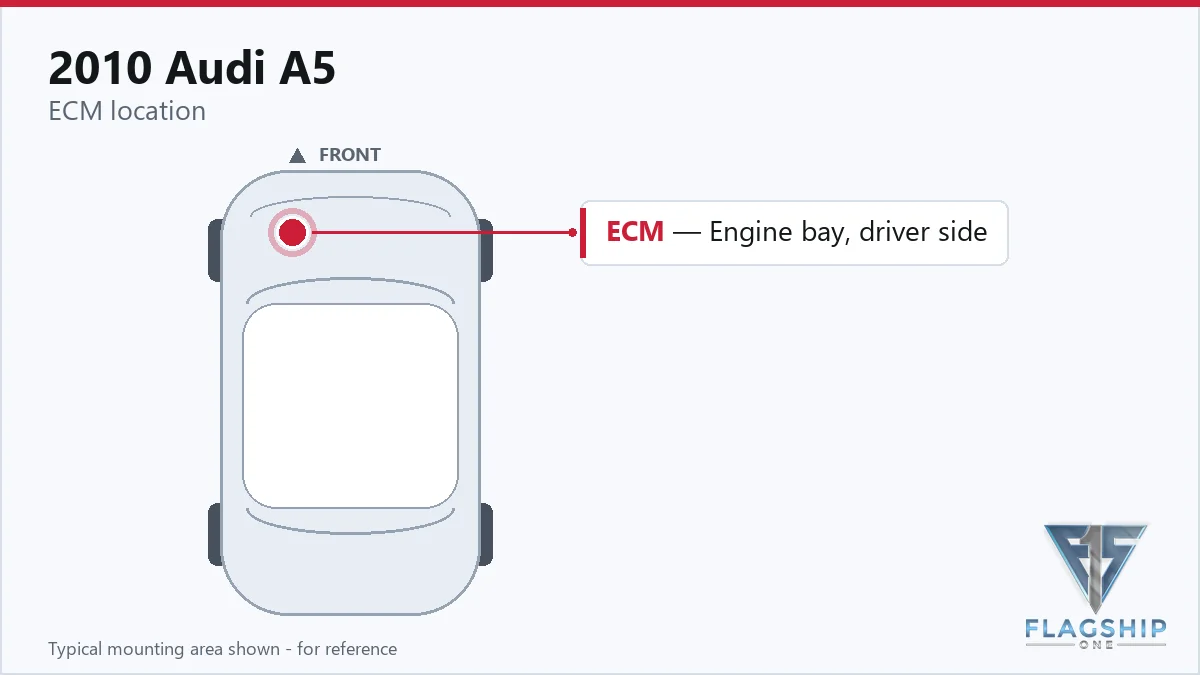
Work with the ignition off, and treat the module as static-sensitive: avoid touching the connector pins at any point.
| Operation | Configuration | Book Time |
|---|---|---|
| Powertrain Control Module R&R | A5 Quattro | 1.0 hr |
| Powertrain Control Module R&R | S5 | 1.0 hr |
| Powertrain Control Module R&R | A5 | 1.0 hr |
| Powertrain Control Module Relearn | A5 Quattro | 0.5 hr |
| Powertrain Control Module Relearn | S5 | 0.5 hr |
| Powertrain Control Module Relearn | A5 | 0.5 hr |
| Engine Control Module Relearn | A5 Quattro | 0.5 hr |
| Engine Control Module Relearn | S5 | 0.5 hr |
After replacing the powertrain control module (PCM) in your 2010 Audi A5, a factory relearn procedure is required to synchronize the new unit with the vehicle’s systems. This step, which typically takes 0.5 hours of labor, ensures the PCM communicates correctly with the engine, transmission, ABS, and AWD modules via the data bus. Without this calibration, the vehicle may experience shifting issues, reduced power, or even a no-start condition. The process involves using specialized diagnostic equipment to reset adaptive values and confirm proper signal transmission. However, if you opt for a VIN-programmed replacement unit, these programming steps are already completed before installation. This eliminates the need for additional labor time and reduces the risk of post-installation errors, allowing your Audi A5 to return to optimal performance more quickly. Always verify that the replacement module matches your vehicle’s exact configuration to avoid compatibility issues.
When the powertrain control module (PCM) in your 2010 Audi A5 begins to fail, the symptoms can vary from subtle to severe. One of the most common signs is an intermittent no-start condition, where the engine cranks but refuses to fire. This often occurs because the PCM fails to send the correct signals to the fuel injectors or ignition system. Stalling at idle or during acceleration is another frequent issue, as the module may lose its ability to regulate fuel delivery or spark timing. You might also notice rough idling, misfires, or a sudden drop in power, particularly under load. In some cases, the check engine light will illuminate, accompanied by trouble codes such as internal control module memory checksum error, which indicates corruption within the PCM’s memory. Other potential symptoms include erratic shifting, where the transmission hesitates or jerks between gears, or a complete loss of communication with the scan tool. If the PCM’s data bus connection to the ABS or AWD module is disrupted, you may also experience traction control or stability control warnings. These issues often worsen over time, so addressing them promptly can prevent further damage to other systems.
Common signs include stalling, rough idling, a no-start condition, or trouble codes related to engine performance. If the check engine light is on, a scan tool can reveal codes like P0601, which often point to PCM issues. Erratic shifting or loss of communication with the scan tool may also indicate a failing module.
While the physical replacement is straightforward, the PCM requires a relearn procedure to function correctly. This involves specialized diagnostic equipment to synchronize the module with the vehicle’s systems. Without this step, the vehicle may not start or may run poorly. Professional installation is recommended unless you have access to the necessary tools.
The relearn procedure ensures the new PCM communicates properly with the engine, transmission, ABS, and AWD modules. It resets adaptive values and confirms signal integrity via the data bus. Skipping this step may result in poor performance, shifting issues, or a no-start condition.
In the 2010 Audi A5, the powertrain control module (PCM) typically refers to the combined engine and transmission control unit, while the engine control module (ECM) focuses solely on engine management. Both may require a relearn procedure after replacement, but the PCM’s role is broader, encompassing transmission behavior as well.
Maintain a healthy charging system to prevent voltage spikes, and inspect electrical connectors for corrosion or damage. Avoid jump-starting with improper voltage, and address check engine lights promptly. Keeping the PCM and related modules dry and properly sealed also helps prevent moisture-related issues.
If your 2010 Audi A5 is experiencing PCM-related issues, you have two primary options: repair or replacement. While repairs may address minor faults, a faulty module often requires a full replacement to restore reliable performance. Opting for a pre-programmed unit eliminates the need for post-installation programming, saving time and reducing the risk of errors. Given the labor involved in replacement and relearn procedures, choosing a high-quality replacement module ensures your vehicle returns to optimal operation with minimal downtime.
Flagship One stocks a refurbished, VIN-programmed PCM for the 2010 Audi A5 with a lifetime warranty, free shipping and no core charge. The full Audi A5 module lineup covers other engine configurations as well.
The powertrain control module in your 2010 Audi A5 plays a critical role in engine and transmission performance. When it fails, symptoms like stalling, no-start conditions, or shifting issues can disrupt your driving experience. Understanding the replacement process, from labor times to programming requirements, helps you make informed decisions about repairs. Whether you’re diagnosing an intermittent fault or preparing for a module swap, addressing the issue promptly can prevent further complications. With the right approach, your Audi A5 can continue to deliver the performance and reliability you expect.