
Last updated on August 25th, 2026 at 12:38 pm
The engine control module in your 2012 Mercedes-Benz C-Class manages fuel injection, ignition timing, and emissions systems. Failure may cause erratic engine behavior, poor performance, or complete stalls, often triggered by electrical faults or internal corruption.
If your 2012 Mercedes-Benz C-Class has been stalling unexpectedly, refusing to start, or throwing cryptic engine codes, the culprit may be the engine control module. This compact but critical computer oversees everything from fuel delivery to ignition timing, and when it fails, your vehicle’s performance suffers. Replacing it isn’t just about swapping parts—it involves precise location access, proper installation, and post-replacement programming to restore full functionality. Understanding the role of this module, where it’s located, and what to expect during replacement can save you time and frustration. Whether you’re diagnosing symptoms or preparing for a repair, knowing these details helps you make informed decisions about your C-Class’s health and reliability.
The engine control module in your 2012 Mercedes-Benz C-Class, specifically the ME 9.7 unit, acts as the brain of the powertrain. It continuously monitors sensors for engine speed, air intake, throttle position, and exhaust composition, then adjusts fuel injection, ignition timing, and turbocharger boost to optimize performance and emissions. This module also communicates with the transmission control unit to ensure smooth gear shifts, making it a central hub for drivability. When it malfunctions, you may notice hesitation under acceleration, rough idling, or even a complete loss of power. Because it integrates so many systems, a failing module can trigger a cascade of issues, from poor fuel economy to replacement engine computers for the C-Class that require precise programming to match your vehicle’s specifications. Without proper function, your C-Class may struggle to meet emissions standards or deliver the responsive driving experience Mercedes-Benz engineered.
2012 Mercedes-Benz C-Class
OEM programmed ECM for your 2012 Mercedes-Benz C-Class — plug & play, no dealer visit.
Free shipping · Lifetime warranty
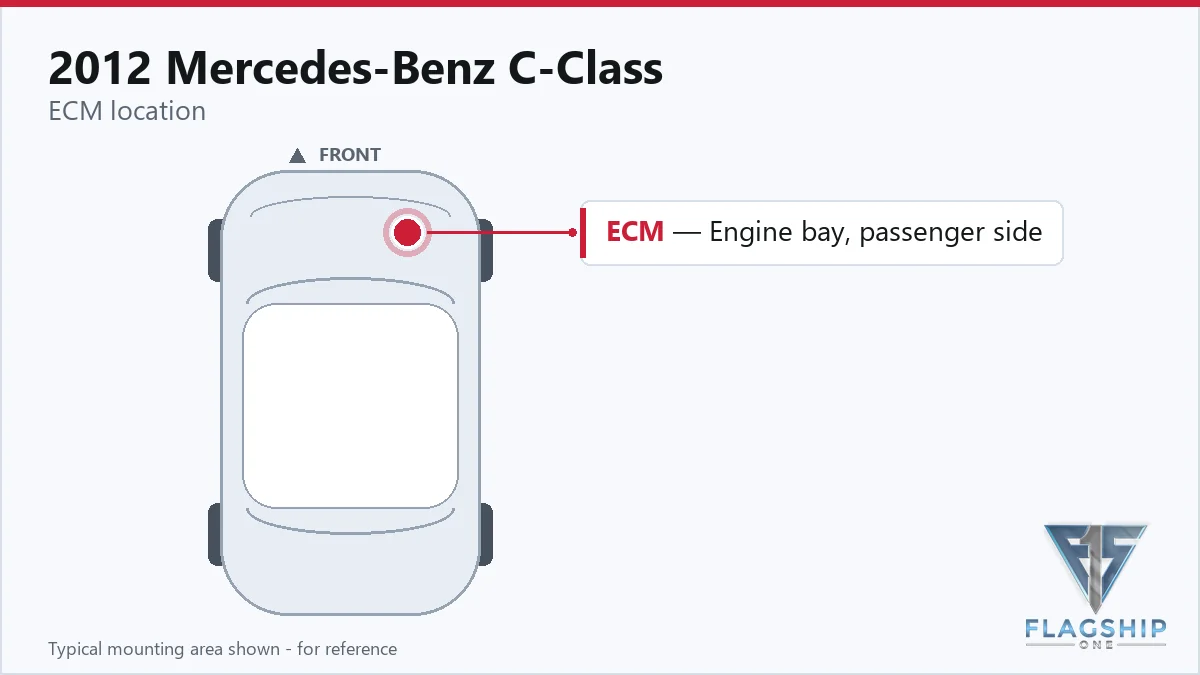
In your 2012 Mercedes-Benz C-Class, the ME-SFI control module is mounted on the intake manifold, directly supporting the engine. This location provides easy access to engine sensors and actuators but requires careful handling during replacement. To replace the module, you’ll need to disconnect the battery, remove the engine cover, and unplug the wiring harness connected to the unit. The module is secured with fasteners, which should be loosened and retightened to the manufacturer’s torque specifications. Labor time for removal and reinstallation is typically 0.7 hours, according to factory estimates. After installation, the module must undergo a relearn procedure, which adds another 0.5 hours of labor. This process ensures the module synchronizes with the engine’s sensors and adapts to your vehicle’s specific operating conditions.
Work with the ignition off, and treat the module as static-sensitive: avoid touching the connector pins at any point.
| Operation | Configuration | Book Time |
|---|---|---|
| Engine Control Module R&R | All configurations | 0.7 hr |
| Engine Control Module Relearn | All configurations | 0.5 hr |
| Powertrain Control Module R&R | All configurations | 0.7 hr |
After replacing the engine control module in your 2012 Mercedes-Benz C-Class, the factory procedure requires a relearn process to ensure the new unit communicates correctly with the engine and transmission systems. This step typically takes 0.5 hours and involves using a diagnostic tool to reset adaptations, calibrate sensors, and synchronize the module with the vehicle’s immobilizer. Without this procedure, your C-Class may experience poor performance, stalling, or even a no-start condition. However, a VIN-programmed replacement unit from Flagship One arrives pre-configured to your vehicle’s specifications, eliminating the need for this additional step. This not only saves time but also reduces the risk of programming errors, ensuring your C-Class operates as intended from the moment the new module is installed.
A failing engine control module in your 2012 Mercedes-Benz C-Class may produce a range of symptoms, often starting subtly before becoming more pronounced. You might first notice the engine hesitating during acceleration or idling roughly, as if it’s struggling to maintain a steady rhythm. Over time, these issues can escalate to stalling at stoplights, intermittent no-start conditions, or even sudden loss of power while driving. The check engine light may illuminate, and a scan tool could reveal codes related to fuel injection, ignition timing, or sensor performance. In some cases, the module may fail to communicate with the diagnostic tool entirely, leaving you with limited clues about the root cause. One common fault code associated with internal module failure is an internal control module memory check sum error, which indicates corruption within the module’s memory. Other symptoms may include erratic shifting patterns, poor fuel economy, or the vehicle entering a limp-home mode to prevent further damage. If you experience any of these issues, prompt diagnosis is key to avoiding more severe drivability problems.
Intermittent stalling in your C-Class may stem from a failing engine control module, especially if accompanied by rough idling or hesitation. The module manages fuel and ignition timing, and corruption in its memory or electrical faults can disrupt these processes. A diagnostic scan can confirm if the module is the root cause by checking for internal fault codes or communication errors.
Replacement is typically necessary if the module fails to communicate with a diagnostic tool, sets persistent internal fault codes like P0601, or causes repeated no-start conditions. If basic checks like battery voltage and wiring integrity don’t resolve the issue, the module itself may be irreparably damaged and require a new unit.
Skipping the relearn procedure can lead to poor engine performance, stalling, or even a no-start condition. The module needs to synchronize with the engine’s sensors and adapt to your vehicle’s specific operating conditions. Without this step, the module may not adjust fuel delivery or ignition timing correctly, resulting in drivability issues.
A weak or failing battery can contribute to module failure by causing voltage fluctuations or spikes during cranking. These irregularities may corrupt the module’s memory or damage its internal circuitry over time. Always ensure your battery and charging system are in good condition to protect sensitive electronics.
While your C-Class may still run with fault codes present, driving with a failing module can lead to unpredictable behavior, such as sudden stalling or loss of power. It’s best to diagnose and address the issue promptly to avoid potential safety risks or further damage to the vehicle’s systems.
If your 2012 Mercedes-Benz C-Class is experiencing symptoms of a failing engine control module, you have options for repair or replacement. While some shops may attempt to reflash or repair the existing unit, a VIN-programmed replacement module ensures compatibility and reliability without the need for additional programming. This approach minimizes downtime and reduces the risk of recurring issues, making it a practical choice for restoring your C-Class’s performance and drivability.
Flagship One stocks a refurbished, VIN-programmed PCM for the 2012 Mercedes-Benz C-Class with a lifetime warranty, free shipping and no core charge. The full Mercedes-Benz C-Class module lineup covers other engine configurations as well.
The engine control module in your 2012 Mercedes-Benz C-Class plays a critical role in managing engine performance, fuel efficiency, and emissions. If you’re facing symptoms like stalling, no-start conditions, or persistent fault codes, addressing the module promptly can prevent further complications. Whether you opt for a repair or a replacement, understanding the process and requirements ensures a smoother experience. With the right approach, your C-Class can continue to deliver the responsive and reliable driving experience it was designed for.