
Last updated on August 25th, 2026 at 12:46 pm
The Powertrain Control Module (PCM) in your 2010 Dodge Charger 2.7L manages engine and transmission functions. Failures may lead to poor drivability, warning lights, or no-start conditions due to internal faults or corrupted data.
If your 2010 Dodge Charger 2.7L is experiencing unexplained drivability issues—like rough idle, hesitation, or warning lights—it may be time to examine the Powertrain Control Module (PCM). This critical component oversees engine and transmission performance, and when it fails, symptoms can range from subtle to severe. Understanding the PCM’s role, location, and replacement process helps you make informed decisions. You’ll learn what to expect during repairs, how to recognize failure signs, and why addressing these issues promptly can prevent further complications.
The Powertrain Control Module (PCM) in your 2010 Dodge Charger 2.7L acts as the brain for engine and transmission functions. It processes data from sensors to optimize fuel delivery, ignition timing, and shift points, ensuring smooth operation. A faulty PCM may disrupt these processes, leading to poor performance or even a no-start condition. When replacement becomes necessary, replacement engine computers for the Dodge Charger are designed to restore factory-level functionality, though proper installation and programming are critical to avoid recurring issues.
2010 Dodge Charger 2.7L
OEM programmed ECM for your 2010 Dodge Charger 2.7L — plug & play, no dealer visit.
Free shipping · Lifetime warranty
The PCM in the 2010 Dodge Charger 2.7L is located in the engine compartment, making access straightforward for replacement. Labor estimates for removal and reinstallation typically run 1.0 hours, as the module is secured with fasteners and connected via a wiring harness. Once the old unit is removed, the new PCM must be installed in the same position, ensuring all connectors are properly seated. No additional disassembly is required beyond accessing the module itself, though care should be taken to avoid damaging the electrical connections during the process.
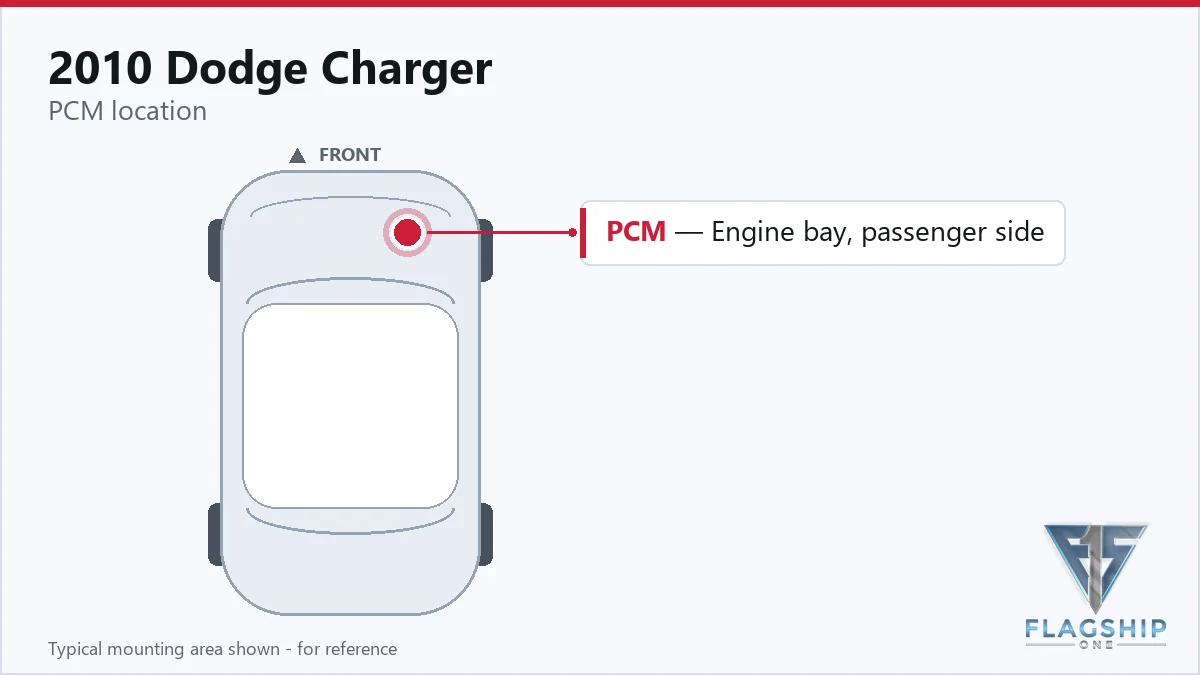
Work with the ignition off, and treat the module as static-sensitive: avoid touching the connector pins at any point.
| Operation | Configuration | Book Time |
|---|---|---|
| Powertrain Control Module R&R | All configurations | 1.0 hr |
| Engine Control Module Relearn | All configurations | 0.5 hr |
| Engine Control Module R&R | All configurations | 1.0 hr |
After replacing the PCM in your 2010 Dodge Charger 2.7L, a factory relearn procedure is often required to synchronize the module with the vehicle’s systems. This step, which typically takes 0.5 hours, ensures proper communication between the PCM and other components. However, a VIN-programmed replacement unit from Flagship One arrives pre-configured, eliminating the need for this additional step and allowing for immediate installation and operation.
A failing PCM in the 2010 Dodge Charger 2.7L may cause a range of symptoms, including rough idle, stalling, or poor acceleration. You might also notice the Malfunction Indicator Light (MIL) illuminating, often accompanied by trouble codes like internal control module memory check sum error. In some cases, the vehicle may enter a performance derate mode, limiting speed or power until the issue is addressed. Scan tool communication failures can also occur, making diagnosis more challenging without proper equipment.
The 2010 Dodge Charger 2.7L PCM may log specific internal trouble codes when faults develop. These codes help pinpoint issues within the module itself, rather than external sensor or wiring problems.
| Code | Meaning | Full Guide |
|---|---|---|
| P0601 | Internal memory checksum error | Full P0601 guide → |
| P0606 | Module processor failure | Full P0606 guide → |
Factory service bulletins for the 2010 Dodge Charger 2.7L address several PCM-related concerns. Bulletin #18-021-13 covers a performance derate issue occurring above 55 mph immediately after start-up during wide-open throttle acceleration. Another bulletin, #18-023-10, targets rough idle on start-up when ambient temperatures drop below 50°F (10°C). Additionally, #18-032-11 focuses on MIL illumination for code P2181, indicating cooling system performance problems that may require PCM updates or inspections.
| Bulletin | Subject | What It Addresses |
|---|---|---|
| 18-021-13 | 18-021-13 Flash: Performance Derate Above 55 MPH Immediately After Start-Up When Accelerating A | — |
| 18-023-10 | 18-023-10 Flash: Rough Idle On Start Up With Ambient Temperatures Below 50° (10° C) | — |
| 18-032-11 | 18-032-11 Flash: MIL Illumination for P2181 – Cooling System Performance | — |
This behavior may stem from a PCM-related issue, particularly if ambient temperatures are below 50°F. Factory bulletins address rough idle and performance derate under these conditions, often requiring a software update or module inspection to resolve.
While the PCM is accessible in the engine compartment, replacement involves more than just swapping the unit. A relearn procedure is typically required, and improper installation may lead to drivability issues or warning lights.
In this vehicle, the terms are often used interchangeably, as the Powertrain Control Module (PCM) combines engine and transmission control functions. The PCM oversees both systems, whereas some vehicles separate these into distinct modules.
When the PCM in your 2010 Dodge Charger 2.7L fails, you have options beyond costly dealer replacements. Refurbished or remanufactured units can restore functionality at a lower cost, provided they are properly programmed and tested. Given the labor involved in replacement and relearn procedures, choosing a pre-configured module may save time and reduce the risk of post-installation issues.

Flagship One stocks a refurbished, VIN-programmed PCM for the 2010 Dodge Charger with a lifetime warranty, free shipping and no core charge. The full Dodge Charger module lineup covers other engine configurations as well.
The 2010 Dodge Charger 2.7L relies on its PCM for smooth operation, and recognizing failure signs early can prevent more serious problems. Whether you opt for a repair or replacement, understanding the module’s role and installation process helps you make the best choice for your vehicle. Addressing PCM issues promptly ensures your Charger continues to perform as expected.