
Last updated on August 25th, 2026 at 12:10 pm
The engine control module manages fuel delivery and ignition timing in your 2006 Mitsubishi Lancer Evolution. Internal faults may cause stalling or no-start conditions. Understanding module function helps diagnose communication losses or performance issues affecting drivability and engine protection systems.
When your 2006 Mitsubishi Lancer Evolution exhibits erratic engine behavior, the powertrain control module often becomes a primary suspect. Diagnosing computer failures requires understanding both the symptoms and the specific service procedures involved in replacement. You need accurate information regarding labor times and access points to plan your repair effectively. This guide outlines the essential steps for addressing control module concerns without unnecessary complication. We focus on factual labor data and factory cautions to ensure you approach the job with confidence. Proper handling of immobilizer components is critical during this process. You will learn about the location behind the glove box and the necessary removal steps. Understanding these requirements helps prevent delays during installation. Our goal is to provide clear technical context for your repair decision. Reading this ensures you know what to expect regarding labor and programming needs before starting work on your vehicle. Many owners hesitate when facing electronic component replacement due to perceived complexity. However, having the correct labor estimates simplifies the planning phase significantly. You can anticipate the scope of work involved in reaching the unit. This knowledge empowers you to discuss options with your service provider accurately. We emphasize neutral facts to help you weigh refurbished versus new options. Your vehicle deserves precise attention to detail during any electronic service intervention. Following factory guidelines ensures system integrity remains intact throughout the repair process.
2006 Mitsubishi Lancer Evolution
OEM programmed replacements — plug & play, no dealer visit.
Find yours by year, make & model →
Free shipping · Lifetime warranty
This computer serves as the central brain for engine management tasks within your 2006 Mitsubishi Lancer Evolution. It processes sensor data to regulate fuel mixtures and ignition timing for optimal performance. Failure here may lead to significant drivability concerns or complete engine shutdown. You rely on this unit for consistent power delivery and emission control compliance. When searching for replacement engine computers for your specific model, compatibility remains the top priority. The module communicates with various subsystems to maintain smooth operation under different driving conditions. Internal circuits handle complex calculations that mechanical components cannot manage alone. Protecting this hardware from voltage spikes or moisture intrusion extends its service life. You should understand that replacing this component involves more than just physical installation. Software configuration plays a vital role in restoring full functionality to your vehicle. Ignoring these digital requirements often results in persistent issues despite hardware changes. Proper integration ensures all sensors report accurately to the central processing unit. Modern engines depend on this electronic control for nearly every operational aspect. Without it, the fuel injectors and spark plugs lack necessary timing signals. You might experience rough idling or hesitation if the module begins failing gradually. Early detection of communication errors can prevent stranded situations on the road. Maintaining electrical connections ensures reliable data transmission between the computer and sensors. Your investment in a quality replacement protects the long-term health of the engine.
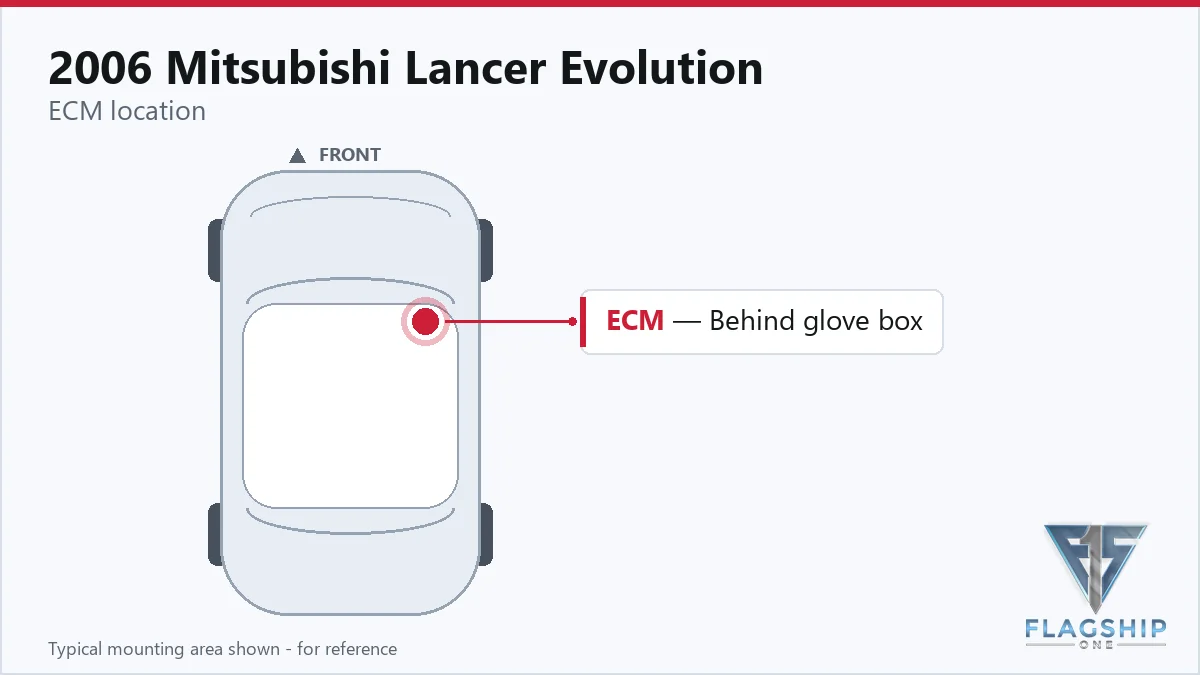
Factory service information places the control module behind the glove box in your 2006 Mitsubishi Lancer Evolution. Reaching this component requires removing the glove box assembly and harness cover first. These steps provide the necessary access path for safe extraction and installation. Book times indicate physical removal and replacement takes 0.4 hours for this task. You should anticipate additional time for careful handling of interior trim pieces. The factory caution notes specific procedures when replacing immobilizer system related parts. Pre-removal and post-installation operation steps must be followed to avoid security lockouts. Refer to Group 52A interior section for detailed removal instructions regarding the glove box. Technicians often need to disconnect the battery before starting this specific repair. Secure mounting ensures the unit remains protected from vibration and road debris. You must verify all connectors seat properly before reassembling the interior components. Rushing this process may lead to poor electrical contacts or damaged pins. Following the documented access path prevents unnecessary force on surrounding plastic parts. After physical installation, verify all fasteners are tightened to prevent rattles. Your attention to detail here ensures the module stays secure during driving.
| Operation | Configuration | Book Time |
|---|---|---|
| Powertrain Control Module Relearn | All configurations | 0.5 hr |
| Engine Control Module R&R | All configurations | 0.4 hr |
Factory procedures require specific operations after module replacement to ensure system compatibility. Your vehicle needs these steps to recognize the new hardware correctly. Flagship One units arrive as a VIN-programmed replacement unit so those steps are already done. This eliminates the need for additional programming equipment at the shop. You save time by avoiding complex software initialization sequences manually. The immobilizer system integrates directly with the engine computer for security. Skipping required configuration often results in a no-start condition despite proper installation. Pre-removal and post-installation operation guidelines protect against data loss. Your technician should verify communication before finalizing the repair job. Proper programming ensures all keys function correctly with the new module. This approach streamlines the replacement process significantly for your 2006 Mitsubishi Lancer Evolution. You benefit from reduced labor exposure regarding software configuration tasks. Trusting a pre-configured unit reduces the risk of human error during setup.
Common failure symptoms of this module type include sudden engine stalling or no-start conditions. You may notice the check engine light illuminating without obvious mechanical causes. Dead scan-tool communication often points directly to internal computer failure. Misfire codes can appear even when ignition components test within specification. Shifting issues may arise if the transmission relies on engine data from this unit. Your 2006 Mitsubishi Lancer Evolution might hesitate during acceleration if signals are corrupted. Intermittent power loss suggests the processor is struggling to manage fuel delivery. Electrical gremlins often accompany failing control modules in high-performance applications. You should rule out wiring problems before condemning the computer entirely. Persistent faults despite component replacement indicate a deeper electronic control issue. Monitoring live data helps identify communication drops between sensors and the module. Addressing these symptoms early prevents further damage to connected systems. Your vehicle may enter limp mode to protect the engine from harm.
Driving with a failing module risks sudden stalling or engine damage. You should address performance issues immediately to ensure safety on the road. Continued operation may lead to complete loss of propulsion without warning.
Flagship One units arrive ready to install without additional coding. Your technician can skip complex software steps since the unit is pre-configured. This reduces labor time and potential configuration errors during service.
Book times indicate physical removal and replacement takes 0.4 hours. You should plan for additional time regarding relearn procedures which require 0.5 hours. Total shop time varies based on technician experience and access conditions.
The factory removal procedure reaches the control module behind the glove box. You must remove the glove box assembly and harness cover for access. This location protects the unit but requires interior disassembly for service.
Skipping required operations may cause security lockouts preventing engine start. Your vehicle needs proper configuration to recognize the new hardware fully. Following factory cautions ensures the immobilizer system functions correctly after service.
Choosing between repair and refurbished replacement depends on your specific situation and budget. Refurbished units offer a balance of reliability and cost effectiveness for your 2006 Mitsubishi Lancer Evolution. You avoid the high expense of brand new dealer parts while gaining warranty coverage. Consider the labor involved when deciding whether to rebuild your original unit. A direct replacement often simplifies the process for your service provider significantly. Evaluate your options based on downtime and long-term reliability expectations.
Flagship One stocks a refurbished, VIN-programmed PCM for the 2006 Mitsubishi Lancer Evolution with a lifetime warranty, free shipping and no core charge. The full Mitsubishi Lancer Evolution module lineup covers other engine configurations as well.
Replacing the engine computer in your 2006 Mitsubishi Lancer Evolution requires attention to factory procedures and labor times. You now understand the access points and programming requirements involved in this repair. Proper handling ensures your vehicle returns to optimal performance without security issues. Trust factual data to guide your decision on replacement options. Your engine deserves reliable electronic control for safe and consistent driving experiences.