
Last updated on August 25th, 2026 at 12:08 pm
The powertrain control module manages engine functions in your 2004 Pontiac Vibe. Internal failures often trigger warning lights or prevent starting. Replacing this unit requires specific handling to avoid static damage and ensures proper vehicle operation returns.
When your 2004 Pontiac Vibe exhibits strange electrical behavior or refuses to start, the engine management system often deserves scrutiny. Many owners encounter situations where diagnostic tools cannot communicate with the vehicle or persistent warning lights remain despite basic repairs. Understanding the role of the central computer helps you make informed decisions about necessary repairs. This guide explains where the module lives, how technicians access it, and what programming steps follow installation. You will learn about factory bulletins affecting this model and specific trouble codes linked to internal processor failures. Reading this information prepares you for conversations with repair shops regarding labor expectations and parts requirements. Proper handling prevents static damage during replacement procedures. Knowing the specific labor times helps you verify repair estimates accurately. We focus on factual data regarding the 2004 Pontiac Vibe to ensure you have realistic expectations for resolving these complex electronic issues without unnecessary guesswork during the diagnostic process.
The powertrain control module serves as the primary brain for your 2004 Pontiac Vibe engine management system. It processes data from various sensors to adjust fuel delivery and ignition timing constantly. Without this component functioning correctly, the vehicle cannot operate efficiently or sometimes at all. Internal circuits manage critical operations like transmission shifting and emissions control monitoring. When these circuits degrade, performance suffers noticeably. You might seek replacement engine computers for the Vibe to restore proper function when repairs fail. The unit coordinates spark plug firing sequences based on real-time driving conditions. It also stores diagnostic trouble codes when parameters fall outside expected ranges. Factory designs integrate this hardware deeply into the wiring harness. Replacing it involves more than simple swapping due to security features. The computer ensures all systems work together harmoniously under varying loads. Failure often manifests as drivability concerns rather than complete silence. Technicians treat this component as a sealed unit without internal serviceable parts. Understanding its scope helps you recognize why specific programming steps remain mandatory after physical installation occurs within the engine bay or cabin area.
Accessing the module requires removing interior trim pieces rather than working under the hood. The unit sits beneath the storage area within the instrument panel. Technicians must reach this area to disconnect electrical connectors safely. Book guides assign 0.8 hours for removing and installing the powertrain control module. Another entry lists 0.8 hours for engine control module removal and replacement specifically. A separate task for engine control module relearn takes 0.5 hours. Data exchange happens via the connector positioned on the left side under the panel. Static electricity poses a significant risk during this procedure. Ensure the key remains out while swapping electrical plugs. Disconnecting power sources like the battery cable prevents voltage spikes. The factory specifies complete replacement since no serviceable parts exist inside the casing. Touching internal circuitry or metal contacts invites static electricity harm. Following these steps ensures the new unit survives the installation process without immediate failure due to human error during the swap.
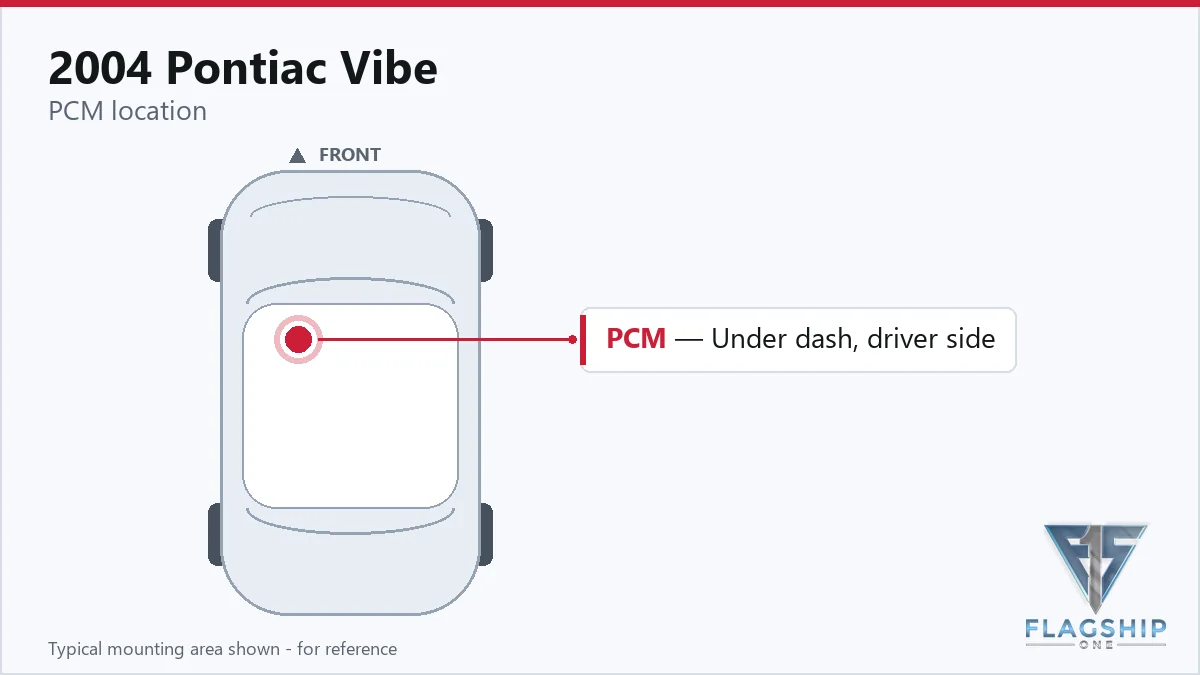
Work with the ignition off, and treat the module as static-sensitive: avoid touching the connector pins at any point.
| Operation | Configuration | Book Time |
|---|---|---|
| Powertrain Control Module R&R | All configurations | 0.8 hr |
| Engine Control Module R&R | All configurations | 0.8 hr |
| Engine Control Module Relearn | All configurations | 0.5 hr |
2004 Pontiac Vibe
OEM programmed replacements — plug & play, no dealer visit.
Find yours by year, make & model →
Free shipping · Lifetime warranty
Factory procedures dictate specific steps after installing a new control module. Replacement control modules arrive preprogrammed from the manufacturing facility. They only require the vehicle identification number to be programmed into the system. Avoid flashing software unless specific repair steps mandate it. General Motors Service Bulletins often provide specific instructions for these cases. Flagship One units arrive ready with a VIN-programmed replacement unit so those steps are already done. This eliminates the need for specialized scanning tools during the final setup. The factory caution notes that programming applications require downloading for reprogramming powertrain control modules. Some bulletins address malfunction indicator lamp issues requiring reprogramming. Using a preconfigured part simplifies the repair workflow significantly. Technicians avoid potential errors associated with manual flashing processes. Your vehicle returns to service faster when the software matches the hardware initially. This approach reduces the likelihood of configuration mistakes during the final stages of the repair job at the shop.
Common failure symptoms include no-start conditions or sudden stalling while driving. You might experience misfire codes that persist despite changing spark plugs. Dead scan-tool communication prevents technicians from reading stored data effectively. Shifting issues often arise when the computer cannot manage transmission signals. Internal processor errors trigger specific diagnostic trouble codes regularly. A code like internal memory check fault P0601 indicates control module internal performance problems. Drivers often notice the warning light glowing on the dashboard unexpectedly. Engine performance may feel sluggish or unresponsive to throttle inputs. Fuel economy typically drops when the system enters limp mode. Some owners report intermittent electrical glitches across multiple systems. These signs suggest the central processor is struggling to maintain stable operation. Ignoring these warnings often leads to complete failure eventually. Testing equipment can show code P0133 present in current or historical memory. Addressing these symptoms early prevents further damage to connected sensors. Your 2004 Pontiac Vibe relies on stable voltage for consistent computer function.
Several module-internal trouble codes are documented for this vehicle model. These codes indicate specific failures within the computer hardware itself. Reading them confirms whether replacement is necessary instead of sensor swaps. The list includes various memory and processor fault identifiers.
Factory service bulletins address specific programming and warning light concerns. Document #09-06-04-006 and #09-06-04-006A address software setup for the module dated May 29, 2009. File #09-06-04-008 and #09-06-04-008B relates to warning lights and code P0133 from May 24, 2010. Owners report the warning light appears on the dashboard unexpectedly. Testing equipment can show code P0133 present in current or historical memory. These documents guide technicians on proper software updates. Following these instructions ensures compatibility with existing engine hardware.
| Bulletin | Subject | What It Addresses |
|---|---|---|
| 09-06-04-006 | Downloading and Installation of Vibe Programming Application for Reprogramming Powertrain Contr | — |
| 09-06-04-008 | Malfunction Indicator Lamp (MIL) Illuminated, DTC P0133 Set (Reprogam Powertrain Control Module | Some customers may comment that the malfunction indicator lamp (MIL) is illuminated. A scan tool may reveal DTC P0133 set as Current or in |
Driving is not recommended as stalling may occur. Safety risks increase if the engine cuts power unexpectedly. You should arrange towing to a repair facility immediately.
Factory units typically require VIN programming after installation. Some suppliers provide preprogrammed options to simplify this step. Always verify status before installation begins.
It is located below the instrument panel storage compartment. Access requires removing interior trim pieces carefully. Technicians work from the cabin rather than the engine bay.
Book guides assign 0.8 hours for removing and installing the powertrain control module. Additional time may be needed for programming procedures. Verify estimates with your shop.
Yes, bulletins cover programming applications and MIL illumination issues. Specific codes like P0133 are addressed in factory documentation. Technicians should check for updates.
Repairing the original unit is rarely feasible due to sealed construction. Refurbished replacement options offer a practical path forward for most owners. You gain reliability without the cost of brand new dealership parts. Consider the labor times when budgeting for this repair job.
Flagship One stocks a refurbished, VIN-programmed PCM for the 2004 Pontiac Vibe with a lifetime warranty, free shipping and no core charge. The full Pontiac Vibe module lineup covers other engine configurations as well.
Your 2004 Pontiac Vibe depends on a functional computer for daily operation. Understanding the replacement process helps you manage repair expectations effectively. Contact specialists who understand these specific vehicle requirements for assistance. Proper installation ensures long-term reliability for your engine management system. Take time to review all factory cautions before beginning work. This approach protects your investment and maintains vehicle performance standards over time.