
Last updated on August 25th, 2026 at 12:04 pm
The engine control computer in your 2003 Toyota Tacoma PreRunner manages fuel delivery, ignition timing, and emissions functions for the 3.4L V6. When internal circuitry degrades, the module may cause hard starting, erratic idle, or complete no-start conditions. A failed unit often prevents scan-tool communication, leaving you unable to read or clear diagnostic trouble codes.
When your 2003 Toyota Tacoma PreRunner begins to exhibit drivability problems that defy conventional troubleshooting, the engine control computer becomes a prime suspect. This module, sometimes referred to as the Powertrain Control Module or Engine Control Module depending on the diagnostic tool’s terminology, serves as the central processor governing your 3.4L V6 fuel injection, ignition timing, idle speed regulation, and emissions monitoring. A failing computer can produce symptoms that mimic bad sensors, vacuum leaks, or fuel pump issues, which makes accurate diagnosis essential before spending money on parts that may not resolve the problem. Understanding how this module operates, where it is physically located in your truck, and what the factory service procedure requires after replacement will help you make an informed repair decision. Whether you are tackling the job yourself or bringing the vehicle to a technician, knowing the book time, relearn requirements, and programming steps allows you to evaluate quotes and avoid unnecessary labor charges. This guide walks through the module role, common failure indicators, replacement logistics, and the advantages of choosing a pre-programmed unit over a blank one.
2003 Toyota Tacoma PreRunner
OEM programmed ECM for your 2003 Toyota Tacoma PreRunner — plug & play, no dealer visit.
Free shipping · Lifetime warranty
The engine control module in the 2003 Toyota Tacoma PreRunner functions as the electronic brain of your 3.4L V6 powertrain. It continuously processes input signals from dozens of sensors throughout the engine and drivetrain, including the mass airflow sensor, throttle position sensor, oxygen sensors, coolant temperature sender, crankshaft position sensor, and camshaft position sensor. Using this data, the computer calculates precise fuel injector pulse widths, ignition advance angles, and idle air control valve positioning to maintain optimal combustion efficiency across all operating conditions. The module also monitors evaporative emissions components, EGR operation, and catalytic converter efficiency to ensure compliance with OBD II standards. When you select replacement Tacoma engine computers for your truck, it is important to understand that these units are calibrated specifically for the 3.4L V6 and its corresponding transmission configuration. The computer relies on software maps stored in read-only memory, and over time, prolonged heat exposure inside the cabin, voltage transients from a failing alternator or weak battery, and moisture intrusion through degraded connector seals can corrupt that data or damage the internal processor. Symptoms of internal failure often develop gradually. You may notice intermittent rough idle, unexplained stalling at traffic lights, or a persistent check engine lamp that returns even after sensor replacement. In more advanced cases, the module may stop communicating with diagnostic scanners entirely, which effectively blocks all code reading and clearing operations. Because the computer controls both fuel and spark, a total failure typically results in a crank-no-start condition or, in rare instances, a vehicle that will not even crank through its immobilizer integration.
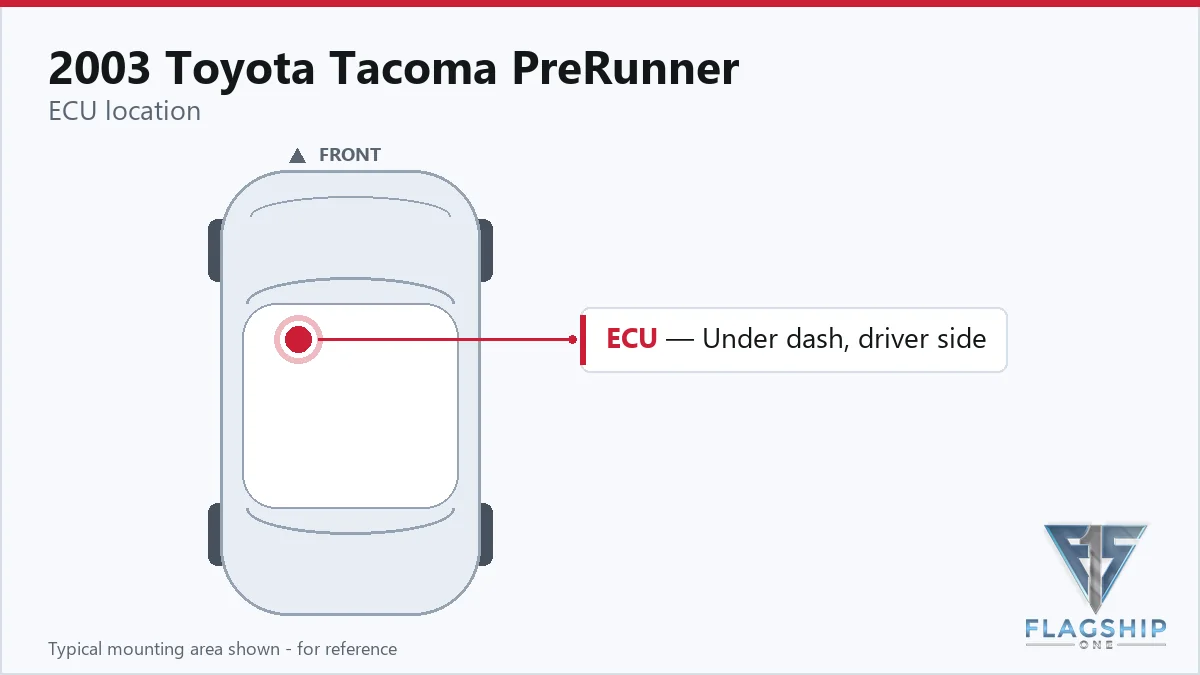
The factory wiring guide component grid places the engine control unit inside the instrument panel area of your 2003 Toyota Tacoma PreRunner. Accessing the module typically involves removing trim panels on the driver side of the dashboard to expose the mounting bracket and electrical connectors. The published labor guide lists 0.7 hours for removal and reinstallation of the Powertrain Control Module, and an equal 0.7 hours for the Engine Control Module, reflecting the same physical procedure regardless of the terminology your diagnostic equipment uses. Once the new unit is physically installed, the factory service procedure calls for a relearn process. The guide allocates 0.5 hours for a Powertrain Control Module relearn and 0.5 hours for an Engine Control Module relearn. These relearn steps allow the replacement computer to synchronize with your vehicle immobilizer, idle control strategy, and learned fuel trim values. Because the module sits inside the cabin rather than the engine bay, it is somewhat sheltered from underhood heat and moisture, though cabin humidity and condensation can still reach the connectors over time.
| Operation | Configuration | Book Time |
|---|---|---|
| Powertrain Control Module R&R | All configurations | 0.7 hr |
| Powertrain Control Module Relearn | All configurations | 0.5 hr |
| Engine Control Module Relearn | All configurations | 0.5 hr |
| Engine Control Module R&R | All configurations | 0.7 hr |
After the physical swap is complete, the factory procedure requires a relearn sequence so the replacement computer can adapt to your specific 2003 Toyota Tacoma PreRunner. The published labor guide allocates 0.5 hours for this relearn process, which covers idle adaptation, fuel trim baseline learning, and in some cases immobilizer key recognition. Without completing this step, the engine may idle erratically, fail to start, or trigger diagnostic trouble codes related to learned data mismatch. A technician typically uses a compatible scan tool to initiate the relearn and monitor sensor data until the computer stabilizes. When you choose a VIN-programmed replacement unit from Flagship One, the critical programming data tied to your truck vehicle identification number is already loaded onto the module before it ships. This means the immobilizer synchronization and baseline calibration work that the factory relearn addresses are already completed, so your installer can focus on the physical removal and reinstallation without worrying about whether a blank module will communicate with your truck security system.
Several drivability complaints on the 2003 Toyota Tacoma PreRunner can trace back to a deteriorating engine control computer. One of the most common early indicators is a persistent check engine lamp that illuminates even after you have replaced the sensors or components that the codes point to. For example, if you replace an oxygen sensor and the corresponding code returns within a few drive cycles, the computer itself may be misinterpreting the sensor signal or failing to process it correctly. Rough idle that comes and goes without any apparent vacuum leak or ignition fault is another frequent symptom. The 3.4L V6 may also develop a stalling habit, particularly when decelerating to a stop or when the engine is cold, because the module struggles to maintain proper idle air control positioning. Misfire codes that appear across multiple cylinders simultaneously, especially when the ignition coils and spark plugs are known to be good, can indicate that the computer is no longer firing the injectors or coils with correct timing. In more severe cases, the module may refuse to communicate with any diagnostic scanner, which means your technician cannot pull codes, view live data, or perform bidirectional tests. A total internal failure usually results in a crank-no-start condition, as the computer no longer sends fuel injector or ignition coil commands. Some owners also report intermittent shifting irregularities if the module oversees transmission solenoid control, though this depends on the specific configuration of your truck.
The factory wiring guide component grid places the engine ECU inside the instrument panel area. Access typically requires removing trim panels on the driver side of the dashboard to reach the mounting bracket and electrical connectors.
The published labor guide lists 0.7 hours for removal and reinstallation of the module. A separate relearn process is estimated at 0.5 hours. Your technician may spend additional time on diagnosis before the swap.
Yes, the factory procedure calls for a relearn after installation to synchronize the module with your truck immobilizer and learned fuel trim values. Flagship One ships units that are already VIN-programmed, which covers the critical calibration data before installation.
Common indicators include a persistent check engine lamp that returns after sensor replacement, intermittent rough idle, stalling when decelerating, misfire codes across multiple cylinders, and loss of scan-tool communication. A total failure often produces a crank-no-start condition.
It depends on the nature of the failure. If the module is still communicating and the engine runs, you may be able to drive short distances, but drivability may be unpredictable. If the module has stopped communicating or the engine will not start, the vehicle needs to be towed for repair.
When your 2003 Toyota Tacoma PreRunner shows signs of engine computer failure, you generally have two paths. A repair shop may attempt to diagnose and refurbish the existing module, though internal processor damage is often not serviceable at the component level. The more reliable route is a replacement unit matched to your truck VIN and calibration. Flagship One provides pre-programmed engine computers for the Tacoma PreRunner, which eliminates the relearn steps that a blank module would require and gets your 3.4L V6 back on the road with less downtime.
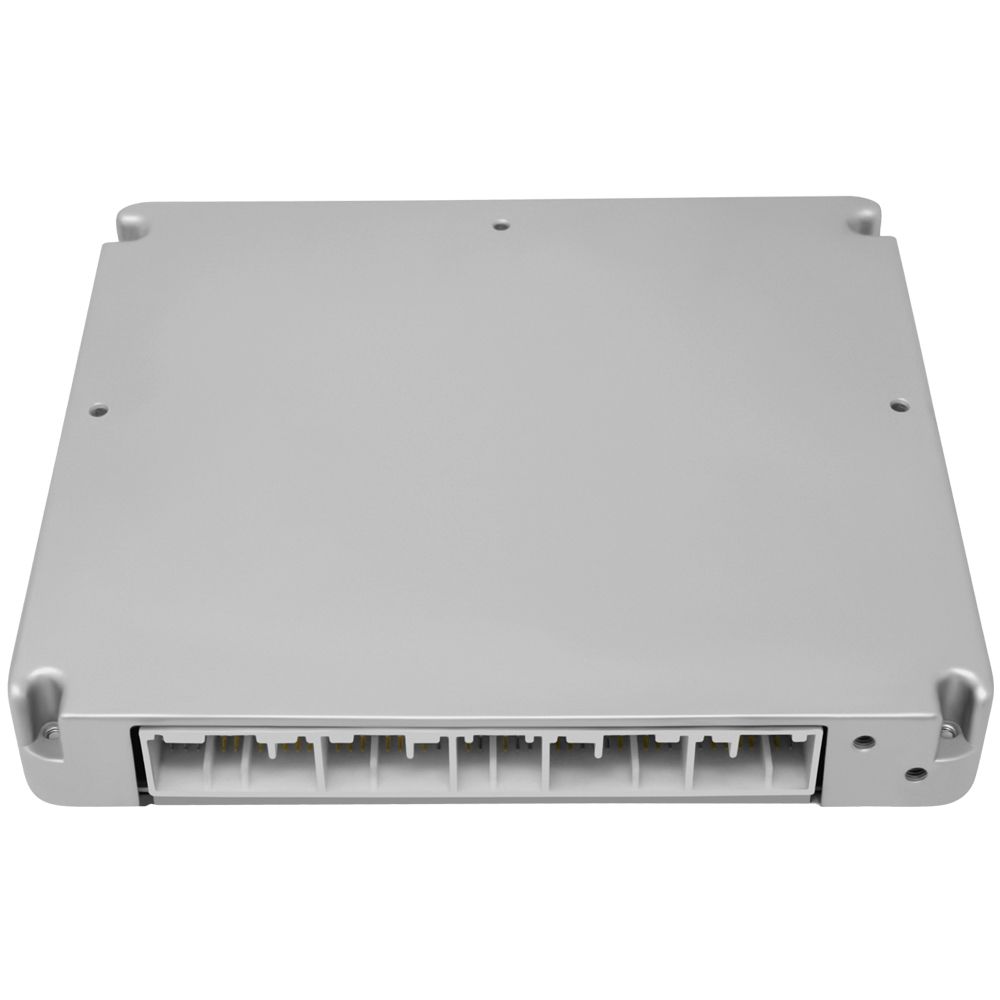
Flagship One stocks a refurbished, VIN-programmed PCM for the 2003 Toyota Tacoma PreRunner with a lifetime warranty, free shipping and no core charge. The full Toyota Tacoma PreRunner module lineup covers other engine configurations as well.
The engine control computer in your 2003 Toyota Tacoma PreRunner plays a central role in keeping the 3.4L V6 running smoothly and efficiently. Recognizing the symptoms of module failure early, understanding the instrument panel location, and knowing the factory labor times help you plan the repair with confidence. A VIN-programmed replacement from Flagship One can simplify the process by eliminating the relearn procedure, saving your technician time and getting your truck back to reliable daily service.