
Last updated on August 25th, 2026 at 02:13 pm
The 2003 Kia Sorento‘s engine management system relies on two linked control modules. The Engine Control Module monitors fuel delivery and emissions, while the Powertrain Control Module manages transmission functions. Failure in either can cause drivability issues or no-start conditions.
If your 2003 Kia Sorento won’t start, runs poorly, or shows warning lights, the problem may lie with one of its control modules. This guide explains what these computers do, typical failure symptoms, and your repair options. You’ll learn the difference between the Engine Control Module and Powertrain Control Module, what the factory service procedure involves, and why some replacement units come pre-programmed while others require dealer-level setup. Understanding these details helps you make informed decisions whether you plan to repair yourself or leave it to professionals.
The 2003 Kia Sorento uses two separate but interconnected control modules to manage its 3.5L engine. The Engine Control Module primarily handles fuel injection timing, idle speed, and emissions sensor inputs. The Powertrain Control Module integrates transmission shift logic with engine management, making it the central computer for drivability. Both modules communicate constantly; if one fails or sends corrupted data, the vehicle may not run at all. When these modules fail, you typically see a no-start condition, stalling, or illuminated malfunction indicator lamp. The modules are physically separate units, though they work in concert — understanding which one is causing your issue saves diagnostic time and money. Replacement engine computers for the Sorento must be programmed to match your specific vehicle identification number to function properly.
Flagship One keeps Kia Sorento replacement engine computers in stock for exactly this failure pattern.
2003 Kia Sorento
OEM programmed ECM for your 2003 Kia Sorento — plug & play, no dealer visit.
Free shipping · Lifetime warranty
The factory removal procedure reaches the control module at the intake manifold area on the 2003 Kia Sorento. This location requires careful disassembly of intake plumbing and associated wiring to access the unit. For the Engine Control Module, book time for removal and reinstallation is 0.4 hours, with an additional 0.5 hour relearn procedure after installation. The Powertrain Control Module takes longer at 1.4 hours for R&R plus 0.5 hours for relearn. Both modules require the technician to secure all electrical connectors firmly and verify proper mounting before reassembly. Working near the intake manifold also means managing vacuum lines and throttle body connections carefully during the procedure.
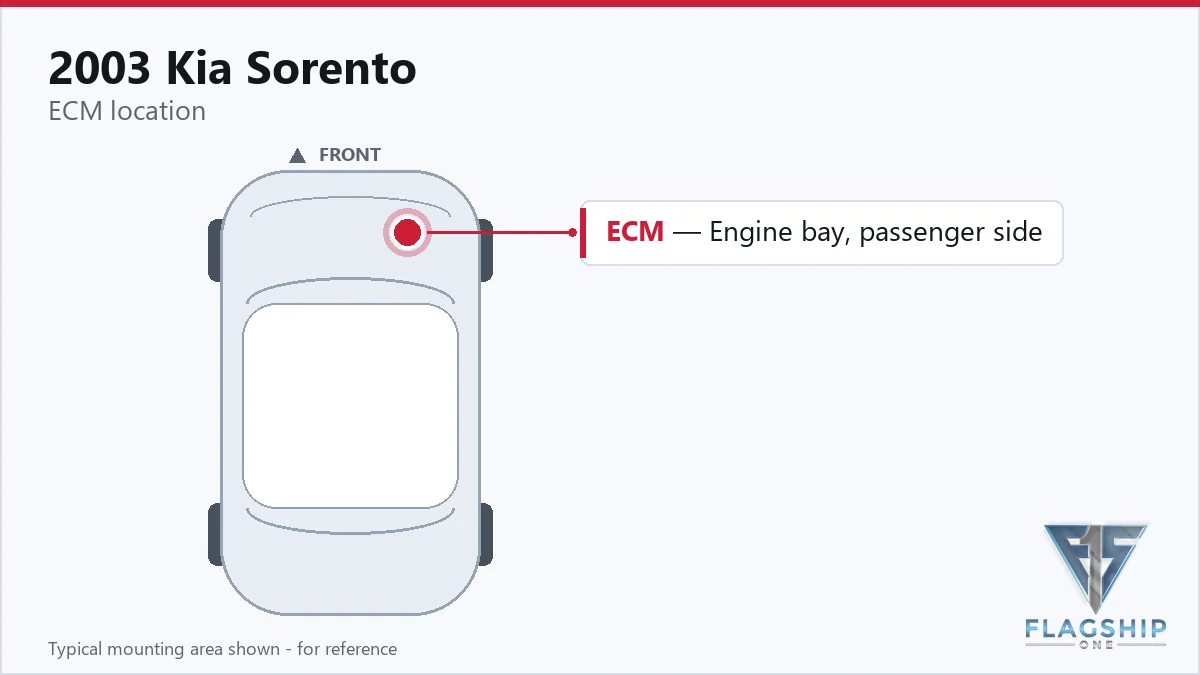
Work with the ignition off, and treat the module as static-sensitive: avoid touching the connector pins at any point.
| Operation | Configuration | Book Time |
|---|---|---|
| Engine Control Module R&R | All configurations | 0.4 hr |
| Engine Control Module Relearn | All configurations | 0.5 hr |
| Powertrain Control Module R&R | All configurations | 1.4 hr |
| Powertrain Control Module Relearn | All configurations | 0.5 hr |
After replacing either control module on your Sorento, the factory procedure requires a relearn procedure to establish communication between the new unit and the vehicle’s sensors. This step is mandatory — without it, the engine may run poorly or not start at all. The ECM relearn takes 0.5 hours, and the PCM relearn also requires 0.5 hours. However, when you purchase a VIN-programmed replacement unit from Flagship One, these programming steps are already completed before the module ships. The unit arrives ready to install, eliminating the need for dealer programming equipment or software updates at your local shop.
Every VIN-programmed replacement unit from Flagship One arrives with these steps already completed.
Control module failure in the 2003 Kia Sorento often presents as a no-start condition where the engine cranks but won’t fire. You may also experience intermittent stalling,hesitation under acceleration, or multiple misfire codes appearing simultaneously. Some owners report that their scan tool cannot communicate with the PCM, showing no data or connection errors — this strongly suggests module internal failure. Transmission shifting problems such as harsh shifts, failure to engage gears, or stuck in limp mode can point to PCM issues rather than the ECM. The malfunction indicator lamp may illuminate even when no diagnostic trouble codes are present, which the factory TSB specifically addresses for this model year.
Factory service bulletin ENG068 covers an intermittent MIL illumination with no stored fault code on certain Kia models including the 2003 Sorento. The bulletin provides information specifically regarding diagnostic trouble code P1330, which relates to the control module’s internal monitoring function. Technicians are directed to verify proper module ground connections and check for voltage spikes before replacing components. This bulletin confirms that even when the MIL lights with no codes present, the control module itself may still be the root cause.
| Bulletin | Subject | What It Addresses |
|---|---|---|
| — | TSB • Body Electrical System • [ENG068] Intermittent MIL ON With No Fault Code Stored – Informa | — |
A used unit requires dealer programming to accept your vehicle’s VIN, which most independent shops cannot perform. Additionally, used modules may have underlying damage or remaining service life concerns. A VIN-programmed replacement from a reputable supplier typically provides better long-term value.
Yes, this symptom pattern can indicate PCM failure, particularly if the starter receives no signal or the engine immediately dies after starting. The PCM controls starter relay and fuel pump relay operation. A qualified technician can verify whether the module is receiving and sending proper signals.
The Engine Control Module handles engine-specific functions like fuel delivery and emissions monitoring. The Powertrain Control Module integrates transmission control with engine management. They are separate physical units that communicate — both can fail independently, and symptoms often overlap.
When your 2003 Kia Sorento needs a control module, you have two primary paths: installation of a new OEM unit through the dealer, or a VIN-programmed replacement from Flagship One. Dealer parts come blank and require programming appointments, adding time and cost. Our replacement units arrive pre-programmed to your exact VIN, ready to install. Both options carry similar warranty coverage, but the pre-programmed route typically gets you back on the road faster without dealer scheduling delays.
Flagship One stocks a refurbished, VIN-programmed PCM for the 2003 Kia Sorento with a lifetime warranty, free shipping and no core charge. The full Kia Sorento module lineup covers other engine configurations as well.
The 2003 Kia Sorento relies on its Engine Control Module and Powertrain Control Module to run properly. When either fails, symptoms range from no-start to shifting problems. Understanding the factory labor times, programming requirements, and your replacement options helps you approach the repair confidently. Whether you handle the installation yourself or trust a professional, knowing what the procedure involves ensures you receive fair service and appropriate parts for your Sorento.