
Last updated on August 25th, 2026 at 01:37 pm
The powertrain control module on the 2002 Ford E-150 Econoline is the central computer managing engine and transmission operation. Internal circuitry failures may set permanent fault codes, illuminate the check-engine lamp, and produce symptoms ranging from hard starting to complete communication loss.
When a 2002 Ford E-150 Econoline sets powertrain-related fault codes without a clear mechanical cause, the powertrain control module itself may be the culprit. This guide explains what the PCM does in this specific van, how to recognize when it has failed internally, what replacement involves, and what steps the factory requires after installation. You will learn the role of the module in engine and transmission management, the typical symptoms of internal failure, and why a post-install relearn procedure matters. Whether you are diagnosing a check-engine lamp, planning a repair, or weighing replacement options, the information here supports a clear-eyed decision without sales pressure.
The powertrain control module on the 2002 Ford E-150 Econoline is the primary computer governing engine and transmission function. It processes input from dozens of sensors to control fuel injector pulsing, ignition timing, emissions equipment operation, and automatic transmission shift points. The module also monitors its own internal circuits for faults. On a vehicle with the 4.2L V6, the PCM directly affects throttle response, idle quality, fuel economy, and shift firmness. If internal voltage regulators, memory circuits, or processor logic degrade, the module may generate fault codes for conditions that do not actually exist in the engine. Finding replacement engine computers for the E-150 becomes necessary when diagnostic evidence points to module-internal failure rather than sensor or wiring problems. Because the PCM coordinates both the engine and the transmission control system, a failing unit can produce a wide range of symptoms across multiple vehicle systems.
Flagship One keeps Ford Van (E-Series) replacement engine computers in stock for exactly this failure pattern.
The powertrain control module on the 2002 Ford E-Series van is positioned next to the air cleaner assembly. Accessing the unit requires removing the air cleaner housing and any intervening brackets or ducting. The factory removal procedure specifies reaching the module from that general area, which means working in the engine bay between the left frame rail and the firewall. Book time for removal and installation on the 4.2L engine is listed at 0.6 hours. The 2002 E-150 requires a separate relearn procedure after the module is installed, accounting for an additional 0.5 hours of labor. Before beginning any work on electronic engine controls, the battery ground cable must be disconnected as a safety precaution. Once the module is installed and the battery is reconnected, the relearn procedure allows the new PCM to calibrate its operating parameters to the specific vehicle.
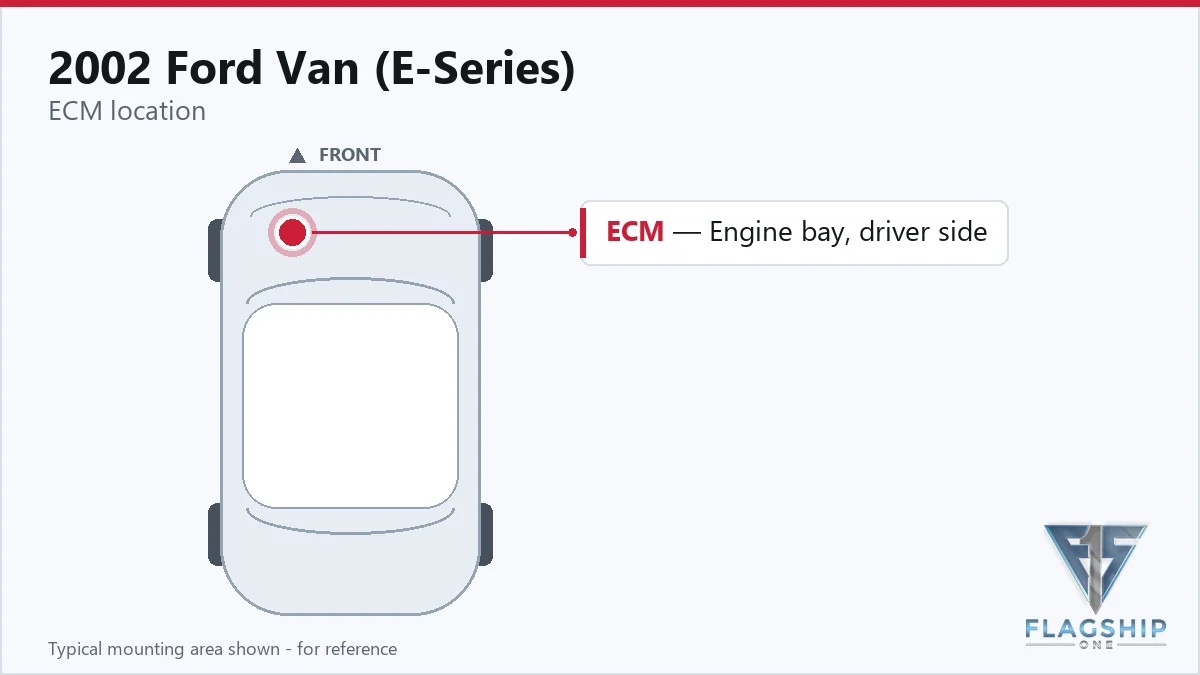
Work with the ignition off, and treat the module as static-sensitive: avoid touching the connector pins at any point.
| Operation | Configuration | Book Time |
|---|---|---|
| Powertrain Control Module R&R | 4.2L | 0.6 hr |
| Powertrain Control Module R&R | 4.6L | 0.6 hr |
| Powertrain Control Module R&R | 5.4L | 0.6 hr |
| Powertrain Control Module Relearn | E-150 Econoline | 0.5 hr |
| Powertrain Control Module Relearn | E-150 Econoline Club Wagon | 0.5 hr |
| Engine Control Module Relearn | E-150 Econoline | 0.5 hr |
| Engine Control Module Relearn | E-150 Econoline Club Wagon | 0.5 hr |
| Engine Control Module R&R | 4.2L | 0.6 hr |
2002 Ford E-150
OEM programmed replacements — plug & play, no dealer visit.
Find yours by year, make & model →
Free shipping · Lifetime warranty
After replacing the powertrain control module on the 2002 Ford E-150, the factory service procedure requires a relearn step that synchronizes the new module with the vehicle’s unique identity and operating characteristics. This step is listed separately from the physical removal and installation labor, adding 0.5 hours to the total job. Flagship One units ship pre-programmed with the vehicle identification number already loaded, which means the post-install relearn steps that would normally be required at a dealership or independent shop are already completed on the bench. You can install the module and reconnect the battery without needing to perform the factory relearn sequence, provided the unit you receive matches your vehicle’s specifications.
Every VIN-programmed replacement unit from Flagship One arrives with these steps already completed.
A failing powertrain control module on the 2002 Ford E-150 may produce symptoms that are intermittent at first and become more consistent over time. Hard starting, rough idle, stalling, and hesitation under acceleration are common when the module can no longer manage fuel delivery or ignition timing accurately. Transmission shifting may become harsh, soft, or unpredictable because the PCM also controls the automatic gearbox. Diagnostic scanners may show no communication with the module or display codes that do not correspond to actual sensor failures. Fault codes in the P0600 and P1600 series often indicate module-internal problems rather than external circuit issues. DTC P1639 and related codes appearing after a check-engine lamp illumination frequently accompany complete or partial loss of module communication.
The following trouble codes have been documented in the module-internal memory of this vehicle. These codes originate within the PCM or ECM itself rather than from external sensor or wiring faults, and their presence supports a diagnosis of module-level failure rather than a problem in the engine wiring harness or associated components.
| Code | Meaning | Full Guide |
|---|---|---|
| P0602 | Control module programming error | Full P0602 guide → |
| P0603 | Keep-alive memory (KAM) error | Full P0603 guide → |
| P0605 | Internal ROM error | Full P0605 guide → |
| P0606 | Module processor failure | Full P0606 guide → |
| P0645 | Module-internal fault | Full P0645 guide → |
| P1605 | Module-internal fault | — |
| P1633 | Module-internal fault | — |
| P1635 | Module-internal fault | — |
| P1636 | Module-internal fault | — |
| P1639 | Module-internal fault | — |
| P1640 | Module-internal fault | — |
| P1641 | Module-internal fault | — |
Factory bulletin 02-23-04 addresses a condition where the 4X4 lamp remains illuminated after powertrain control module or instrument cluster replacement on gasoline-engine vehicles. Inaccurate or inoperative speedometer readings may also occur, along with the presence of DTC P1635 or P1639 following module replacement. This condition highlights the importance of using a correctly programmed replacement unit and completing any required post-installation procedures. When the wrong calibration or an unprogrammed module is installed, the vehicle may exhibit symptoms that mimic the original failure even though the replacement part itself is functional.
| Bulletin | Subject | What It Addresses |
|---|---|---|
| 02-23-04 | 4X4 LAMP ILLUMINATED AFTER POWERTRAIN CONTROL MODULE (PCM) OR INSTRUMENT CLUSTER REPLACEMENT – | — |
Yes, a failing sensor can trigger codes that appear to originate in the module. Professional diagnosis distinguishes between external sensor or wiring faults and genuine module-internal failures by checking circuit data with the module removed from the equation.
If the replacement module is not VIN-programmed, the vehicle may run poorly or not at all until a relearn procedure is performed. Flagship One units arrive pre-programmed with the vehicle identification number, reducing the post-installation steps needed.
The relearn procedure is a calibration step that adapts the new module to the specific vehicle. Reprogramming involves loading the correct software calibration file, which Flagship One handles before the unit ships.
Diagnosing a powertrain control module failure on a 2002 Ford E-150 requires confirming that external sensor and wiring faults are not producing codes that mimic internal module problems. If the evidence points to module-internal failure, you face a choice between a repaired unit, a new-old-stock module, or a current-production replacement. Each option carries different costs, warranty coverage, and compatibility considerations. Review the specific codes, symptoms, and vehicle history before deciding.
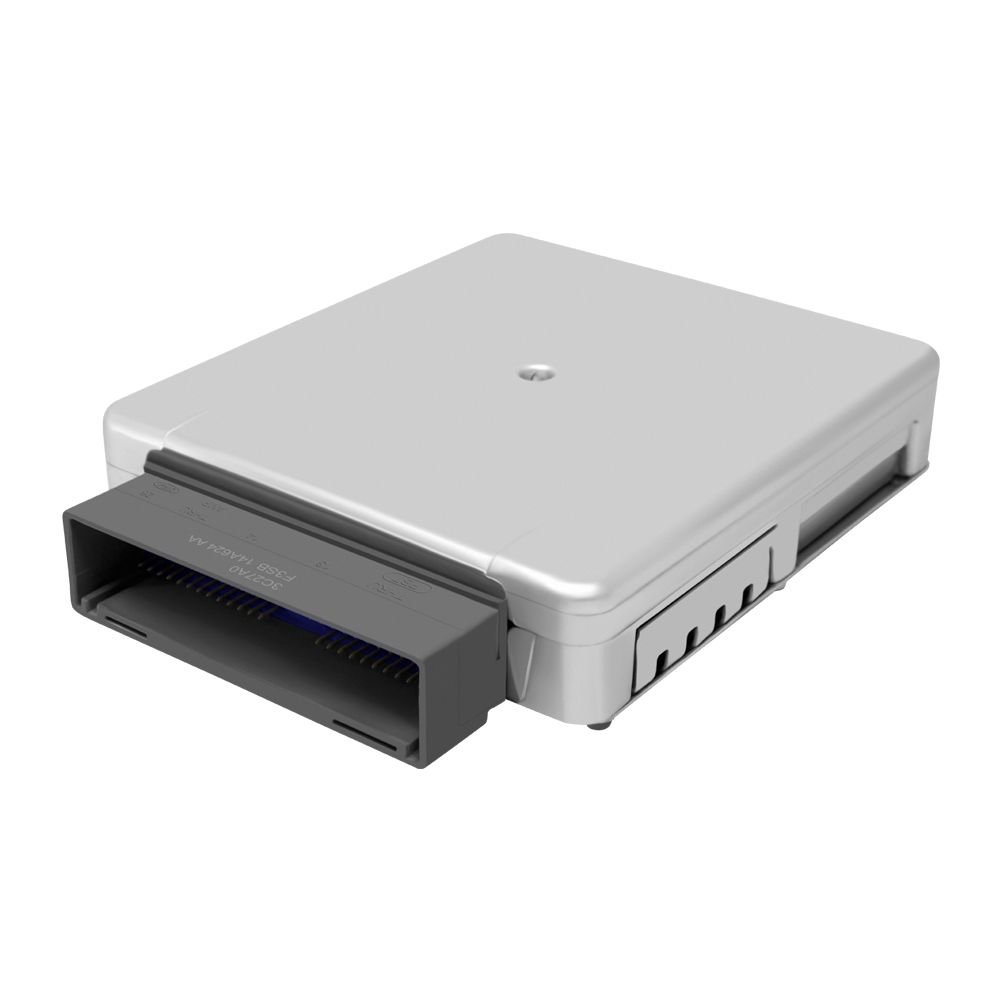
Flagship One stocks a refurbished, VIN-programmed PCM for the 2002 Ford Van (E-Series) with a lifetime warranty, free shipping and no core charge. The full Ford Van (E-Series) module lineup covers other engine configurations as well.
The 2002 Ford E-150 Econoline depends on its powertrain control module to manage both engine and transmission functions reliably. Internal module failures can produce a wide range of drivability symptoms and set codes across multiple families. Knowing the location next to the air cleaner, the 0.6-hour book time for removal and installation, and the 0.5-hour relearn requirement helps you evaluate labor estimates. A pre-programmed replacement eliminates the post-install relearn burden that would otherwise be required at additional cost.