
Last updated on August 25th, 2026 at 02:29 pm
In the 2000 Chevrolet Tracker, the Powertrain Control Module (PCM) or Engine Control Module (ECM) manages fuel injection, ignition timing, and transmission shift points. Failure of this module often results from voltage spikes, corrosion, or internal component wear, leading to drivability issues and stored trouble codes.
If your 2000 Chevrolet Tracker 1.6L is experiencing drivability problems such as stalling, no-start conditions, or persistent check-engine lights, the Powertrain Control Module (PCM) or Engine Control Module (ECM) may be at fault. This guide explains what these modules do, how to recognize failure symptoms, and what the factory requires for a proper replacement. You will learn the labor times involved, the critical programming steps, and the factory cautions that protect the module during service. Understanding these points helps you make an informed decision about repairing or replacing the computer in your Tracker.
The Powertrain Control Module (PCM) in your 2000 Chevrolet Tracker 1.6L acts as the central brain for engine and transmission management. It processes sensor inputs to control fuel delivery, ignition timing, idle speed, and shift patterns. The Engine Control Module (ECM) is essentially the same component, with the terms used interchangeably in many service documents. When this module fails, it can cause a range of drivability symptoms and may store internal trouble codes such as P0601, P0602, or P0606. If you need a replacement, you can find replacement engine computers for the Tracker that meet factory specifications. The module must be programmed with the correct calibration information, which is critical to proper operation of the vehicle.
The PCM/ECM in the 2000 Chevrolet Tracker is installed in the vehicle and must be accessible for connector removal. Factory labor times list 0.5 hours for PCM removal and replacement and 0.9 hours for ECM removal and replacement. Before beginning, ensure the battery is fully charged. The factory procedure requires turning the ignition off when installing or removing PCM connectors, and when disconnecting or reconnecting power sources such as the battery cable, PCM pigtail, PCM fuse, or jumper cables. To prevent electrostatic discharge damage, do not touch the connector pins or soldered components on the circuit board. After installation, the replacement module must be programmed.
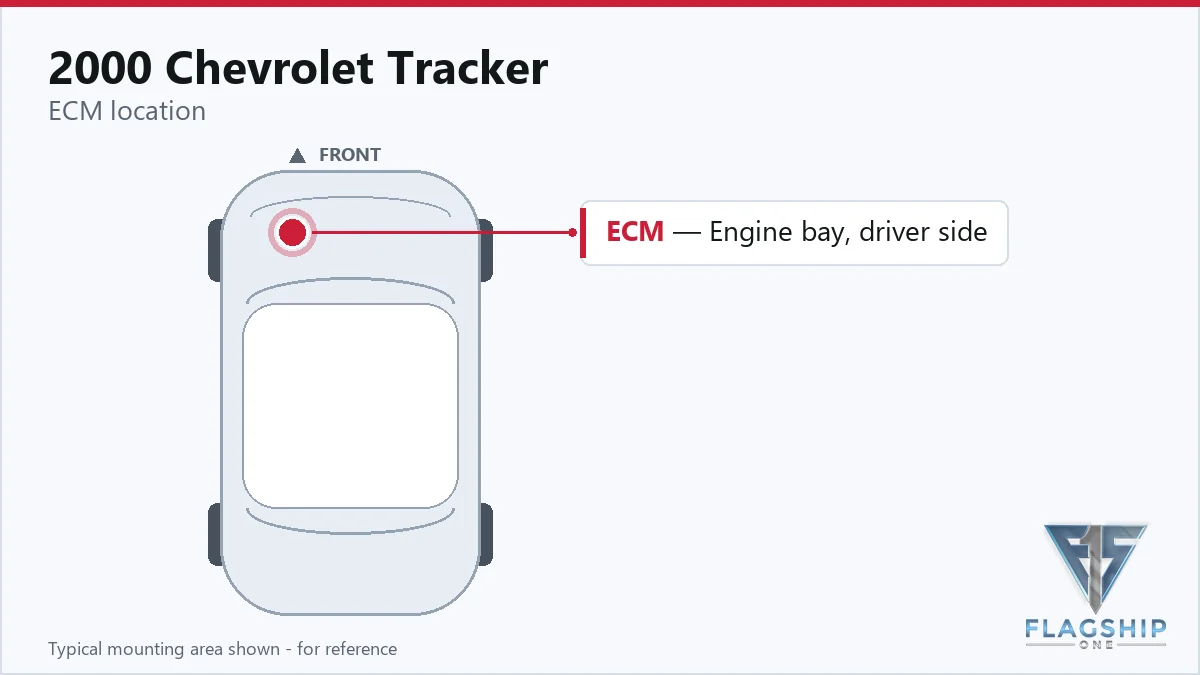
Work with the ignition off, and treat the module as static-sensitive: avoid touching the connector pins at any point.
| Operation | Configuration | Book Time |
|---|---|---|
| Powertrain Control Module R&R | All configurations | 0.5 hr |
| Powertrain Control Module Relearn | All configurations | 0.5 hr |
| Engine Control Module R&R | All configurations | 0.9 hr |
| Engine Control Module Relearn | All configurations | 0.5 hr |
2000 Chevrolet Tracker
OEM programmed ECM for your 2000 Chevrolet Tracker — plug & play, no dealer visit.
Free shipping · Lifetime warranty
Factory procedure for the 2000 Chevrolet Tracker requires that a replacement PCM be programmed with the correct calibration information. This involves connecting a Tech 2 scan tool to the vehicle, inspecting connections at the Techline Terminal, scan tool, DLC, and PCM, then reprogramming the control module. The EPROM must be flashed with calibration data critical to proper operation. Programming should only be performed when directed by a service procedure or a General Motors service bulletin. Flagship One provides a VIN-programmed replacement unit that arrives with the correct calibration already installed, so those post-install programming steps are already completed.
A failing PCM or ECM in the 2000 Chevrolet Tracker can produce several noticeable symptoms. The engine may crank but not start, or it may stall unexpectedly while driving. You might experience rough idle, misfires, or poor acceleration. The check-engine light may illuminate, and a scan tool may show communication failures or internal module faults. One common internal fault is internal control module fault P0601, which indicates a memory or checksum error within the module. Other symptoms include erratic transmission shifting, reduced fuel economy, and the vehicle entering a fail-safe or limp-home mode. If you encounter these issues, diagnosing the module should be a priority.
The following trouble codes are documented for the 2000 Chevrolet Tracker as module-internal faults. These codes indicate problems within the PCM/ECM itself rather than external sensors or circuits:
General Motors issued service bulletin #99-06-04-053, dated October 26, 1999, regarding PCM reprogramming for the 2000 Chevrolet Tracker. This bulletin provides information on when and how to reprogram the control module. It emphasizes that programming should only be performed when directed by a service procedure or a General Motors service bulletin, as programming at other times will not permanently correct a customer concern. The bulletin also outlines the steps for connecting a Tech 2 scan tool and inspecting connections before reprogramming.
| Bulletin | Subject | What It Addresses |
|---|---|---|
| 99-06-04-053 | Info – PCM Reprogramming – (Oct 26, 1999) | — |
Factory labor time for PCM removal and replacement is 0.5 hours. For the ECM, the book time is 0.9 hours. Actual time may vary depending on access and condition of connectors.
A used PCM must be programmed with the correct calibration for your specific vehicle. The factory requires that the replacement module be flashed with proper calibration data. A used module may not have the correct software and could cause drivability issues.
P0601 is an internal control module fault indicating a memory or checksum error within the PCM/ECM. This typically means the module has failed internally and requires replacement. It is one of several module-internal codes documented for this vehicle.
When your 2000 Chevrolet Tracker needs a new PCM or ECM, you have two main paths: have a shop perform the factory programming procedure, or choose a refurbished module that arrives ready to install. A pre-programmed unit eliminates the need for a dealer visit and scan-tool reprogramming, saving time and labor costs. For the Tracker 1.6L, ensure the replacement matches your engine and transmission configuration.
Flagship One stocks a refurbished, VIN-programmed PCM for the 2000 Chevrolet Tracker with a lifetime warranty, free shipping and no core charge. The full Chevrolet Tracker module lineup covers other engine configurations as well.
The PCM and ECM are vital to the performance of your 2000 Chevrolet Tracker 1.6L. Recognizing symptoms like no-start, stalling, or internal trouble codes can guide you toward the right repair. Whether you opt for a refurbished unit or a new module, proper programming is essential. A pre-programmed replacement simplifies the process and gets your Tracker back on the road quickly.