
Last updated on August 25th, 2026 at 11:52 am
The engine control module in the 1999 Volkswagen Cabrio manages fuel injection, oxygen sensor feedback, and EVAP canister purge operation. When this module fails internally, it may trigger diagnostic codes P0604, P0605, or P0606, leading to drivability problems such as stalling, no-start conditions, or erratic engine behavior.
When your 1999 Volkswagen Cabrio begins exhibiting stalling, no-start conditions, or unexpected diagnostic trouble codes, the engine control module may be at fault. This component serves as the central processor for your vehicle’s fuel injection, oxygen sensor feedback, and evaporative emissions systems. Understanding what this module does, where it sits in your vehicle, and what steps are necessary after replacement can help you make informed decisions about repair. Internal module failures often manifest as specific diagnostic codes that point directly to processor faults rather than sensor or wiring issues. This guide walks through the module’s role in your Cabrio, its physical location, the labor time involved in replacement, factory programming requirements, and the technical service bulletins that address known concerns. Whether you are diagnosing a current problem or planning ahead, having the right information about your engine control module can save time and prevent unnecessary parts swapping.
The engine control module in your 1999 Volkswagen Cabrio functions as the onboard computer responsible for regulating fuel delivery, ignition timing, and emissions control. It continuously processes input from sensors throughout the engine bay and adjusts operating parameters to maintain efficient combustion. In this particular vehicle, the module also oversees oxygen sensor control and EVAP canister purge functions, making it integral to both performance and emissions compliance. When you shop for 1999 Volkswagen Cabrio replacement ECMs you are addressing a component that directly governs how your engine runs under all driving conditions. Internal failures of this processor typically produce diagnostic codes in the P0600 range, which specifically indicate faults within the module itself rather than in external sensors or wiring harnesses. These codes often appear when the module’s internal memory or processing circuitry degrades, which may happen gradually or suddenly. Because the Cabrio’s 2.0L engine relies on this module for precise fuel metering and emissions management, a failing unit can affect everything from cold-start performance to fuel economy. Replacing the module with a properly programmed unit restores the computational accuracy your engine management system depends on.
1999 Volkswagen Cabrio 2.0L
OEM programmed ECM for your 1999 Volkswagen Cabrio 2.0L — plug & play, no dealer visit.
Free shipping · Lifetime warranty
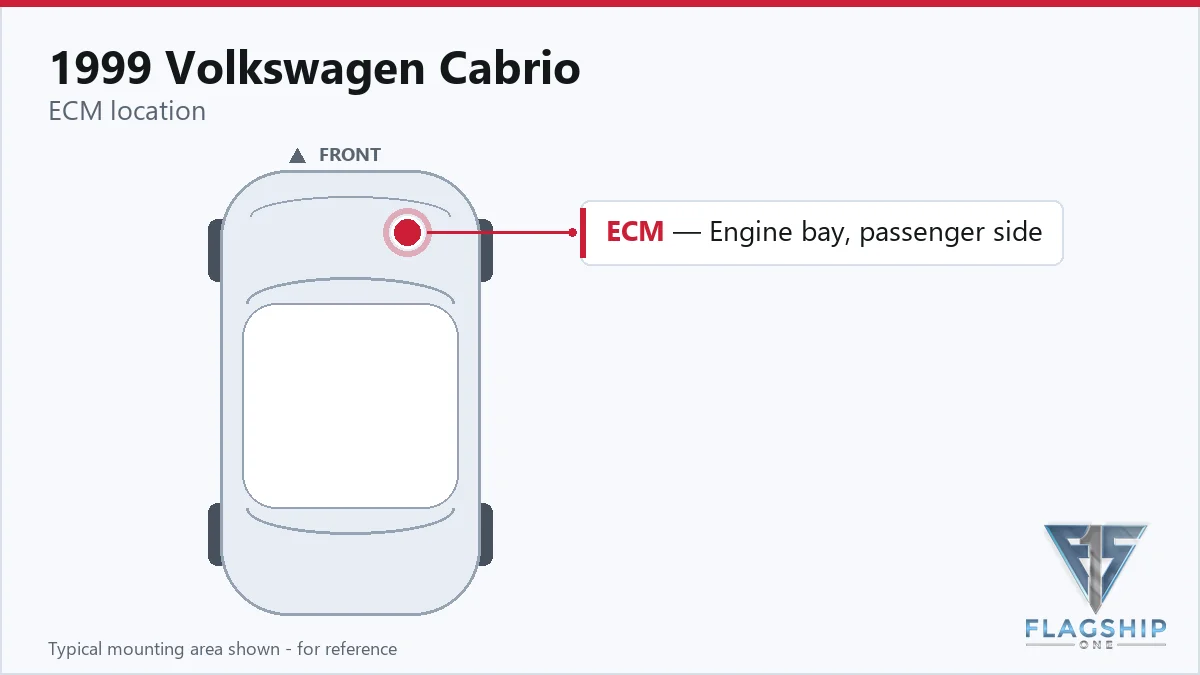
The factory component-location overview for the 1999 Volkswagen Cabrio places the engine control module in the plenum chamber on the right side of the vehicle. This area, typically accessed from the engine bay, houses the module in a protected location away from direct engine heat. Removing and installing the engine control module carries a book time of 0.3 hours, indicating a relatively straightforward physical swap that an experienced technician can complete without extensive disassembly. Once the new module is physically installed, the factory relearn procedure requires 0.5 hours of labor to complete. This relearn step ensures the replacement module syncs properly with your vehicle’s immobilizer and engine management systems. The same 0.3-hour book time applies to powertrain control module removal and installation, and the powertrain control module relearn also requires 0.5 hours. Additionally, an engine control module reset procedure is listed at 0.3 hours, which may be necessary during certain diagnostic or adaptation steps. These labor times reflect standard industry flat-rate estimates and assume proper tools and familiarity with the Cabrio’s engine compartment layout.
| Operation | Configuration | Book Time |
|---|---|---|
| Powertrain Control Module Relearn | All configurations | 0.5 hr |
| Powertrain Control Module R&R | All configurations | 0.3 hr |
| Engine Control Module R&R | All configurations | 0.3 hr |
| Engine Control Module Reset | All configurations | 0.3 hr |
| Engine Control Module Relearn | All configurations | 0.5 hr |
After replacing the engine control module in your 1999 Volkswagen Cabrio, the factory procedure typically requires a relearn step to synchronize the new unit with your vehicle’s immobilizer and engine management systems. The factory relearn carries a book time of 0.5 hours. Technical service bulletin 96-07-42 specifically addresses immobilizer adaptation when replacing the ECM on models equipped with Immobilizer 3 or 4. When you install a VIN-programmed replacement unit from Flagship One, those programming and adaptation steps have already been completed at the factory. Your module arrives flashed to your specific vehicle identification number, which typically eliminates the need for a dealership visit to perform the relearn or immobilizer adaptation. This means the 0.5-hour relearn procedure and the 0.3-hour reset procedure may not be necessary, saving both time and additional labor costs during the installation process.
A failing engine control module in the 1999 Volkswagen Cabrio often produces symptoms that can mimic other engine problems, making accurate diagnosis important. Common signs include difficulty starting or a complete no-start condition where the engine cranks but refuses to fire. Stalling at idle or during deceleration may also occur, along with rough running or misfire-like symptoms that do not trace to spark plugs or coils. You might notice the check engine lamp illuminating with module-internal codes such as P0605 internal ROM fault, which specifically points to a processor-level failure rather than a sensor issue. In some cases, a scan tool may fail to establish communication with the module entirely, leaving you unable to read or clear codes. Fuel economy may degrade noticeably, and the EVAP system may not function correctly if the module can no longer control the canister purge solenoid. Because these symptoms overlap with fuel pump, ignition, and sensor failures, confirming a module-internal code is often the clearest indicator that the ECM itself needs replacement.
The following trouble codes have been documented as module-internal faults for the 1999 Volkswagen Cabrio. These codes specifically indicate failures within the engine control module’s internal circuitry rather than problems with external sensors, wiring, or actuators. When any of these codes appear, the module itself typically requires replacement rather than component-level repair.
| Code | Meaning | Full Guide |
|---|---|---|
| P0604 | Internal RAM error | Full P0604 guide → |
| P0605 | Internal ROM error | Full P0605 guide → |
| P0606 | Module processor failure | Full P0606 guide → |
Two technical service bulletins from the factory address engine control module concerns relevant to your 1999 Volkswagen Cabrio. Bulletin 24-07-102 covers ECM replacement procedures for all vehicles and all engine codes except the 2.0L AEG variant. This bulletin provides factory guidance on the proper replacement process for your vehicle’s engine configuration. Bulletin 96-07-42 addresses the immobilizer synchronization process needed when a new ECM is installed on models equipped with Immobilizer 3 or 4. This bulletin outlines the necessary steps to pair the replacement module with your vehicle’s immobilizer system so the engine starts and runs correctly after installation. Both bulletins emphasize the importance of following documented factory procedures during module replacement to ensure proper immobilizer function and engine management integration.
| Bulletin | Subject | What It Addresses |
|---|---|---|
| 24-07-102 | TT 24-07-102 1999 > All Vehicles, All Engine Codes except 2.0L AEG – ECM Replacement | — |
| 96-07-42 | TT 96-07-42 All Models With Immobilizer 3 or 4, Immobilizer Adaptation When Replacing the ECM | — |
The engine control module manages fuel injection, oxygen sensor feedback, and EVAP canister purge operation in your Cabrio. It processes sensor inputs and adjusts engine operating parameters to maintain efficient combustion and emissions compliance.
The factory component-location overview places the engine control module in the plenum chamber on the right side of the vehicle. Book time for removal and installation is 0.3 hours, indicating straightforward access from the engine bay area.
The factory procedure typically requires a relearn step of 0.5 hours and may involve immobilizer adaptation per bulletin 96-07-42. A VIN-programmed unit from Flagship One arrives with these steps already completed, which typically eliminates the need for dealership programming.
If your 1999 Volkswagen Cabrio is showing module-internal trouble codes or exhibiting symptoms consistent with a failing engine control module, you have options. A professional diagnosis can confirm whether the ECM is the root cause or if another component is responsible. Once confirmed, a replacement module programmed to your vehicle’s identification number offers a direct path to restoring proper engine management. Flagship One provides pre-programmed units that arrive ready to install, which may eliminate the need for additional dealership visits and relearn procedures.
Flagship One stocks a refurbished, VIN-programmed PCM for the 1999 Volkswagen Cabrio with a lifetime warranty, free shipping and no core charge. The full Volkswagen Cabrio module lineup covers other engine configurations as well.
The engine control module in your 1999 Volkswagen Cabrio plays a central role in fuel management, emissions control, and overall drivability. When internal faults arise, replacing the module with a properly programmed unit is often the most effective solution. Flagship One offers VIN-programmed replacements that arrive ready for installation, which may simplify the repair process and reduce downtime for your vehicle.