
Last updated on August 25th, 2026 at 02:45 pm
In the 1997 BMW 3 Series, the Engine Control Module (ECM) and Powertrain Control Module (PCM) act as the vehicle’s central computers, managing engine timing, fuel delivery, and transmission coordination. Failure of either unit typically results in stored fault codes, loss of engine control, and illumination of the check engine light.
When the check engine light appears on a 1997 BMW 3 Series, many owners discover that the engine’s computer modules may be at fault. The ECM and PCM govern critical engine and transmission functions, and a malfunction can lead to a range of drivability issues. This guide explains what these modules do in this specific model, how they are accessed and replaced, and what factory procedures are required after a swap. By understanding the process, you can assess whether a repair or a refurbished replacement best fits your situation, and you’ll know what to expect during the service.
The Engine Control Module in the 1997 BMW 3 Series processes sensor data to control fuel injection, ignition timing, and emissions, while the Powertrain Control Module oversees transmission shift logic and coordinates with the ECM for smooth power delivery. Both computers store diagnostic trouble codes when parameters fall outside normal limits, which is why a persistent check engine light often points to a module issue. Proper operation is essential for fuel efficiency, emissions compliance, and overall drivability. The vehicle relies on these units to interpret inputs from the crankshaft position sensor, throttle position sensor, and many others, translating them into precise actuator commands. Maintenance of the ECM and PCM helps ensure that the engine runs as intended and that the transmission shifts correctly. For owners needing a new unit, replacement engine computers for the 1997 BMW 3 Series are available and can be installed without major disassembly.
1997 BMW 3 Series
OEM programmed replacements — plug & play, no dealer visit.
Find yours by year, make & model →
Free shipping · Lifetime warranty
In the 1997 BMW 3 Series, the ECM and PCM are mounted within the engine compartment, typically attached to the firewall or near the intake manifold. Access usually involves removing a few fasteners and disconnecting the main harnesses. The labor book time lists 0.4 hours for removing and reinstalling each module, reflecting the relatively straightforward nature of the job. After the unit is seated, the electrical connectors are reattached and any mounting bolts are torqued to the specifications noted in the service manual. The process does not require extensive component removal, making it a task that can often be completed within a single service appointment.
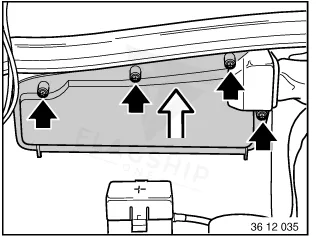
Work with the ignition off, and treat the module as static-sensitive: avoid touching the connector pins at any point.
| Operation | Configuration | Book Time |
|---|---|---|
| Engine Control Module R&R | All configurations | 0.4 hr |
| Powertrain Control Module R&R | All configurations | 0.4 hr |
| Powertrain Control Module Relearn | All configurations | 0.5 hr |
Once a new ECM or PCM is installed in the 1997 BMW 3 Series, the factory procedure includes a Powertrain Control Module relearn step that typically takes about 0.5 hours. This process restores the module’s adaptive memory and ensures proper communication with the vehicle’s sensors. Flagship One units arrive as a VIN‑programmed replacement unit so the relearn is already completed, allowing the technician to skip this step and proceed directly to final verification.
A failing ECM or PCM in a 1997 BMW 3 Series may cause the engine to stall, refuse to start, or run roughly, often accompanied by misfire codes. Drivers might notice a loss of power, erratic shifting, or a complete loss of communication with a scan tool. The check engine light will illuminate, and stored faults such as internal control module memory error can appear in the diagnostic readout. In some cases, the vehicle may exhibit reduced fuel efficiency or abnormal exhaust emissions, reflecting the computer’s inability to manage the engine’s operating parameters correctly.
| Bulletin | Subject | What It Addresses |
|---|---|---|
| — | Check Engine Light Illuminated, Faults Stored in DME/ECM | — |
| — | Engine Control Module Codes | — |
The service book lists 0.4 hours for removing and reinstalling the Engine Control Module on this model.
Factory guidelines call for a PCM relearn procedure that usually takes about 0.5 hours, but a VIN‑programmed unit from Flagship One eliminates that step.
Yes, because the ECM and PCM work together to manage engine output and shift timing, a faulty ECM can lead to erratic or harsh shifts.
The P0601 code signals an internal control module memory error, often pointing to an ECM or PCM issue.
Not necessarily; each module can be serviced independently, but it’s wise to verify the health of both during diagnosis.
When faced with a faulty ECM or PCM in your 1997 BMW 3 Series, you can choose a repair that restores the original unit or opt for a refurbished replacement that meets factory specifications. Both paths aim to return your vehicle to reliable operation, and understanding the labor involved helps you plan accordingly.
Flagship One stocks a refurbished, VIN-programmed PCM for the 1997 BMW 3 Series with a lifetime warranty, free shipping and no core charge. The full BMW 3 Series module lineup covers other engine configurations as well.
The 1997 BMW 3 Series relies on its ECM and PCM for smooth engine and transmission performance. Whether you repair or replace, ensuring proper installation and programming will keep your vehicle running as intended. Consider a VIN‑programmed unit for a streamlined solution.