
Last updated on August 25th, 2026 at 01:55 pm
The engine control module (ECM) in your 1995 Mitsubishi Eclipse manages fuel delivery, ignition timing, and emissions systems. Failure may cause erratic engine behavior, stalling, or a no-start condition, often without warning.
If your 1995 Mitsubishi Eclipse has started running poorly—or refuses to start at all—the engine control module (ECM) may be the culprit. Unlike modern vehicles with advanced diagnostics, this pre-OBD-II model relies on a simpler but still critical computer to manage fuel, ignition, and emissions. When the ECM fails, symptoms can range from subtle drivability issues to a complete no-start condition. Replacing it isn’t just about swapping parts; the module must be configured to your vehicle’s specific settings to ensure proper operation. Understanding the role of the ECM, how to replace it, and what to expect afterward can save you time and frustration. Whether you’re diagnosing a stalling issue or preparing for a replacement, knowing these details helps you make informed decisions about your Eclipse’s repair needs.
1995 Mitsubishi Eclipse 2.0L: When the
OEM programmed replacements — plug & play, no dealer visit.
Find yours by year, make & model →
Free shipping · Lifetime warranty
The engine control module in your 1995 Mitsubishi Eclipse serves as the brain of the engine management system. It continuously monitors sensors for data like engine speed, air intake, and coolant temperature, then adjusts fuel injection and ignition timing to optimize performance and emissions. Without a functioning ECM, your Eclipse may struggle to start, run erratically, or even stall unexpectedly. This module is particularly important in pre-OBD-II vehicles like yours, where diagnostic feedback is limited compared to newer models. When the ECM fails, it often disrupts multiple systems at once, leading to symptoms that can mimic other issues, such as a faulty fuel pump or ignition coil. Replacing the module involves installing one of the replacement engine computers for the Eclipse that matches your vehicle’s specifications. A properly functioning ECM ensures smooth operation, better fuel efficiency, and compliance with emissions standards, making it a critical component for reliable driving.
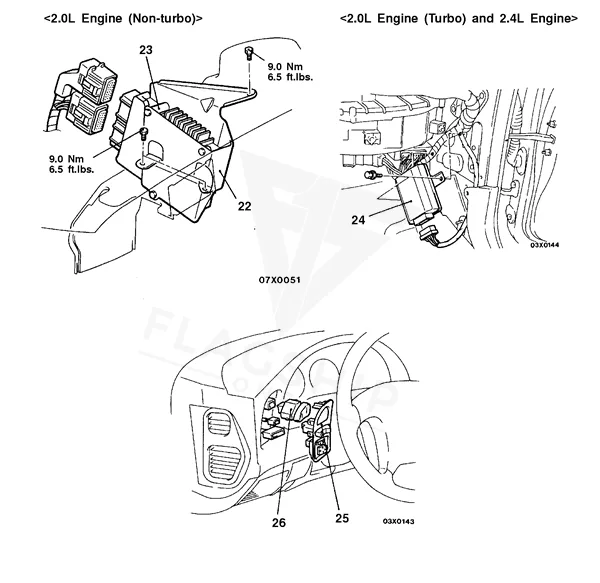
The engine control module in your 1995 Mitsubishi Eclipse is typically located in the engine bay, often mounted near the firewall or on the inner fender. Accessing it requires removing a few bolts or clips securing the protective cover, then disconnecting the wiring harness. The replacement process is straightforward but requires care to avoid damaging connectors or the module itself. According to factory labor estimates, removing and reinstalling the ECM takes about 0.9 hours. There are no special tools required beyond basic hand tools, but ensuring the battery is disconnected before starting is critical to prevent electrical shorts. Once the old module is removed, the new one can be installed in the same location, with the wiring harness reconnected securely. Torque specifications for mounting bolts are not typically provided, but snugging them evenly prevents stress on the module housing.
| Operation | Configuration | Book Time |
|---|---|---|
| Engine Control Module R&R | All configurations | 0.9 hr |
| Powertrain Control Module R&R | All configurations | 0.9 hr |
| Powertrain Control Module Relearn | All configurations | 0.5 hr |
After replacing the engine control module in your 1995 Mitsubishi Eclipse, the factory procedure requires a relearn process to synchronize the new unit with your vehicle’s systems. This step, which typically takes about 0.5 hours, ensures the ECM adapts to your engine’s unique characteristics, such as fuel trims and idle settings. Without this procedure, your Eclipse may experience rough idling, poor acceleration, or even stalling. However, if you install a VIN-programmed replacement unit, this relearn step is already completed, saving you time and potential frustration. The pre-configured module arrives ready to plug in and drive, eliminating the need for additional programming tools or dealer visits. This convenience is particularly valuable for pre-OBD-II vehicles like yours, where diagnostic and programming options are more limited than in newer models.
A failing engine control module in your 1995 Mitsubishi Eclipse can cause a variety of symptoms, often without clear warning signs. One of the most common issues is a no-start condition, where the engine cranks but refuses to fire. Stalling at idle or during acceleration is another frequent complaint, often accompanied by a rough or uneven idle. Some drivers notice poor fuel economy or hesitation under load, as the ECM struggles to maintain proper fuel delivery and ignition timing. In some cases, the vehicle may run fine one day and refuse to start the next, making diagnosis challenging. Electrical issues, such as intermittent power loss to sensors or actuators, can also arise, leading to erratic behavior like sudden surges or misfires. If your Eclipse exhibits these symptoms, it’s worth checking for internal ECM faults, such as a memory integrity error, which can confirm the module’s failure. Since pre-OBD-II vehicles lack the detailed diagnostic feedback of newer models, these symptoms often require a process of elimination to pinpoint the ECM as the root cause.
Random stalling in your Eclipse can stem from several issues, but a failing ECM is a likely culprit. The module controls fuel delivery and ignition timing, so if it malfunctions, the engine may cut out unexpectedly. Other symptoms, like rough idling or poor acceleration, often accompany stalling when the ECM is at fault. Testing the module or replacing it with a known-good unit can help confirm the diagnosis.
Diagnosing an ECM failure in your Eclipse involves ruling out other potential causes, such as a bad fuel pump, ignition coil, or sensor. Start by checking for spark and fuel pressure; if both are present but the engine still won’t start, the ECM may be the issue. A scan tool can also check for internal ECM faults, though pre-OBD-II vehicles provide limited feedback. Swapping in a known-good ECM is often the most reliable way to confirm the problem.
Driving with a faulty ECM is risky, as it can lead to further engine damage. A failing module may cause poor fuel mixture, leading to overheating or excessive wear on internal components. Additionally, erratic behavior like stalling or misfires can create unsafe driving conditions. If you suspect ECM issues, it’s best to address them promptly to avoid more costly repairs down the road.
Yes, the factory procedure requires a relearn process after installing a new ECM in your Eclipse. This step ensures the module adapts to your engine’s specific characteristics, such as idle speed and fuel trims. However, if you install a VIN-programmed replacement unit, this step is already completed, saving you time and effort. Skipping the relearn process may result in poor performance or drivability issues.
In your 1995 Mitsubishi Eclipse, the terms ECM (engine control module) and PCM (powertrain control module) are often used interchangeably, as the vehicle’s computer primarily manages engine functions. The ECM handles fuel injection, ignition timing, and emissions, while a PCM in other vehicles might also control transmission functions. For your Eclipse, the replacement process and labor times are identical for both modules, as they serve the same core purpose.
If your 1995 Mitsubishi Eclipse is experiencing symptoms like stalling, rough idling, or a no-start condition, replacing the engine control module may be the solution. While a new or refurbished ECM can restore proper engine function, choosing a VIN-programmed unit eliminates the need for post-installation programming, saving you time and hassle. Whether you opt for a dealer replacement or an aftermarket solution, ensuring the module is correctly configured for your vehicle is key to a smooth repair.
Flagship One stocks a refurbished, VIN-programmed PCM for the 1995 Mitsubishi Eclipse with a lifetime warranty, free shipping and no core charge. The full Mitsubishi Eclipse module lineup covers other engine configurations as well.
A faulty engine control module in your 1995 Mitsubishi Eclipse can lead to frustrating and unpredictable driving issues, from stalling to complete no-start conditions. Replacing the ECM is a straightforward process, but ensuring it’s properly programmed for your vehicle is critical for reliable performance. By understanding the symptoms, replacement steps, and preventive measures, you can address ECM issues confidently and keep your Eclipse running smoothly for years to come.