
Last updated on August 25th, 2026 at 02:37 pm
The engine control module in your 1991 Buick Regal 3.1L manages fuel injection, ignition timing, and emissions systems. It reads sensor data and commands actuators. Failure may come from internal solder fractures, voltage spikes, heat cycling, or connector corrosion, leading to drivability problems or a non-running engine.
If your 1991 Buick Regal 3.1L has suddenly developed a no-start condition, random stalling, or strange transmission behavior, the engine control module may be the root cause. On this pre-OBD-II sedan, the computer is the brain behind fuel delivery, spark timing, and automatic-transmission control. When it begins to fail, symptoms can mimic bad sensors, a worn fuel pump, or ignition problems, which makes accurate diagnosis important before you replace anything. This guide explains what the module does in your specific vehicle, where it lives, how much labor the books assign, and what the factory expects after installation. You will also learn the critical ignition-off caution that protects the module from permanent damage during service. Whether you are doing the repair yourself or simply want to understand the estimate from your shop, the information here is focused on the 1991 Buick Regal 3.1L and written in plain terms. By the end, you will know how to recognize failure, why proper handling matters, and how a programmed replacement can simplify the job.
1991 Buick Regal 3.1L
OEM programmed ECM for your 1991 Buick Regal 3.1L — plug & play, no dealer visit.
Free shipping · Lifetime warranty
In the 1991 Buick Regal 3.1L, the engine control module is the electronic controller that interprets signals from sensors such as the coolant temperature sensor, throttle position sensor, mass airflow sensor, and crankshaft position sensor. It uses those inputs to calculate injector pulse width, ignition advance, idle speed, and torque-converter clutch operation. Because this model year sits before the standardized OBD-II era, the module communicates through manufacturer-specific diagnostic routines rather than the later generic protocols. That distinction matters when choosing test equipment and when ordering a replacement. The module stores calibration data and learned adaptive values for your exact engine and transmission combination, which is why a simple plug-and-play swap often requires a relearn or pre-programming step. When the internal circuit board suffers solder joint cracks, capacitor leakage, or damage from a voltage spike, the engine may crank but fail to start, stall under load, or run rough. Heat and vibration inside the passenger compartment can accelerate these failures over time. Moisture entering the connector can also corrode pins and create intermittent contact. If you are planning to restore reliable operation, you can explore replacement engine computers for the Regal that are calibrated to your vehicle identification number before shipping. A correctly matched module preserves factory performance and avoids the guesswork of manual programming.
On the 1991 Buick Regal 3.1L, the control module is mounted inside the passenger compartment, tucked beneath the instrument panel on the right-hand side. That location keeps the unit away from direct engine heat and road splash, but it still sees temperature swings and vibration over the years. Access typically requires lowering or removing the lower dash trim on the passenger side so you can reach the mounting bracket and electrical connector. The published labor allowance for Engine Control Module removal and replacement is 1.0 hour. If your documentation refers to the unit as a Powertrain Control Module, the listed removal and replacement time is 0.9 hour. Those figures are book times only; actual shop time can vary with rust, broken fasteners, or prior modifications. During service, the factory caution is non-negotiable: the ignition switch must remain OFF whenever you unplug the module, disconnect the battery, pull the module fuse, or reconnect power. Ignoring that step can destroy the module internally. After the new unit is secured and the connector is fully seated, the lower trim is reinstalled.
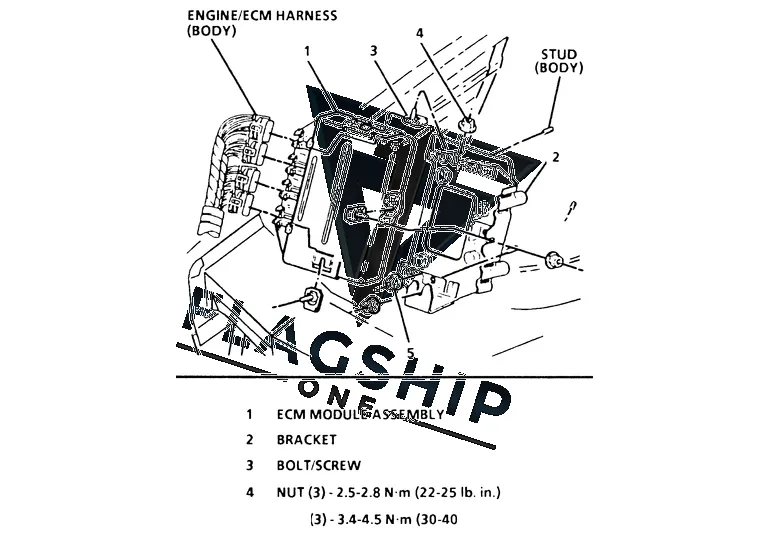
Work with the ignition off, and treat the module as static-sensitive: avoid touching the connector pins at any point.
| Operation | Configuration | Book Time |
|---|---|---|
| Powertrain Control Module Relearn | All configurations | 0.5 hr |
| Powertrain Control Module R&R | All configurations | 0.9 hr |
| Engine Control Module Relearn | All configurations | 0.5 hr |
| Engine Control Module R&R | All configurations | 1.0 hr |
After a module is replaced in the 1991 Buick Regal 3.1L, the factory procedure calls for a relearn so the controller can adapt to the engine and transmission. The published labor allowance for that relearn is 0.5 hour whether the unit is called an Engine Control Module or a Powertrain Control Module. The process lets the controller reset learned values such as idle trim and transmission shift timing. However, when you receive a VIN-programmed replacement unit from Flagship One, that relearn work has already been completed at the bench. The module is loaded with the correct calibration for your specific 1991 Buick Regal 3.1L before it ships, which means the documented 0.5-hour relearn is normally not required during your installation. You still connect the battery and module connector only with the ignition OFF, then start the engine and verify normal idle and shift behavior. If any stored adaptive values need minor refinement, normal driving over the next few days typically completes the process automatically.
A failing engine control module in the 1991 Buick Regal 3.1L can produce a wide range of drivability complaints that often look like other failures. The most common symptom is a crank-but-no-start condition: the starter spins normally, fuel pressure reads acceptable, spark appears present, yet the engine refuses to fire because the module is not triggering injectors or coils correctly. Intermittent stalling is another classic sign, especially after the engine warms up or when you stop at a light. Some drivers report sudden loss of power under acceleration, random misfires, or a transmission that shifts too early, too late, or harshly. Because the module also handles communication with diagnostic equipment, a scan tool that cannot link to the controller can point to an internal module fault rather than a wiring issue. Rough idle, poor fuel economy, and an illuminated service engine soon light may accompany these problems. On this pre-OBD-II model, you will not see standardized P-codes; instead, a factory scan tool or blink-code routine reads manufacturer-specific fault information. If multiple sensors have been replaced without lasting improvement, the module itself deserves closer inspection.
The module is mounted inside the passenger compartment, beneath the instrument panel on the right side. You will usually remove the lower passenger-side dash trim to reach it. Always keep the ignition OFF while the connector or battery is disconnected.
The book time for Engine Control Module removal and replacement is 1.0 hour. If the estimate uses the Powertrain Control Module terminology, the listed time is 0.9 hour. The relearn procedure is listed at 0.5 hour, though it is normally already done on a VIN-programmed replacement.
Factory guidance states that power must never be connected or disconnected while the ignition is on. That rule covers unplugging the module, removing the battery cable, pulling the fuse, or jump-starting the battery. Violating it can permanently damage the module internally.
Look for crank-but-no-start, intermittent warm stalling, rough idle, unexpected transmission shifting, loss of scan-tool communication, and persistent drivability issues that continue after sensors and ignition parts have been ruled out.
The factory procedure calls for a 0.5-hour relearn after installation. Flagship One units are VIN-programmed before shipping, so that relearn is typically unnecessary. Normal driving completes any minor adaptive learning automatically.
When the engine control module in your 1991 Buick Regal 3.1L fails, you can choose between hours of diagnostic labor chasing intermittent faults or installing a replacement that is already calibrated to your vehicle. A refurbished, VIN-matched module saves the separate programming step and gets you back on the road with factory-correct calibration.
Flagship One stocks a refurbished, VIN-programmed PCM for the 1991 Buick Regal with a lifetime warranty, free shipping and no core charge. The full Buick Regal module lineup covers other engine configurations as well.
The 1991 Buick Regal 3.1L relies on its engine control module for starting, running, and shifting smoothly. Recognizing the symptoms, respecting the ignition-off caution, and choosing a VIN-programmed replacement can turn a frustrating no-start or stalling problem into a straightforward repair. If your Regal is showing the signs described here, replacing the module may be the right next step.