
Last updated on August 25th, 2026 at 01:56 pm
The Powertrain Control Module (PCM) in a 1990 Mitsubishi Galant manages engine and transmission functions. Failures may cause starting issues, poor performance, or transmission shifting problems without triggering obvious dashboard warnings.
If your 1990 Mitsubishi Galant is experiencing unexplained stalling, difficulty starting, or transmission shifting issues, the Powertrain Control Module (PCM) may be the culprit. This critical component oversees engine and transmission operations, and its failure can disrupt multiple systems. Replacing it involves accessing a specific location and following factory procedures to ensure proper function. Understanding the role of the PCM, its common failure symptoms, and the steps involved in replacement can help you make informed decisions about repairs. A pre-programmed replacement unit can simplify the process by eliminating additional programming steps.
1990 Mitsubishi Galant
OEM programmed replacements — plug & play, no dealer visit.
Find yours by year, make & model →
Free shipping · Lifetime warranty
In the 1990 Mitsubishi Galant, the Powertrain Control Module (PCM) acts as the brain for both the engine and transmission. It processes sensor data to adjust fuel delivery, ignition timing, and shift points, ensuring smooth operation. A malfunctioning PCM may lead to poor performance, stalling, or even a no-start condition. Since this vehicle predates OBD-II, diagnostic tools won’t display standardized trouble codes, making physical symptoms the primary indicator of failure. When replacement becomes necessary, replacement PCMs for the Galant are designed to restore factory-level control without requiring extensive reprogramming.
The PCM in the 1990 Mitsubishi Galant is mounted in a location similar to that of the Mirage and Diamante models. Replacing it involves removing the module from its mounting bracket, disconnecting the wiring harness, and installing the new unit. Labor estimates for this procedure typically allocate 1.0 hour for removal and reinstallation. After installation, a relearn procedure is required, which may add 0.5 hour to the total labor time. No specialized tools are specified, but care should be taken to ensure proper connector seating and secure mounting.
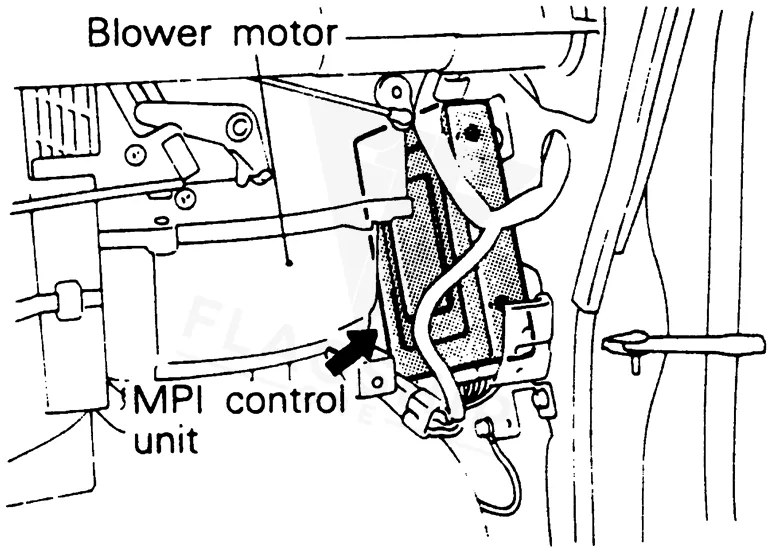
Work with the ignition off, and treat the module as static-sensitive: avoid touching the connector pins at any point.
| Operation | Configuration | Book Time |
|---|---|---|
| Engine Control Module R&R | All configurations | 0.7 hr |
| Powertrain Control Module R&R | All configurations | 1.0 hr |
| Powertrain Control Module Relearn | All configurations | 0.5 hr |
After replacing the PCM in a 1990 Mitsubishi Galant, the factory procedure requires a relearn process to synchronize the module with the vehicle’s systems. This step typically takes 0.5 hour and ensures proper engine and transmission operation. However, a VIN-programmed replacement unit from Flagship One arrives pre-configured, eliminating the need for this additional step. This simplifies the installation process and reduces the overall time required for the repair.
A failing PCM in the 1990 Mitsubishi Galant may cause a range of symptoms, including intermittent stalling, difficulty starting, or erratic transmission shifting. You might also notice poor fuel economy or a rough idle, as the module struggles to regulate engine functions. In some cases, the vehicle may enter a limp-home mode, limiting performance to prevent further damage. Since this model lacks OBD-II diagnostics, there are no standardized trouble codes to confirm the issue. However, if the PCM is at fault, symptoms often appear suddenly and may worsen over time without intervention.
Replacing the PCM is possible if you have basic mechanical skills and the right tools. The module is accessible, but proper connector seating and secure mounting are critical. A factory relearn procedure is also required unless using a pre-programmed unit.
Common signs include stalling, no-start conditions, or erratic transmission shifting. Since this model lacks OBD-II diagnostics, symptoms are the primary indicator. A professional scan tool may help rule out other issues.
A used PCM may function, but compatibility depends on the donor vehicle’s configuration. Even if it fits, a relearn procedure is typically required. A pre-programmed replacement unit eliminates this step and ensures proper operation.
If your 1990 Mitsubishi Galant is showing signs of PCM failure, you have options. A repair may be possible, but a refurbished replacement unit can restore factory performance with less hassle. Pre-programmed modules eliminate the need for post-install procedures, simplifying the process. Consider the age of your vehicle and the reliability of a direct replacement when deciding on the best approach.
Flagship One stocks a refurbished, VIN-programmed PCM for the 1990 Mitsubishi Galant with a lifetime warranty, free shipping and no core charge. The full Mitsubishi Galant module lineup covers other engine configurations as well.
The 1990 Mitsubishi Galant relies on its PCM to manage critical engine and transmission functions. If yours is failing, a replacement can restore smooth operation. Opting for a pre-programmed unit streamlines the process, saving time and reducing potential complications. Addressing the issue promptly can help avoid further drivability problems down the road.