
Last updated on August 25th, 2026 at 11:45 am
The engine control module in your 2010 Volkswagen Golf GTI manages fuel delivery, ignition timing, and emissions functions for the 2.0L turbocharged engine. When this module fails, your vehicle may experience misfires, stalling, difficulty starting, or illuminated warning lamps with stored diagnostic codes.
When your 2010 Volkswagen Golf GTI develops drivability issues that resist conventional repairs, the engine control module may be a contributing factor. This onboard computer governs critical engine functions including fuel injection timing, ignition sequencing, and emissions monitoring for the 2.0L turbocharged powerplant. A failing ECM often produces intermittent symptoms that mimic other mechanical or electrical problems, making accurate diagnosis essential before replacing any components. Understanding what the module does, where it sits in your vehicle, and what procedures follow installation helps you make informed repair decisions. The factory service information for this vehicle provides specific labor times, component location data, and a relevant technical service bulletin that addresses stored diagnostic trouble codes. Armed with this information, you can approach repairs with realistic expectations about time investment and post-installation requirements. This guide compiles the documented facts for your GTI into one resource. Whether you are troubleshooting persistent check-engine warnings or planning a module replacement, the details here clarify what the factory expects and how a pre-programmed unit may streamline the process. You will find labor times, location information, bulletin references, and practical guidance for protecting your replacement investment.
The engine control module in your 2010 Volkswagen Golf GTI functions as the central processing unit for the 2.0L engine management system. It continuously reads input from sensors monitoring airflow, coolant temperature, throttle position, camshaft and crankshaft position, oxygen content, and knock activity. Using this data, the module calculates precise fuel injector pulse widths, ignition advance angles, boost control parameters, and variable valve timing commands to optimize performance, efficiency, and emissions compliance. When the ECM operates correctly, your GTI delivers smooth power, stable idle quality, and consistent fuel economy. The module also runs continuous self-diagnostic routines, storing diagnostic trouble codes when it detects values outside expected ranges. This self-monitoring capability is what makes scan-tool communication so valuable during troubleshooting. Module failure may stem from internal component degradation, voltage spikes from a failing alternator or improper jump-starting, moisture intrusion through damaged connector seals, or thermal stress accumulated over years of underhood heat cycling. Symptoms of a compromised ECM often overlap with those of faulty sensors, wiring harness issues, or fuel delivery problems, which is why thorough diagnosis matters before committing to replacement. Choosing 2010 Golf GTI replacement modules that arrive pre-programmed eliminates the need for dealer-level software flashing after installation. A properly matched unit restores the engine management logic your vehicle relies on for everyday drivability and emissions readiness. The factory component-location overview for this vehicle identifies the plenum chamber as the mounting area, and the documented labor time for GTI-specific ECM removal and replacement is 0.9 hours, reflecting the relatively accessible placement of this component compared to some configurations.
2010 Volkswagen Golf GTI
OEM programmed ECM for your 2010 Volkswagen Golf GTI — plug & play, no dealer visit.
Free shipping · Lifetime warranty
The factory component-location overview for your 2010 Volkswagen Golf GTI places the engine control module in the plenum chamber, a protected area beneath the windshield cowl that shields the unit from direct engine heat while keeping it accessible to service technicians. The plenum chamber location generally means removing cowl trim or weather sealing to reach the module connector and mounting hardware. According to documented book times, ECM removal and replacement on the GTI requires 0.9 hours. A separate ECM relearn procedure adds 0.5 hours to the service visit. For comparison, the Golf variant lists 1.4 hours for ECM removal and replacement, indicating the GTI configuration may offer somewhat easier access to the module. If your vehicle is equipped with an anti-theft system, powertrain control module removal and replacement time increases to 2.3 hours, while vehicles without anti-theft list 1.8 hours. These PCM times differ from the ECM-specific figures, so confirming which module your repair addresses ensures accurate time estimates before scheduling service.
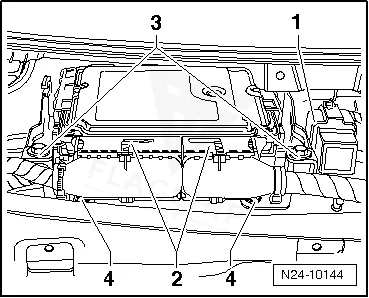
Work with the ignition off, and treat the module as static-sensitive: avoid touching the connector pins at any point.
| Operation | Configuration | Book Time |
|---|---|---|
| Powertrain Control Module R&R | Without Anti-Theft System | 1.8 hr |
| Powertrain Control Module R&R | With Anti-Theft System | 2.3 hr |
| Powertrain Control Module R&R | Golf | 1.4 hr |
| Engine Control Module R&R | GTI | 0.9 hr |
| Engine Control Module R&R | Golf | 1.4 hr |
| Engine Control Module Relearn | GTI | 0.5 hr |
| Engine Control Module Relearn | Golf | 0.5 hr |
After installing a replacement engine control module in your 2010 Volkswagen Golf GTI, the factory procedure requires an ECM relearn operation. The documented relearn time is 0.5 hours for the GTI, and this step allows the new module to synchronize with the immobilizer, throttle body, and other adaptive components that the original unit had already learned over thousands of driving cycles. Without this relearn, your vehicle may exhibit unstable idle, throttle response irregularities, or even a no-start condition if the immobilizer fails to recognize the new module. The relearn typically requires a compatible diagnostic tool capable of communicating with the Volkswagen engine management protocol. Selecting a pre-programmed replacement unit from Flagship One means the VIN-specific software and coding data are already loaded onto the module before it ships. This pre-programming covers the immobilizer integration and basic operating parameters, so the factory relearn steps that would otherwise require a dealer visit are already completed. Your installer can focus on the physical swap, which the factory rates at 0.9 hours for the GTI, rather than spending additional time on software initialization.
Engine control module failure in your 2010 Volkswagen Golf GTI can produce a wide range of symptoms that often overlap with other vehicle systems, making diagnosis challenging without proper scan-tool evaluation. One of the most common indicators is an illuminated malfunction indicator lamp accompanied by stored diagnostic trouble codes. You may notice rough idle, hesitation during acceleration, or a noticeable drop in fuel economy as the module struggles to maintain proper fuel and ignition mapping. Stalling at idle or during deceleration is another frequent complaint, particularly when the ECM loses its ability to manage idle air control or throttle adaptation correctly. In more advanced cases, your vehicle may crank but fail to start, especially if the module has lost immobilizer synchronization or internal memory corruption prevents basic engine management functions. Misfire-related codes such as random cylinder misfire detected often appear when the ECM cannot properly regulate ignition timing or fuel delivery, though these codes may also point to coil packs, spark plugs, or fuel injectors rather than the module itself. Complete loss of scan-tool communication strongly suggests internal ECM failure rather than a sensor or actuator problem. Additional warning signs include unexpected transmission behavior if the ECM shares data with the transmission controller, persistent emissions monitor readiness failures, and intermittent electrical symptoms that appear and disappear without any apparent pattern. Because these symptoms mimic many other faults, confirming ECM failure typically requires ruling out sensors, wiring, and mechanical issues first.
Volkswagen service bulletin 01-09-09 addresses a condition where the malfunction indicator lamp illuminates and multiple diagnostic trouble codes are stored in the ECM fault memory of affected vehicles. The documented codes include P0300 through P0304, which indicate random and individual cylinder misfires, P0102 for mass airflow circuit low input, P1297 related to boost pressure, P0420 for catalyst system efficiency below threshold, and P0441 for evaporative emission system incorrect purge flow. The bulletin prescribes update programming as the corrective action, meaning the factory remedy involves reflashing the ECM with revised software rather than replacing the module entirely. If your 2010 Volkswagen Golf GTI exhibits this combination of codes and has not yet received the software update described in the bulletin, that reflash may resolve the symptoms without requiring hardware replacement. However, if the module has already been updated or if internal failure is confirmed, replacement becomes the appropriate path.
| Bulletin | Subject | What It Addresses |
|---|---|---|
| 01-09-09 | Attachment: 01-09-09 – Update Programming, MIL ON, DTCs P0300-P0304, P0102, P1297, P0420 and P0 | — |
The factory component-location overview places the ECM in the plenum chamber, which is the protected area beneath the windshield cowl. This location shields the module from direct engine heat while keeping it accessible for service. Accessing it typically involves removing cowl trim or weather sealing to reach the connector and mounting hardware.
The documented book time for ECM removal and replacement on the GTI is 0.9 hours. An additional ECM relearn procedure requires 0.5 hours. For comparison, the Golf variant lists 1.4 hours for the same removal and replacement operation, suggesting the GTI may offer slightly easier access to the module.
Yes, the factory procedure includes an ECM relearn that takes 0.5 hours on the GTI. This step synchronizes the new module with the immobilizer and adaptive components. A pre-programmed replacement unit from Flagship One arrives with VIN-specific software already loaded, which may reduce or eliminate the need for dealer-level programming after installation.
Bulletin 01-09-09 addresses a condition where the malfunction indicator lamp turns on and multiple codes are stored in the ECM, including P0300 through P0304, P0102, P1297, P0420, and P0441. The prescribed remedy is update programming, meaning the factory solution involves reflashing the ECM with revised software rather than replacing the module.
Driving with a compromised ECM is not recommended. Symptoms may include stalling, misfires, or no-start conditions that could leave you stranded. Additionally, continued operation with stored misfire or emissions codes may affect catalytic converter health and fuel economy. Have the vehicle diagnosed promptly to determine whether the ECM or another component is at fault.
If diagnosis confirms that your 2010 Volkswagen Golf GTI needs an engine control module replacement, you have options. A dealer-installed new module includes factory programming but often carries higher cost and longer wait times. A refurbished unit from Flagship One arrives pre-programmed to your specific VIN, potentially reducing both installation time and total expense. The documented 0.9-hour replacement time for the GTI means the physical swap is straightforward for a qualified technician.
Flagship One stocks a refurbished, VIN-programmed PCM for the 2010 Volkswagen Golf GTI with a lifetime warranty, free shipping and no core charge. The full Volkswagen Golf GTI module lineup covers other engine configurations as well.
Your 2010 Volkswagen Golf GTI relies on a properly functioning engine control module to manage the 2.0L turbocharged engine with precision. Whether you are addressing symptoms covered by service bulletin 01-09-09 or replacing a confirmed failed unit, understanding the plenum chamber location, the 0.9-hour book time, and the 0.5-hour relearn requirement helps you plan the repair confidently. A pre-programmed replacement from Flagship One may simplify the process and get your vehicle back on the road sooner.