
Last updated on August 25th, 2026 at 11:47 am
The engine control module in your 2015 Volkswagen e-Golf manages critical powertrain functions, regulating how the electric drivetrain responds to driver input. When this unit fails, your vehicle may experience starting difficulties, drivability problems, or complete loss of communication with diagnostic equipment, leaving you unable to read or clear fault codes through normal procedures.
When your 2015 Volkswagen e-Golf begins exhibiting unusual drivability behavior or your scan tool cannot establish communication with the powertrain system, the engine control module may be at the center of the problem. This component serves as the central brain for your vehicle’s powertrain, and when it malfunctions, the effects can range from subtle performance changes to a complete no-start condition. Understanding what this module does, where it lives in your vehicle, and what is involved in replacing it can help you make informed decisions about repairs. Electric vehicles like the e-Golf rely heavily on their control electronics, and the engine computer plays a vital role in ensuring smooth operation of the drivetrain. Whether you are diagnosing intermittent issues or facing a confirmed module failure, knowing the replacement process, expected labor times, and programming requirements gives you a clearer picture of what the repair entails. This guide walks through the essentials so you can approach the situation with confidence and a solid understanding of the steps your technician may follow.
The engine control module in your 2015 Volkswagen e-Golf functions as the primary electronic controller for the powertrain, processing inputs from various sensors and sending commands to actuators throughout the drivetrain system. In an electric vehicle, this responsibility is especially significant because the module coordinates the relationship between the high-voltage battery, the electric motor, and the throttle input from the driver. It continuously adjusts parameters to maintain efficient operation and safe power delivery. When this unit begins to fail, the consequences often extend beyond a simple warning light. You may notice reduced power, unexpected behavior during acceleration, or difficulty starting the vehicle at all. Because the module also manages communication with other onboard systems, a failing unit can prevent your diagnostic scanner from reading data, making the troubleshooting process more complex. Choosing replacement engine computers for the e-Golf becomes relevant when diagnosis confirms the module itself is the source of the problem rather than a peripheral sensor or wiring issue. The module’s role is so central that many drivability complaints ultimately trace back to it, either directly through internal failure or indirectly through corrupted data processing. Understanding its function helps you appreciate why a thorough diagnosis matters before committing to replacement, since many symptoms can overlap with other component failures in the powertrain system.
2015 Volkswagen e-Golf
OEM programmed ECM for your 2015 Volkswagen e-Golf — plug & play, no dealer visit.
Free shipping · Lifetime warranty
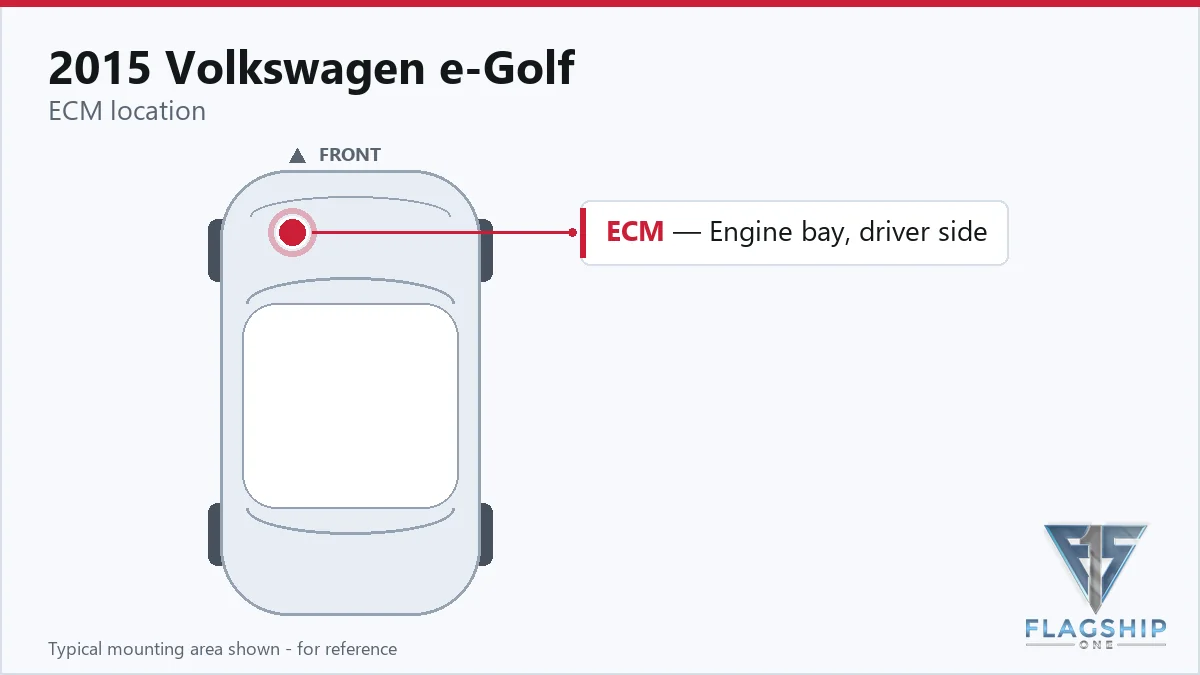
The factory component-location overview for the 2015 Volkswagen e-Golf places the engine control module inside the engine compartment, situated between the battery and the E-box. This location means the module is generally accessible from under the hood, though the surrounding components may need to be moved or disconnected to reach it properly. According to published labor guides, removing and replacing the module typically requires 9.6 hours, which reflects the complexity of accessing the unit, disconnecting the wiring harnesses, and reinstalling everything securely. A separate relearn procedure after the new module is installed generally takes 0.5 hours, and powertrain control system diagnosis and testing before replacement also typically requires 0.5 hours. These book times give you a realistic expectation of what your technician may need to complete the job, though actual times may vary depending on shop conditions and any additional issues discovered during the process.
Work with the ignition off, and treat the module as static-sensitive: avoid touching the connector pins at any point.
| Operation | Configuration | Book Time |
|---|---|---|
| Powertrain Control Module Relearn | All configurations | 0.5 hr |
| Powertrain Control Module R&R | All configurations | 9.6 hr |
| Powertrain Control System Diagnosis & Testing | All configurations | 0.5 hr |
After the engine control module in your 2015 Volkswagen e-Golf has been replaced, the factory procedure typically requires a relearn process so the new unit can synchronize with the vehicle’s immobilizer, throttle body, and other adaptive parameters. This step ensures the replacement module recognizes your vehicle’s specific configuration and communicates properly with all interconnected systems. Without completing the relearn, the drivetrain may not function correctly, or the vehicle may not start at all. The published labor time for this relearn procedure is 0.5 hours, which reflects the time a technician generally needs to perform the synchronization using compatible diagnostic equipment. Additionally, the new module must be configured to match your vehicle’s identification number and original specifications. When you choose a VIN-programmed replacement unit from Flagship One, those programming steps are already completed before the part ships. This means the module arrives already configured for your specific e-Golf, so your technician can focus on the physical installation and the relearn rather than starting the programming process from scratch.
A failing engine control module in your 2015 Volkswagen e-Golf can produce a range of symptoms that may develop gradually or appear suddenly. One of the most common signs is a no-start condition, where the vehicle cranks or attempts to run but cannot achieve proper operation because the module is not sending the necessary commands to the drivetrain. Stalling while driving is another frequent complaint, as the module may intermittently lose its ability to regulate power delivery, causing the motor to shut off unexpectedly. You may also experience misfire-like symptoms or rough operation, even though an electric vehicle does not have traditional combustion misfires, because the module may struggle to coordinate power delivery smoothly. Diagnostic trouble codes related to internal module faults can appear, and in some cases, your scan tool may fail to communicate with the module entirely, preventing you from reading or clearing codes through normal procedures. Shifting or drivability issues may also surface if the module loses its ability to manage power transitions properly. Because these symptoms can overlap with sensor failures, wiring problems, or other electronic issues, a thorough diagnosis is essential before concluding the module itself has failed. The published diagnosis and testing time of 0.5 hours reflects the initial evaluation your technician may perform to determine whether the module is the root cause.
Published labor guides indicate that removing and replacing the module generally requires 9.6 hours. A separate relearn procedure after installation typically takes 0.5 hours, and initial diagnosis and testing usually require 0.5 hours. Actual times may vary depending on shop conditions and any additional issues found during the repair.
The factory component-location overview places the engine control module inside the engine compartment, positioned between the battery and the E-box. This means the module is generally accessible from under the hood, though surrounding components may need to be moved to reach it properly.
Yes, the factory procedure typically requires a relearn process after the new module is installed so it can synchronize with your vehicle’s immobilizer and adaptive parameters. This relearn generally takes 0.5 hours. A VIN-programmed replacement unit from Flagship One arrives already configured for your specific vehicle, so the initial programming steps are already completed.
Common symptoms may include a no-start condition, stalling while driving, rough or inconsistent power delivery, and inability of a scan tool to communicate with the module. Diagnostic trouble codes related to internal module faults may also appear. Because these symptoms can overlap with other component failures, a thorough diagnosis is recommended before replacing the module.
Driving with a suspected module failure is not recommended. The module controls critical powertrain functions, and a failing unit may cause unexpected stalling or loss of power while driving. If your vehicle exhibits symptoms such as stalling, no-start conditions, or active warning lights, have it diagnosed by a qualified technician before continuing to drive.
When facing a confirmed engine control module failure in your 2015 Volkswagen e-Golf, you generally have two paths: attempting a repair of the existing unit or replacing it with a refurbished, pre-programmed module. Repairs may not always be feasible depending on the nature of the failure, and a replacement often provides a more reliable solution. Flagship One offers VIN-programmed replacement units configured specifically for your e-Golf, eliminating the need for initial programming and simplifying the installation process for your technician.
Flagship One stocks a refurbished, VIN-programmed PCM for the 2015 Volkswagen e-Golf with a lifetime warranty, free shipping and no core charge. The full Volkswagen e-Golf module lineup covers other engine configurations as well.
Understanding the role and replacement process of the engine control module in your 2015 Volkswagen e-Golf equips you to make informed repair decisions. From its location between the battery and the E-box to the 9.6-hour replacement time and 0.5-hour relearn procedure, knowing what to expect helps you plan with confidence. A VIN-programmed replacement from Flagship One can streamline the process and get your e-Golf back on the road.