
Last updated on August 25th, 2026 at 11:52 am
The Engine Control Module (ECM) in your 1995 Volkswagen Passat manages fuel injection, ignition timing, and emissions systems. Failures may cause erratic idling, stalling, or a complete no-start condition, often triggered by voltage spikes or internal memory faults.
If your 1995 Volkswagen Passat has been stalling unexpectedly, refusing to start, or throwing cryptic engine codes, the Engine Control Module (ECM) may be the culprit. This small but critical computer governs everything from fuel delivery to ignition timing, and when it fails, your vehicle’s performance can suffer dramatically. Replacing the ECM isn’t just about swapping a part—it involves precise location access, labor time, and post-install procedures to ensure the new unit communicates correctly with the rest of your Passat’s systems. Understanding these steps can help you avoid unnecessary delays, whether you’re tackling the job yourself or working with a mechanic. This guide breaks down what the ECM does, where it’s located, how replacement works, and what to expect during the relearn process, so you can make an informed decision about repairs or replacements.
The Engine Control Module (ECM) in your 1995 Volkswagen Passat acts as the brain of the engine, continuously monitoring sensors and adjusting fuel injection, ignition timing, and emissions controls to keep the vehicle running smoothly. Without a functioning ECM, your Passat may struggle to start, idle erratically, or even cut out while driving. This module also plays a key role in the vehicle’s immobilizer system, ensuring the engine only starts with the correct key. When the ECM fails, it often triggers internal fault codes that can be read with a scan tool, though symptoms may appear before any codes are logged. Replacing the ECM isn’t just about restoring basic functionality—it’s about ensuring all engine parameters are calibrated correctly for optimal performance. If you’re considering replacement engine computers for the Passat, it’s important to understand how the module integrates with the vehicle’s other systems, including the transmission control module located under the rear seat, to avoid compatibility issues or additional relearn steps.
1995 Volkswagen Passat
OEM programmed ECM for your 1995 Volkswagen Passat — plug & play, no dealer visit.
Free shipping · Lifetime warranty
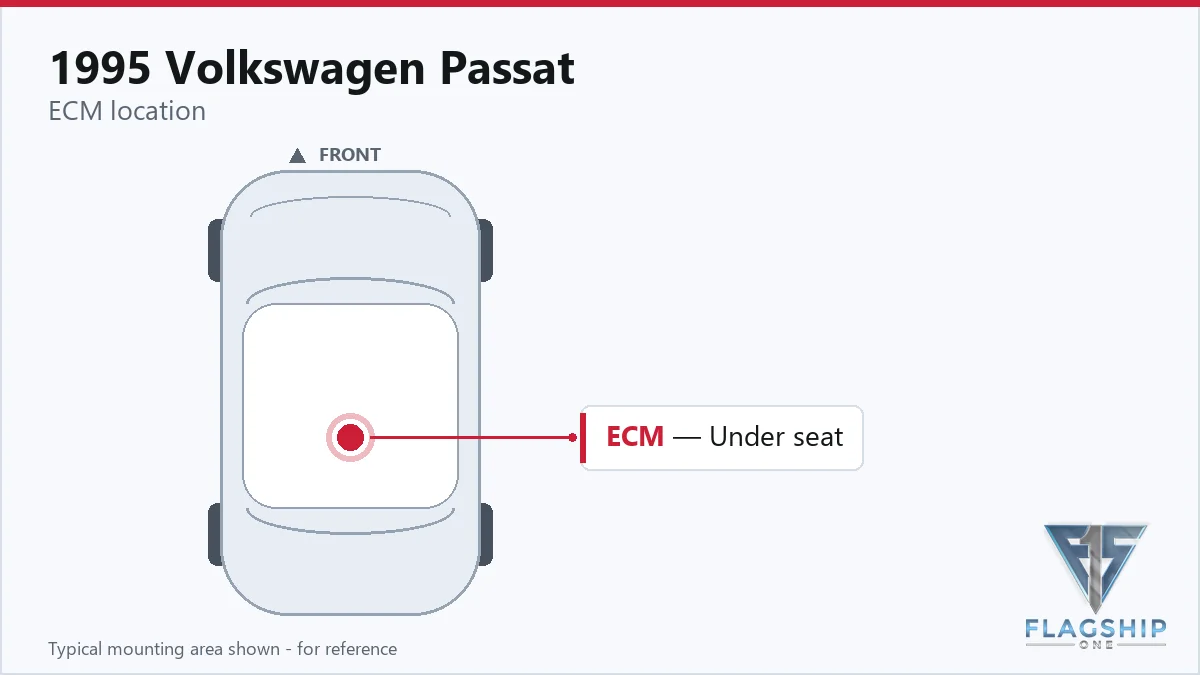
The ECM in your 1995 Volkswagen Passat is located in the plenum chamber on the right side of the engine bay. Accessing it requires removing the plenum cover, which is typically secured with a few bolts or clips. Once exposed, the ECM is held in place by a mounting bracket or directly attached to the plenum. The labor time for removing and replacing the ECM is listed as 0.3 hours, though this may vary slightly depending on the condition of the connectors or mounting hardware. After installation, the module must be reset or relearned, which adds another 0.5 hours of labor. The transmission control module (TCM) is located under the rear seat, but it’s a separate component and doesn’t directly affect ECM replacement. Always ensure the battery is disconnected before working on the ECM to avoid voltage spikes or electrical shorts.
| Operation | Configuration | Book Time |
|---|---|---|
| Powertrain Control Module Relearn | All configurations | 0.5 hr |
| Powertrain Control Module R&R | All configurations | 0.3 hr |
| Engine Control Module R&R | All configurations | 0.3 hr |
| Engine Control Module Reset | All configurations | 0.3 hr |
| Engine Control Module Relearn | All configurations | 0.5 hr |
After replacing the ECM in your 1995 Volkswagen Passat, the factory procedure requires a relearn process to synchronize the module with the vehicle’s immobilizer system and other onboard computers. This typically involves using a scan tool to reset the ECM and perform an adaptation procedure, which can take up to 0.5 hours of labor. The process ensures the new module recognizes the vehicle’s VIN and communicates correctly with the transmission control module and other systems. However, if you install a VIN-programmed replacement unit, these steps are already completed, saving you time and potential headaches. The relearn procedure is critical—skipping it may result in a no-start condition or erratic engine behavior. Always follow the manufacturer’s guidelines or consult a professional to ensure the job is done correctly.
When the ECM in your 1995 Volkswagen Passat begins to fail, you may notice a range of symptoms that can make driving frustrating or even unsafe. One of the most common signs is a no-start condition, where the engine cranks but refuses to fire up. Stalling or rough idling, especially at stoplights or during deceleration, is another red flag, often accompanied by a check engine light. Misfire codes, such as internal control module RAM error, may appear on a scan tool, indicating the ECM is struggling to process data correctly. In some cases, the vehicle may enter a “limp mode,” where power is severely limited to prevent further damage. Dead or intermittent communication with a scan tool is another telltale sign of ECM failure, as the module may fail to respond to diagnostic requests. Shifting issues, particularly in automatic transmissions, can also occur if the ECM isn’t communicating properly with the transmission control module. If you experience any of these symptoms, it’s worth having the ECM checked, as ignoring them could lead to more serious engine or drivetrain problems.
The 1995 Volkswagen Passat’s ECM is known to log specific internal trouble codes when it begins to fail. These codes can help pinpoint the issue and guide repairs, though they may not always appear before symptoms become noticeable. Below are the documented module-internal trouble codes for this vehicle.
| Code | Meaning | Full Guide |
|---|---|---|
| P0604 | Internal RAM error | Full P0604 guide → |
| P0605 | Internal ROM error | Full P0605 guide → |
| P0606 | Module processor failure | Full P0606 guide → |
Volkswagen issued service bulletin #96-07-42 to address immobilizer adaptation procedures when replacing the ECM in models equipped with Immobilizer 3 or 4. The bulletin outlines the steps required to ensure the new ECM synchronizes correctly with the vehicle’s security system, preventing a no-start condition. This process typically involves using a factory scan tool to perform an adaptation procedure, which can add time to the replacement process. If the adaptation isn’t completed, the vehicle may crank but fail to start, leaving you stranded. Always refer to the bulletin’s instructions or consult a professional to avoid complications during ECM replacement.
| Bulletin | Subject | What It Addresses |
|---|---|---|
| 96-07-42 | TT 96-07-42 All Models With Immobilizer 3 or 4, Immobilizer Adaptation When Replacing the ECM | — |
If your Passat cranks but doesn’t start after an ECM replacement, the immobilizer system may not be properly adapted to the new module. Factory service bulletin #96-07-42 outlines the adaptation procedure, which typically requires a scan tool to synchronize the ECM with the vehicle’s security system. Skipping this step can result in a no-start condition, even if the ECM is functioning correctly.
ECM failure in your 1995 Volkswagen Passat often presents as a combination of symptoms, such as stalling, misfire codes, or scan-tool communication issues. If the vehicle throws codes like P0604, P0605, or P0606, the ECM is likely the culprit. However, similar symptoms can also stem from faulty sensors, wiring issues, or fuel system problems, so a thorough diagnosis is recommended.
Replacing the ECM in your Passat is a straightforward job if you’re comfortable working with electrical components. The module is located in the plenum chamber, and the labor time is minimal. However, the post-install relearn procedure can be tricky without the right tools, so if you’re unsure, it’s best to consult a professional to avoid complications.
Skipping the ECM relearn procedure after replacement may result in a no-start condition or erratic engine behavior. The relearn process ensures the new module synchronizes with the vehicle’s immobilizer system and other onboard computers. Without it, the ECM may not recognize the VIN or communicate properly with the transmission control module, leading to performance issues.
Ignoring ECM-related trouble codes can lead to more serious issues over time. For example, a failing ECM may cause the engine to run too rich or too lean, damaging the catalytic converter or other emissions components. It can also lead to poor fuel economy, reduced power, or even complete engine failure if left unaddressed. Addressing codes promptly can save you from costly repairs down the road.
If your 1995 Volkswagen Passat is experiencing ECM-related issues, you have a few options for moving forward. A repair may be possible if the module’s failure is isolated to a specific component, but this isn’t always cost-effective or reliable. Alternatively, replacing the ECM with a new or refurbished unit can restore full functionality, especially if the replacement is VIN-programmed to match your vehicle. This approach eliminates the need for additional programming steps and ensures compatibility with your Passat’s systems. Consider the labor time, cost, and long-term reliability when deciding between repair and replacement.
Flagship One stocks a refurbished, VIN-programmed PCM for the 1995 Volkswagen Passat with a lifetime warranty, free shipping and no core charge. The full Volkswagen Passat module lineup covers other engine configurations as well.
The ECM in your 1995 Volkswagen Passat is a critical component that keeps your engine running smoothly. Whether you’re dealing with a no-start condition, stalling, or mysterious engine codes, understanding the role of the ECM—and the steps involved in replacing or relearning it—can help you make an informed decision. If you opt for a replacement, choosing a VIN-programmed unit can save you time and hassle, ensuring your Passat gets back on the road without unnecessary delays. Addressing ECM issues promptly can prevent further damage and keep your vehicle reliable for years to come.