
Last updated on August 25th, 2026 at 12:08 pm
The Powertrain Control Module (PCM) in the 1998 Pontiac Grand Am is the central computer that manages fuel injection, ignition timing, and transmission functions. When it fails, the engine may run poorly, shift erratically, or not start at all, often triggering diagnostic trouble codes.
When your 1998 Pontiac Grand Am begins to exhibit erratic shifting, a stubborn check engine light, or a no-start condition, the powertrain control module (PCM) may be the root cause. This computer is the brain behind your engine’s fuel delivery and transmission behavior. Understanding how it works, what happens when it fails, and what it takes to replace it can save you from unnecessary parts swapping and expensive diagnostic time. In this guide, you’ll learn the specific symptoms of a failing PCM in the 3.1L Grand Am, the exact location and labor involved in swapping it, and the critical programming steps that a quality replacement unit should already have completed. You’ll also see the factory service bulletins that address common PCM-related issues and the trouble codes that point directly to module failure. By the end, you’ll know whether your Grand Am’s PCM is the likely culprit and how to get back on the road with confidence.
The PCM in your 1998 Pontiac Grand Am with the 3.1L V6 is the central electronic controller that orchestrates fuel delivery, spark timing, and transmission shift points. It constantly reads data from sensors like the mass airflow sensor, throttle position sensor, and oxygen sensors, then adjusts injector pulse width and ignition advance in real time. On this model, the PCM also manages the 4T60-E automatic transmission, commanding shift solenoids and modulating line pressure for smooth gear changes. The module controls the idle air control valve, fuel pump relay, and cooling fan operation, making it a hub for multiple systems. It stores adaptive learning for idle speed and fuel trim, which is why a failing PCM can cause stalling or rough running that worsens over time. Because the PCM is located under the instrument panel, it is somewhat protected from engine heat and vibration, but it can still suffer from internal circuit degradation or software corruption. When seeking a solution, many owners turn to replacement PCMs for the Grand Am that come pre-programmed with the correct VIN and calibration, eliminating the need for a dealer visit. A properly functioning PCM is essential for passing emissions tests and maintaining fuel economy, as it continuously optimizes the air-fuel ratio and ignition timing based on driving conditions.
1998 Pontiac Grand Am
OEM programmed ECM for your 1998 Pontiac Grand Am — plug & play, no dealer visit.
Free shipping · Lifetime warranty
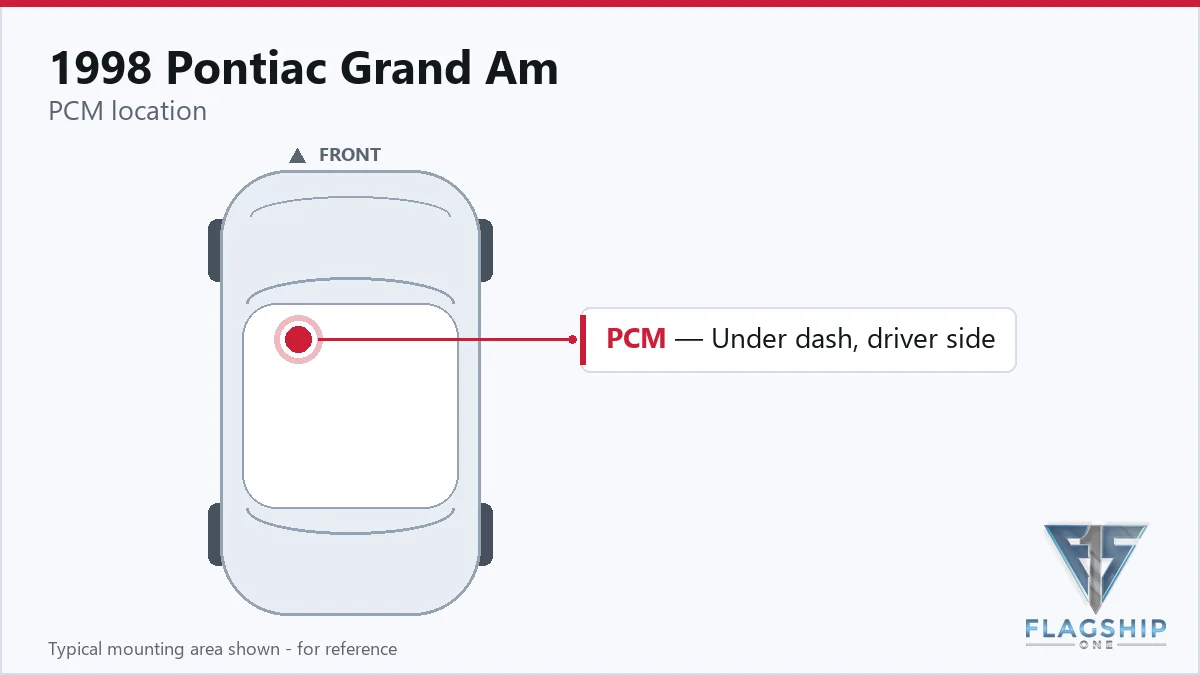
The Powertrain Control Module in the 1998 Grand Am is mounted under the instrument panel, requiring access from inside the vehicle. According to service information, replacing the PCM carries a book time of 1.1 hours. This involves removing trim panels to reach the module, disconnecting the electrical connectors, and swapping the unit. The module is positioned on the passenger side, secured by a bracket, and access typically requires removing the lower dash trim and possibly the glove box. The electrical connectors have locking tabs that must be carefully released. After installation, a Powertrain Control Module relearn procedure is necessary, which adds 0.5 hours. This relearn allows the module to adapt to the vehicle’s specific sensors and actuators. No special tools are required beyond basic hand tools, but care must be taken to avoid static discharge to the connector pins. Because the PCM is sensitive to electrostatic discharge, you should avoid touching the connector pins or circuit board components during the swap.
| Operation | Configuration | Book Time |
|---|---|---|
| Engine Control Module R&R | All configurations | 0.9 hr |
| Powertrain Control Module Relearn | All configurations | 0.5 hr |
| Powertrain Control Module R&R | All configurations | 1.1 hr |
After installing a new or remanufactured PCM, the factory service manual requires a specific relearn procedure. This includes clearing any stored diagnostic trouble codes and allowing the module to learn the idle air control position, fuel trim, and transmission shift adaptives. The relearn process, which takes about 0.5 hours of labor, may involve driving the vehicle through a series of speed and load conditions. Additionally, if the battery was disconnected to clear codes, the PCM loses all learned values, and the accelerator pedal may need to be partially depressed when restarting the engine to prevent stalling. However, when you order a pre-programmed PCM from Flagship One, these steps are already completed. The unit arrives with your Grand Am’s VIN and factory calibration loaded, so the module is ready to plug in and start the engine without a separate trip to the dealer for programming. This eliminates the need for a professional scan tool to perform the theft deterrent relearn or the crankshaft position sensor variation learn, which can be time-consuming and costly. The PCM will immediately communicate with the body control module and fuel pump, allowing the engine to fire up. The relearn of idle and shift adaptives will still occur naturally as you drive.
A failing PCM in a 1998 Pontiac Grand Am often produces symptoms that mimic other problems, making diagnosis challenging. One of the most telling signs is a no-start condition where the engine cranks but does not fire, often because the PCM is not commanding the fuel pump or injectors. You may also experience intermittent stalling, rough idle, or a sudden loss of power while driving. Transmission issues are common, including harsh or delayed shifts, failure to upshift, or a neutral flare where the engine revs but the car does not accelerate. The Service Engine Soon light may illuminate, and a scan tool might reveal a internal memory fault stored in the module, indicating that the PCM’s own self-checks have detected a problem. Other symptoms include dead communication with a scan tool, where the diagnostic port has power but no data, or multiple unrelated sensor codes that are not actually faulty. Because the PCM controls the cooling fan, overheating can occur if the module fails to turn the fan on. In some cases, the vehicle may run in a default “limp” mode with reduced power. The 3.1L engine is known for occasional ignition module failures, but when the PCM is at fault, the symptoms often appear across multiple systems simultaneously. A thorough diagnostic approach includes checking power and ground circuits to the PCM before condemning the module.
The following diagnostic trouble codes are specific to the Powertrain Control Module in the 1998 Pontiac Grand Am. When these codes appear, they point to an internal fault within the PCM itself rather than an external sensor or circuit problem. Addressing them typically requires module replacement or reprogramming.
| Code | Meaning | Full Guide |
|---|---|---|
| P0601 | Internal memory checksum error | Full P0601 guide → |
| P0602 | Control module programming error | Full P0602 guide → |
| P1621 | Control module long-term memory performance | Full P1621 guide → |
| P1629 | Module-internal fault | — |
General Motors issued service bulletin #99-06-04-053 in October 1999 to provide information on PCM reprogramming for various models, including the 1998 Grand Am. This bulletin outlines the importance of using updated calibrations to address driveability concerns. A more specific bulletin, #03-07-30-021A from November 2003, addresses a condition where customers may experience a neutral flare or RPM increase while in drive, no 1–2 upshift, and an illuminated Service Engine Soon light. On 1995–2002 vehicles, the PCM may set DTC P1810, while 2003 models may set P1815. The correction involves reprogramming the PCM with updated software. If your Grand Am exhibits these shift issues, the bulletin confirms that a software update—not necessarily a hardware failure—can resolve the problem.
| Bulletin | Subject | What It Addresses |
|---|---|---|
| 99-06-04-053 | Info – PCM Reprogramming – (Oct 26, 1999) | — |
| 03-07-30-021 | Neutral Flare and/or RPM Flare While In Drive, No 1-2 Upshift, Service Engine Soon (SES) Light | Some customers may comment on a neutral flare and/or RPM increase while in drive or no 1–2 upshift and/or the Service Engine Soon (SES) telltale may be… |
Common symptoms include a no-start condition where the engine cranks but won’t fire, intermittent stalling, rough idle, and transmission problems like harsh shifts or a neutral flare. You may also see an illuminated Service Engine Soon light with internal module trouble codes such as P0601 or P1629, or a complete loss of communication with a scan tool.
In this vehicle, the Powertrain Control Module (PCM) combines the functions of both the engine control module (ECM) and transmission control module (TCM). It manages fuel injection, ignition timing, and transmission shifting from a single unit located under the instrument panel.
Yes, a new or remanufactured PCM typically requires programming with the vehicle’s VIN and the correct calibration. However, a pre-programmed unit from a supplier like Flagship One arrives ready to install, eliminating the need for a dealer visit or specialized scan tool to perform the theft deterrent relearn and other adaptives.
A used PCM may physically fit, but it will still need to be programmed with your VIN and the correct calibration for your specific engine and transmission. Additionally, the module may have underlying faults or wear. A refurbished, tested, and pre-programmed unit is a more reliable choice.
The cost varies depending on whether you choose a dealer-programmed new unit or a refurbished pre-programmed module. Labor typically runs 1.1 hours for the swap plus 0.5 hours for the relearn, but a pre-programmed unit can save you the additional programming labor and the higher part cost of a new OEM module.
When faced with a faulty PCM, you have two paths: attempt to repair the original unit or install a refurbished replacement. Repairing a module with internal faults like P0601 or P1629 requires specialized microsoldering and component-level diagnostics, which is not a DIY task for most. A refurbished PCM that has been thoroughly tested and pre-programmed to your Grand Am’s VIN offers a plug-and-play solution that gets you back on the road quickly. Flagship One provides such units, eliminating the programming step and the uncertainty of a junkyard pull.
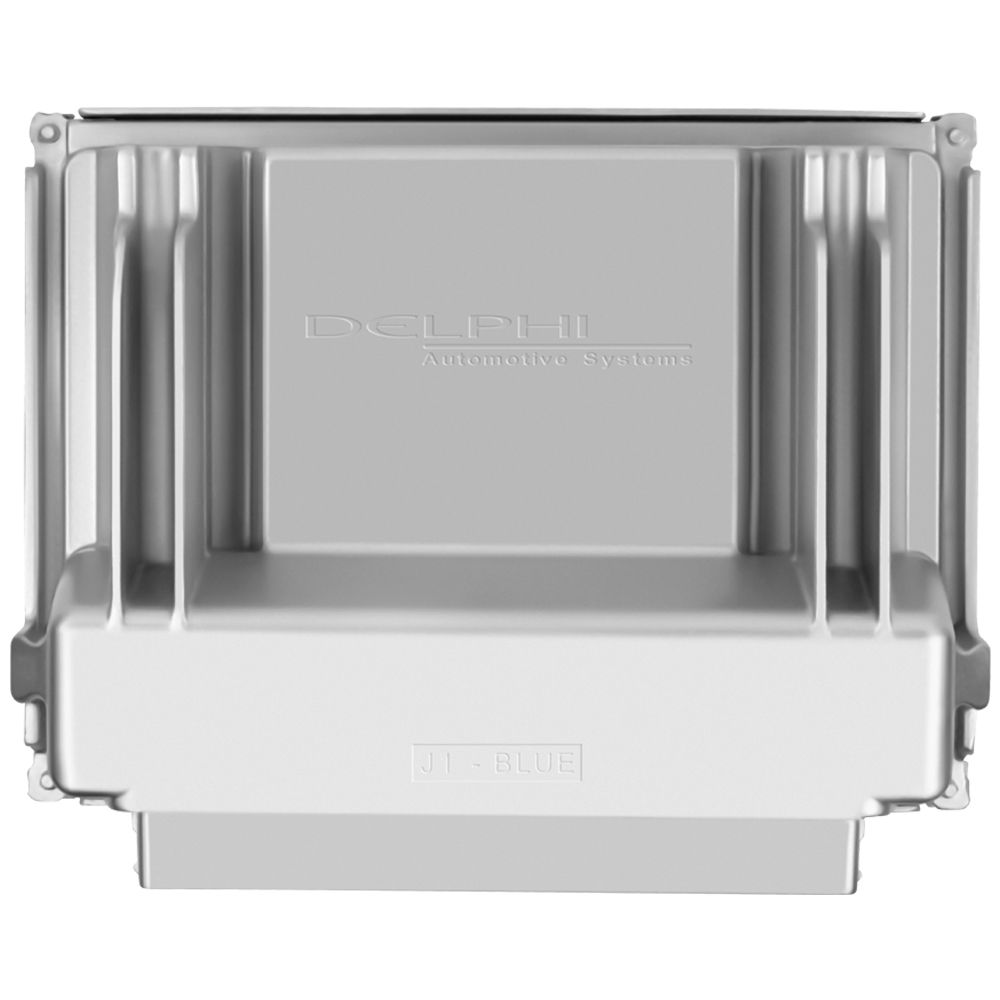
Flagship One stocks a refurbished, VIN-programmed PCM for the 1998 Pontiac Grand Am with a lifetime warranty, free shipping and no core charge. The full Pontiac Grand Am module lineup covers other engine configurations as well.
The 1998 Pontiac Grand Am relies heavily on its PCM for reliable engine and transmission operation. Recognizing the signs of module failure and understanding the replacement process can save you time and frustration. With a properly programmed replacement, you can restore your Grand Am’s performance and avoid the dealer programming fees. Consider a VIN-matched unit to simplify the job and get back to driving with confidence.