
Last updated on August 25th, 2026 at 12:34 pm
The Engine Control Module (ECM) in the 2017 Mercedes-Benz SLC-Class manages fuel injection, ignition timing, and emissions systems. Failure may cause erratic engine behavior, stalling, or complete no-start conditions, often triggered by electrical faults or internal corruption.
If your 2017 Mercedes-Benz SLC-Class has developed unexplained stalling, rough idling, or a stubborn no-start condition, the Engine Control Module (ECM) may be the culprit. This compact but critical computer oversees nearly every aspect of engine performance, from fuel delivery to ignition timing. When it fails, symptoms can range from subtle drivability issues to complete immobilization. Replacing the ECM isn’t just about swapping hardware—it involves precise programming to ensure the new unit communicates correctly with the rest of your vehicle’s systems. Understanding the process, labor requirements, and potential pitfalls can help you avoid unnecessary delays or costly mistakes. Whether you’re a DIY enthusiast or relying on a professional mechanic, knowing what to expect can save time and frustration. This guide covers the essentials: where the ECM is located, what replacement entails, and why a pre-programmed unit might be the most efficient solution for your SLC-Class.
2017 Mercedes-Benz SLC-Class
OEM programmed ECM for your 2017 Mercedes-Benz SLC-Class — plug & play, no dealer visit.
Free shipping · Lifetime warranty
The Engine Control Module (ECM) in the 2017 Mercedes-Benz SLC-Class serves as the brain of the engine management system. It continuously monitors data from sensors throughout the vehicle to optimize fuel injection, ignition timing, and emissions control. This ensures smooth operation, fuel efficiency, and compliance with environmental regulations. When the ECM malfunctions, it can disrupt these processes, leading to poor performance, increased emissions, or even a vehicle that won’t start. The SLC-Class relies on this module to adapt to driving conditions, such as altitude or temperature changes, making it a critical component for both daily driving and long-term reliability. If replacement becomes necessary, you’ll need replacement engine control modules for the SLC-Class that are compatible with your vehicle’s specific configuration. Without proper calibration, a new ECM may fail to communicate with other systems, leaving you with unresolved issues despite the hardware swap.
In the 2017 Mercedes-Benz SLC-Class, the ME-SFI control unit (ECM) is positioned on the left side of the air filter housing. Accessing it requires removing the air filter box and any associated ducting, though the process is straightforward for most mechanics. Once exposed, the module is secured with a few bolts and connected via a multi-pin electrical connector. Replacement labor is typically billed at 0.7 hours, according to factory estimates. After installation, the new unit must be properly torqued to avoid vibration-related issues, though specific torque values aren’t always provided in standard labor guides. The location is chosen for accessibility while protecting the module from excessive heat or moisture, though it remains vulnerable to electrical faults or connector corrosion over time.
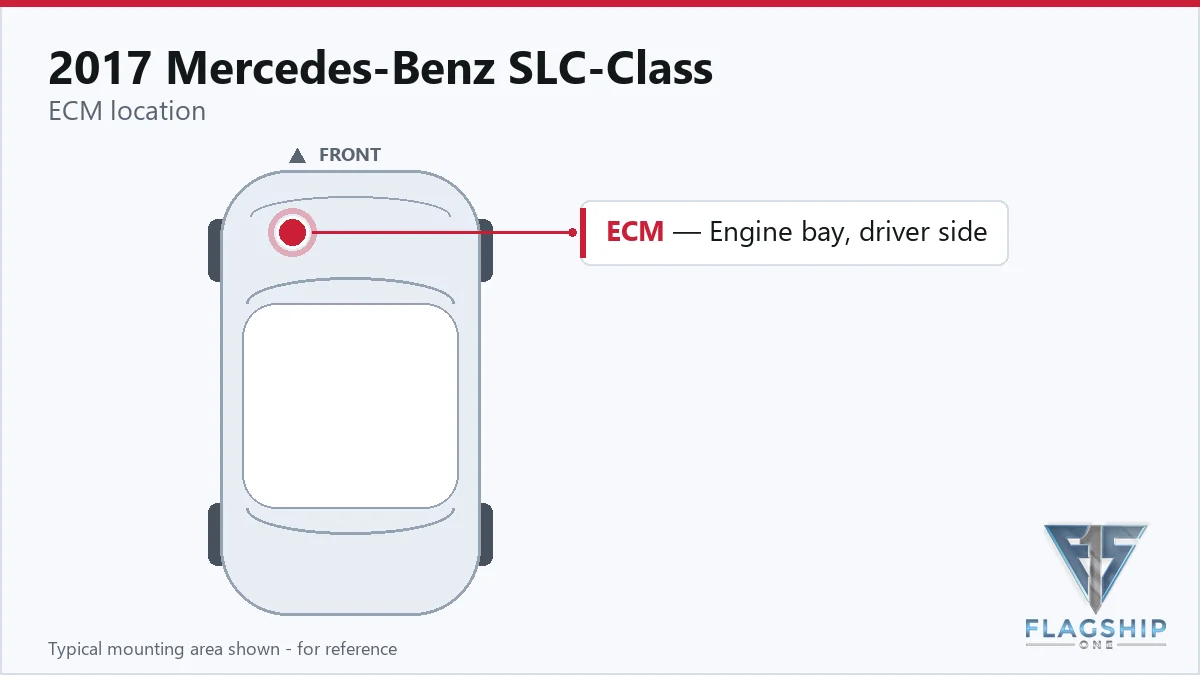
Work with the ignition off, and treat the module as static-sensitive: avoid touching the connector pins at any point.
| Operation | Configuration | Book Time |
|---|---|---|
| Engine Control Module Reset | All configurations | 0.3 hr |
| Engine Control Module R&R | All configurations | 0.7 hr |
| Engine Control Module Relearn | All configurations | 0.5 hr |
| Powertrain Control Module Relearn | All configurations | 0.5 hr |
| Powertrain Control Module R&R | All configurations | 0.7 hr |
After replacing the ECM in your 2017 Mercedes-Benz SLC-Class, the factory procedure requires a control module relearn, which typically takes 0.5 hours of labor. This step ensures the new unit synchronizes with the vehicle’s transmission, emissions, and other systems. Without this relearn, you may experience shifting issues, poor engine performance, or even a no-start condition. However, a VIN-programmed replacement unit arrives pre-configured to your vehicle’s specifications, eliminating the need for this additional step. This not only saves time but also reduces the risk of programming errors that can occur during dealer procedures. If you opt for a non-programmed unit, you’ll need to visit a dealership or a shop equipped with Mercedes-Benz diagnostic tools to complete the relearn process, which may add unexpected costs or delays.
When the ECM in your 2017 Mercedes-Benz SLC-Class begins to fail, symptoms often start subtly before escalating. You might notice the engine stalling unexpectedly, particularly at idle or during deceleration, or experiencing rough running that feels like a misfire. In some cases, the vehicle may refuse to start altogether, leaving you stranded. Other common signs include poor fuel economy, hesitation during acceleration, or the check engine light illuminating with codes related to fuel or ignition systems. Communication issues with scan tools are another red flag—if the ECM isn’t responding, it may indicate internal corruption or electrical failure. One specific fault code often associated with ECM problems is an internal control module memory check error, which suggests the module’s memory has been compromised. These symptoms can mimic other issues, such as sensor failures or fuel system problems, so proper diagnosis is essential before assuming the ECM is at fault.
While the physical replacement is straightforward, the ECM requires programming to match your vehicle’s VIN. If you install a non-programmed unit, you’ll need a dealership or specialized shop to complete the relearn procedure. A pre-programmed unit eliminates this step, making DIY replacement more feasible.
Common ECM failure symptoms include stalling, no-start conditions, and communication errors with scan tools. However, these can also stem from sensor failures or wiring problems. A professional diagnosis, including checking for trouble codes and inspecting electrical connections, is the best way to confirm the ECM is the root cause.
Without the relearn procedure, your SLC-Class may experience poor engine performance, shifting issues, or even a no-start condition. The vehicle’s systems rely on the ECM to communicate properly, and skipping this step can leave the module out of sync with the transmission, emissions, and other critical components.
Used ECMs may not be programmed to your vehicle’s VIN and could carry hidden faults from the donor vehicle. Additionally, they often require dealer programming, which can add cost and time. A new or remanufactured unit with VIN programming is typically a more reliable option.
Yes. A weak or failing battery can cause voltage fluctuations that may corrupt the ECM’s memory or damage its internal components. If your battery is old or struggling to hold a charge, replacing it may prevent future ECM issues.
If your 2017 Mercedes-Benz SLC-Class is experiencing ECM-related issues, you have two primary options: repair or replacement. Repairing the existing module may be possible in some cases, but it often involves diagnosing and fixing internal faults, which can be time-consuming and uncertain. Replacement, particularly with a VIN-programmed unit, offers a more straightforward solution. This approach eliminates the need for dealer programming and ensures your vehicle is back on the road quickly. Given the labor costs associated with relearn procedures, a pre-programmed ECM can also be a cost-effective choice for SLC-Class owners.
Flagship One stocks a refurbished, VIN-programmed PCM for the 2017 Mercedes-Benz SLC-Class with a lifetime warranty, free shipping and no core charge. The full Mercedes-Benz SLC-Class module lineup covers other engine configurations as well.
The 2017 Mercedes-Benz SLC-Class relies on its ECM to deliver smooth, reliable performance, and when it fails, the symptoms can be frustrating. Understanding the replacement process, from labor times to programming requirements, helps you make informed decisions about repairs. Whether you opt for a DIY approach or professional installation, choosing a VIN-programmed replacement unit can save time and hassle. Addressing ECM issues promptly ensures your SLC-Class remains dependable for years to come.