
Last updated on August 25th, 2026 at 12:34 pm
The Engine Control Module in your 2016 Mercedes-Benz S-Class is the primary computer that manages fuel delivery, ignition timing, emissions control, and turbocharger boost in this 4.7L twin-turbocharged engine. When this unit fails, the engine may not start, run poorly, or trigger multiple diagnostic codes.
If your 2016 Mercedes-Benz S-Class is experiencing starting issues, running problems, or diagnostic trouble codes that point to the Engine Control Module, you are facing a significant repair decision. The ECM in this vehicle is not simply a fuel injector controller—it is a sophisticated central computer that manages the entire powertrain, including the 4.7L biturbo V8 engine’s complex fuel and ignition maps, emissions systems, and turbocharger wastegate actuation. Understanding what this module does, where it lives, and what the replacement process involves will help you make an informed choice between expensive dealer repairs and quality aftermarket alternatives. This guide covers the factory-recommended procedures, common failure patterns, and practical considerations for getting your S-Class back on the road.
The Engine Control Module in your 2016 Mercedes-Benz S-Class is the central processing unit for all engine management functions in this luxury flagship sedan. This computer receives input from dozens of sensors throughout the powertrain—including mass airflow sensors, throttle position sensors, oxygen sensors, and knock sensors—and uses that data to calculate optimal fuel delivery, ignition advance, and boost pressure in real time. The module also controls the variable valve timing system, the cylinder-selective fuel injection, and the emissions control circuitry that keeps this vehicle compliant with federal emissions standards. Because the 4.7L engine in this S-Class is twin-turbocharged, the ECM must manage complex boost logic that coordinates turbo spooling with driver throttle inputs. This level of integration means that when the replacement engine computers for the Mercedes-Benz S-Class begins to fail, the effects can cascade across multiple vehicle systems. The module stores its adaptive learning data permanently, so even minor electrical glitches can disrupt the carefully calibrated air-fuel ratios that this sophisticated powertrain requires for smooth operation.
2016 Mercedes-Benz S-Class
OEM programmed ECM for your 2016 Mercedes-Benz S-Class — plug & play, no dealer visit.
Free shipping · Lifetime warranty
The factory removal procedure requires reaching the control module at the intake manifold, which means significant disassembly before the old unit can be extracted. Technicians must first remove the intake ductwork and air intake hoses to gain access to the manifold area where the ECM housing is mounted. The module itself is typically secured with bolts and electrical connectors that require careful disconnection to avoid damaging the harness. Once the old ECM is free, installation reverses these steps—mounting the replacement unit, reconnecting all connectors, and verifying proper seating before reassembly. Book time for the R&R procedure alone is 0.6 hours, though most shops will budget additional time for the inevitable complications that arise when working in tight engine bays. After installation, the relearn procedure adds another 0.5 hours of labor to allow the new module to adapt to your specific engine’s characteristics. If a reset is possible rather than full replacement, that procedure requires 0.3 hours of factory scan-tool time.
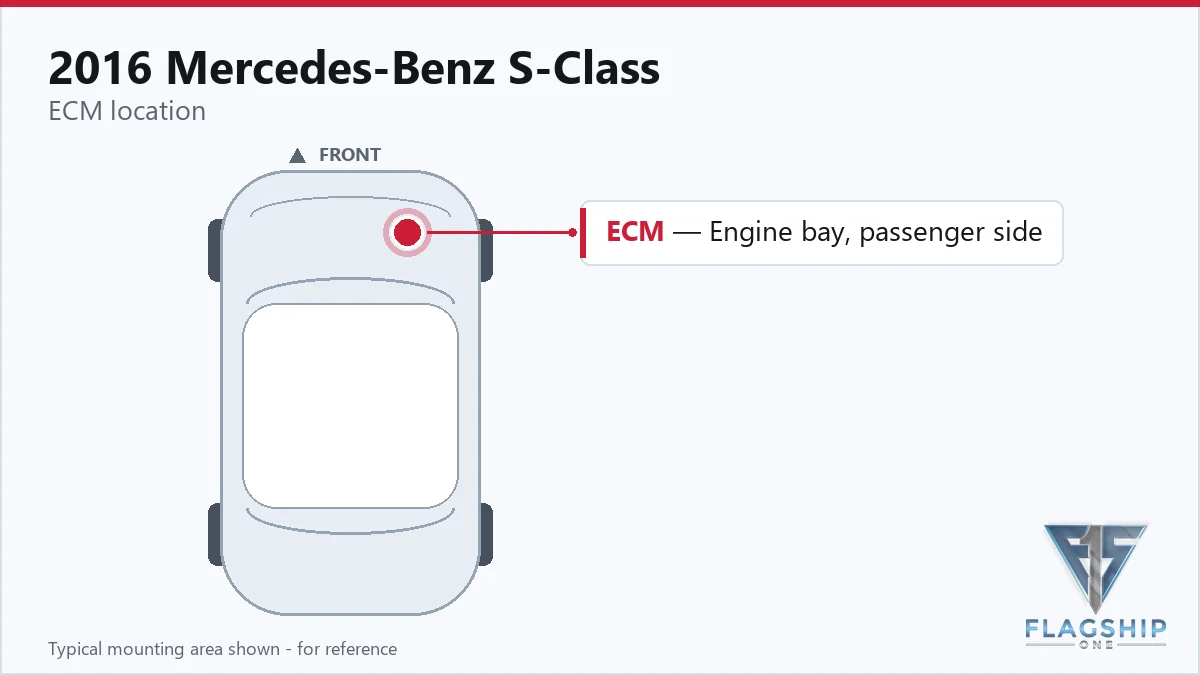
Work with the ignition off, and treat the module as static-sensitive: avoid touching the connector pins at any point.
| Operation | Configuration | Book Time |
|---|---|---|
| Engine Control Module Reset | All configurations | 0.3 hr |
| Engine Control Module R&R | All configurations | 0.6 hr |
| Engine Control Module Relearn | All configurations | 0.5 hr |
| Powertrain Control Module R&R | All configurations | 0.6 hr |
After replacing the Engine Control Module in your 2016 Mercedes-Benz S-Class, the factory procedure requires a relearn process using Mercedes-Benz diagnostic equipment. This relearn procedure allows the new module to calibrate to your specific engine’s fuel trims, idle characteristics, and emissions compliance settings. The process involves driving the vehicle through various operating conditions while the scan tool monitors adaptive tables being populated in the new computer’s memory. Without this procedure, the engine may run poorly, exhibit excessive fuel consumption, or trigger pending diagnostic codes. However, when you purchase a VIN-programmed replacement unit from Flagship One, the module arrives already configured with your vehicle’s specific VIN and pre-loaded with the correct calibration data for your 4.7L engine. This means the relearn procedure is significantly shortened or in some cases bypassed entirely, saving you the full 0.5-hour programming labor charge that the book time specifies.
When the Engine Control Module in a 2016 Mercedes-Benz S-Class begins to fail, the symptoms often manifest as no-start conditions or severe drivability issues that appear suddenly. The engine may crank normally but fail to fire, or it may start and then stall immediately as the ECM loses communication with critical sensors. Many owners report illuminated check engine lights accompanied by multiple diagnostic trouble codes that seem unrelated—codes for misfires, oxygen sensor malfunctions, and throttle position sensor faults all appearing simultaneously, which is a hallmark of ECM internal problems. In some cases, the scan tool may fail to communicate with the ECM at all, indicating an internal electrical failure within the module itself. The vehicle may also exhibit shifting irregularities if the TCM (transmission control module) shares data with a failing ECM, as these units often network together. Other common presentations include rough idle, hesitation under acceleration, and unexpected limp-home mode engagement that severely limits engine power. If you retrieve a internal memory check sum code during diagnosis, this specifically indicates ECM internal memory corruption and confirms the module must be replaced rather than repaired.
A used ECM from another vehicle will require dealer programming to accept your specific VIN and may not have the correct calibration for your 4.7L engine. Additionally, used units carry unknown remaining service life and may fail soon after installation, making them a risky choice compared to professionally rebuilt replacements.
Driving with a compromised ECM is not recommended because the engine may stall unexpectedly, enter limp-home mode, or experience uncontrolled fuel enrichment that can damage catalytic converters. If the module fails completely while driving, the engine will shut off and may not restart, leaving you stranded.
The ECM must be matched to your specific vehicle’s VIN and configured with the correct powertrain calibration data for your engine and transmission combination. Without this programming, the module will not communicate with the rest of the vehicle’s network and the engine will not run properly.
The ECM focuses specifically on engine management functions like fuel delivery and ignition timing, while the PCM in some applications may integrate transmission control. In your 2016 S-Class, these functions are often integrated, but the separate R&R book time of 0.6 hours indicates distinct housing locations that may require individual replacement.
The factory book time for relearn is 0.5 hours, though this can vary based on driving conditions and whether the replacement unit arrived pre-programmed with your VIN. Some relearn procedures require extended drive cycles to fully populate adaptive fuel tables.
When your 2016 Mercedes-Benz S-Class requires ECM replacement, you have two primary paths forward: paying dealer prices for a new unit plus programming labor, or choosing a professionally rebuilt replacement that arrives ready to install. The rebuilt option typically costs significantly less while still meeting OEM specifications. Consider the total cost of ownership including the 0.5-hour relearn procedure that any replacement will require—this is where pre-programmed units from reputable suppliers provide their greatest value by reducing dealer visit requirements.
Flagship One stocks a refurbished, VIN-programmed PCM for the 2016 Mercedes-Benz S-Class with a lifetime warranty, free shipping and no core charge. The full Mercedes-Benz S-Class module lineup covers other engine configurations as well.
The Engine Control Module in your 2016 Mercedes-Benz S-Class is a sophisticated computer that manages critical engine functions, and its failure requires thoughtful replacement decisions. Whether you pursue dealer service or a quality aftermarket unit, understanding the 0.6-hour R&R labor requirement and the 0.5-hour relearn procedure helps you budget appropriately. For owners seeking to avoid multiple dealer visits and programming fees, a VIN-programmed replacement unit offers a practical solution that gets your luxury sedan back on the road efficiently.