
Last updated on August 25th, 2026 at 12:37 pm
The engine control module (ECM) in your 2013 Mercedes-Benz CL-Class manages fuel delivery, ignition timing, and emissions systems. Failures may cause erratic engine behavior, poor performance, or a complete no-start condition due to corrupted data or internal faults.
If your 2013 Mercedes-Benz CL-Class is experiencing unexplained stalling, rough idling, or a refusal to start, the engine control module (ECM) may be the culprit. This small but vital computer oversees nearly every aspect of engine performance, from fuel injection to ignition timing. When it fails, symptoms can range from subtle drivability issues to a complete breakdown. Replacing the ECM isn’t just about swapping a part—it involves precise access, proper programming, and ensuring compatibility with your vehicle’s systems. Understanding the role of the ECM, where it’s located, and what to expect during replacement can save you time and frustration. Whether you’re diagnosing a persistent check engine light or preparing for a repair, knowing these details helps you make informed decisions about your CL-Class’s health and longevity.
The engine control module in your 2013 Mercedes-Benz CL-Class is the brain behind the engine’s operation. It continuously monitors sensors throughout the vehicle to adjust fuel mixture, ignition timing, and emissions controls in real time. This ensures optimal performance, fuel efficiency, and compliance with emissions standards. Without a functioning ECM, your CL-Class may struggle to start, run inefficiently, or even enter a protective limp mode to prevent damage. The module also stores critical data, including adaptive fuel trims and transmission shift patterns, which are essential for smooth operation. When the ECM fails, it often triggers a cascade of symptoms, from misfires to erratic shifting, because the engine no longer receives accurate commands. Replacing it with replacement engine control modules for the CL-Class restores proper communication between the engine and its supporting systems, but the process requires careful handling to avoid further issues. The ECM’s role extends beyond basic engine management—it also interacts with the transmission control module to ensure seamless gear changes, making it a cornerstone of your vehicle’s drivetrain performance.
2013 Mercedes-Benz CL-Class
OEM programmed ECM for your 2013 Mercedes-Benz CL-Class — plug & play, no dealer visit.
Free shipping · Lifetime warranty
In the 2013 Mercedes-Benz CL-Class, the engine control module is mounted near the intake manifold, which means accessing it requires removing some engine bay components. The factory procedure involves disconnecting the battery, unbolting the intake manifold cover, and carefully detaching the wiring harness from the module. Once exposed, the ECM can be unplugged and replaced with a new unit. The labor time for this process is typically around 0.6 hours, though additional time may be needed if other components obstruct access or if corrosion is present on connectors. After installation, the module must be securely fastened to prevent vibration-related issues, and all electrical connections should be inspected for signs of wear or damage. Proper reinstallation of the intake manifold cover is critical to avoid vacuum leaks, which can lead to rough idling or poor engine performance.
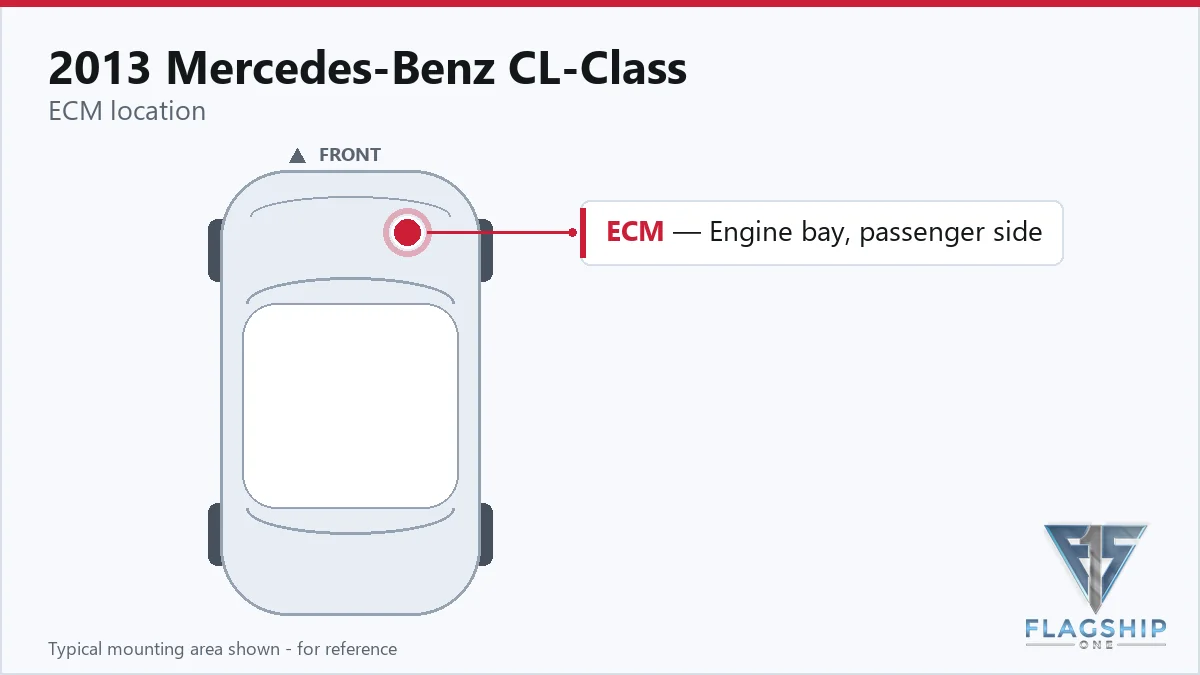
Work with the ignition off, and treat the module as static-sensitive: avoid touching the connector pins at any point.
| Operation | Configuration | Book Time |
|---|---|---|
| Engine Control Module R&R | All configurations | 0.6 hr |
After replacing the engine control module in your 2013 Mercedes-Benz CL-Class, the factory procedure requires programming the new unit to match your vehicle’s specific VIN and configuration. This step ensures the ECM recognizes the engine’s unique calibration, transmission type, and emissions settings. Without proper programming, the module may not communicate with other onboard systems, leading to drivability issues or even a no-start condition. However, when you install a VIN-programmed replacement unit, this step is already completed before the part arrives. The module is pre-loaded with your vehicle’s data, eliminating the need for a dealership visit or additional software updates. This not only saves time but also reduces the risk of programming errors, which can occur if the process is attempted without the correct tools or expertise. Once installed, the new ECM should immediately restore normal engine operation, provided all other components are functioning correctly.
A failing engine control module in your 2013 Mercedes-Benz CL-Class can manifest in several ways, often mimicking other mechanical or electrical issues. One of the most common signs is a no-start condition, where the engine cranks but refuses to fire. This may occur intermittently or become a persistent problem as the module deteriorates. Stalling or rough idling is another frequent symptom, particularly when the ECM struggles to maintain consistent fuel delivery or ignition timing. You might also notice poor acceleration, hesitation, or a general lack of power, as the module fails to adjust engine parameters in real time. Misfire codes, such as internal control module memory check sum error, are often stored in the vehicle’s computer, indicating a fault within the ECM itself. Other potential symptoms include erratic shifting, where the transmission fails to respond smoothly, or a complete loss of communication with a scan tool, leaving you unable to retrieve trouble codes. In some cases, the check engine light may illuminate without any clear pattern, making diagnosis more challenging. If you experience any of these issues, it’s worth inspecting the ECM as a potential cause, especially if other common culprits like spark plugs, fuel injectors, or sensors have already been ruled out.
Common signs include a no-start condition, stalling, rough idling, or misfire codes stored in the computer. If the vehicle struggles to communicate with a scan tool or exhibits erratic shifting, the ECM may be at fault. A professional diagnosis can confirm whether the module needs replacement.
Yes, the factory procedure requires programming the new ECM to match your vehicle’s VIN and configuration. This ensures proper communication with the engine and other onboard systems. However, a pre-programmed replacement unit eliminates this step, as it arrives ready to install.
While the physical replacement is straightforward, accessing the module near the intake manifold requires some mechanical skill. Additionally, programming the new ECM typically requires specialized tools unless you use a pre-programmed unit. If you’re comfortable with basic engine work, it’s doable, but professional installation is recommended for most owners.
ECM failures can result from voltage spikes, moisture intrusion, or internal component degradation over time. Poor electrical connections, such as corroded grounds or damaged wiring, can also contribute to premature failure. Regular maintenance of the vehicle’s electrical system can help prevent these issues.
A new ECM can resolve issues directly related to module failure, such as no-start conditions or misfire codes. However, if other components like sensors, fuel injectors, or spark plugs are faulty, those problems will persist. A thorough diagnosis is essential to identify all potential causes of drivability issues.
If your 2013 Mercedes-Benz CL-Class is showing signs of ECM failure, you have options for repair. A dealership replacement may involve higher costs and programming delays, while a refurbished or new pre-programmed unit can simplify the process. Choosing a VIN-matched replacement ensures compatibility and eliminates the need for post-install programming, getting your vehicle back on the road faster. Consider the severity of your symptoms and your budget when deciding between repair and replacement.
Flagship One stocks a refurbished, VIN-programmed ECM for the 2013 Mercedes-Benz CL-Class with a lifetime warranty, free shipping and no core charge. The full Mercedes-Benz CL-Class module lineup covers other engine configurations as well.
The engine control module in your 2013 Mercedes-Benz CL-Class plays a critical role in maintaining smooth engine operation and drivability. If you’re experiencing symptoms like stalling, misfires, or a no-start condition, the ECM may be the root cause. Replacing it with a pre-programmed unit can restore your vehicle’s performance and reliability. Regular maintenance of your CL-Class’s electrical system can help prevent future ECM issues, ensuring years of dependable driving.