
Last updated on August 25th, 2026 at 12:38 pm
The ME 9.7 Engine Control Module, also called the N3/10, serves as the primary computer for your 2010 Mercedes-Benz E-Class 3.5L engine. This unit manages fuel injection, ignition timing, emissions systems, and communications between engine sensors. Internal electronic failures in this module commonly stem from voltage spikes, prolonged heat exposure, moisture intrusion, or corrupted calibration data. When the module fails, your vehicle may exhibit no-start conditions, stalling, illuminated warning lights, or automatic transmission shifting irregularities.
If your 2010 Mercedes-Benz E-Class is experiencing no-start conditions, intermittent stalling, or illuminated warning lights that resist diagnosis through conventional means, the Engine Control Module may be the root cause. The ME 9.7 unit mounted on your intake manifold handles intensive computational tasks for your 3.5L engine, and internal electronic failures become more likely as these modules age beyond their original service life. This guide walks you through how the module functions in your specific vehicle, what replacement involves mechanically and programmatically, and what options exist when the original unit fails. Understanding the distinction between the physical replacement procedure and the required post-install programming will help you make informed decisions about repair approaches for your 2010 Mercedes-Benz E-Class.
2010 Mercedes-Benz E-Class
OEM programmed ECM for your 2010 Mercedes-Benz E-Class — plug & play, no dealer visit.
Free shipping · Lifetime warranty
The ME 9.7 Engine Control Module functions as the central nervous system for your 2010 Mercedes-Benz E-Class 3.5L engine. This computer receives data from dozens of sensors throughout the drivetrain and adjusts fuel delivery, spark timing, variable valve timing, and emissions equipment in real time to maintain performance while meeting federal standards. Unlike simple relay-style controllers, the ME 9.7 contains internal memory that stores vehicle-specific calibration data, adaptive learning values, and fault records accumulated over years of operation. This complexity means that when internal circuitry degrades from age, heat cycling, or voltage stress, the module cannot simply be repaired with external components. Replacement requires either a brand-new unit programmed with current factory calibration or a properly refurbished module from a specialist like Flagship One who programs replacement engine computers for the E-Class with the correct vehicle identification number data.
Flagship One keeps Mercedes-Benz E-Class replacement engine computers in stock for exactly this failure pattern.
The ME 9.7 control unit on your 2010 Mercedes-Benz E-Class sits atop the intake manifold, a location chosen to minimize wiring harness length but one that subjects the module to elevated temperatures from the adjacent cylinder head. Accessing this unit for replacement requires disconnecting the negative battery terminal first to eliminate residual voltage in the system. Intake ducting and surrounding components must be removed to reach the module’s mounting location. The ECM attaches with multiple fasteners, and the electrical harness connector releases with a primary and secondary locking mechanism. Once the original unit is free, the new or remanufactured module drops into the same mounting points. The physical removal and installation portion of this job carries a factory book time of 0.6 hours for the standard replacement operation. Properly torquing the mounting hardware and ensuring the harness connector clicks securely completes the mechanical portion of the job.
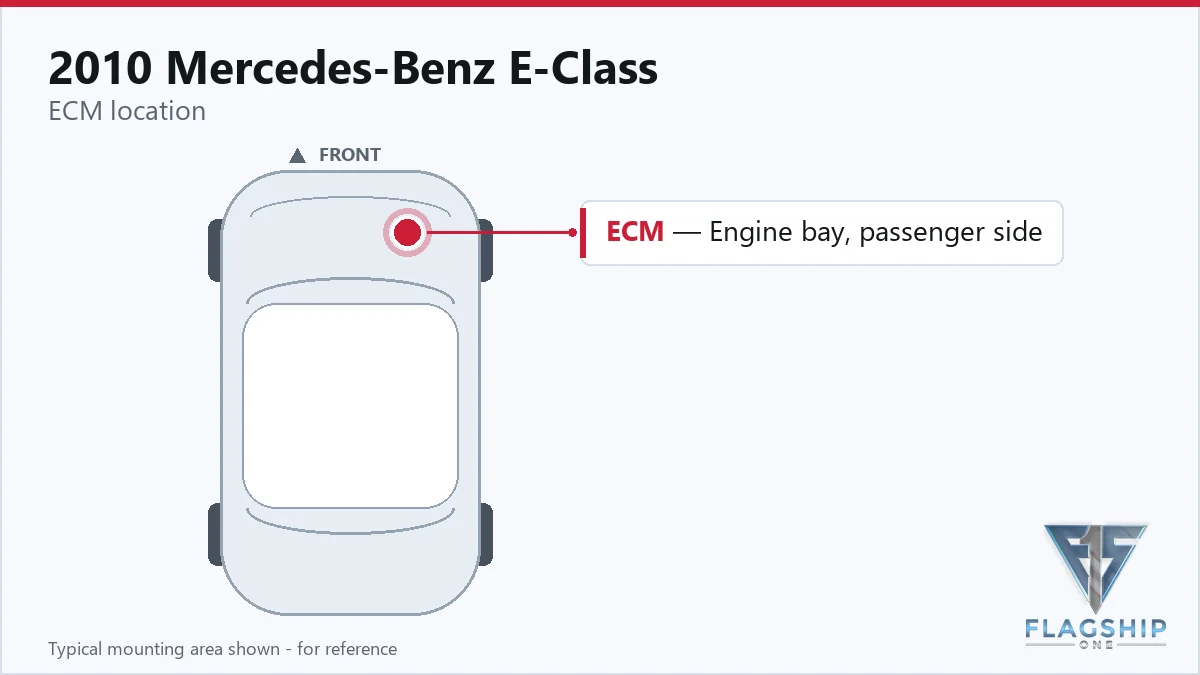
Work with the ignition off, and treat the module as static-sensitive: avoid touching the connector pins at any point.
| Operation | Configuration | Book Time |
|---|---|---|
| Engine Control Module R&R | All configurations | 0.6 hr |
| Engine Control Module Relearn | All configurations | 0.5 hr |
| Powertrain Control Module R&R | All configurations | 0.6 hr |
Following physical installation of a new Engine Control Module in your 2010 Mercedes-Benz E-Class, the factory service procedure requires a relearn process that allows the replacement unit to calibrate itself to your specific vehicle’s sensors and components. This post-installation sequence carries a separate labor allowance of 0.5 hours in official guides. During this procedure, the module learns minimum and maximum signal values from the crankshaft position sensor, camshaft position sensors, and other critical inputs. If this step is skipped or performed incorrectly, your vehicle may run roughly, stall frequently, or fail emissions testing despite having a perfectly functional replacement part. Flagship One eliminates this programming burden by shipping replacement modules that arrive as a VIN-programmed replacement unit, with your specific vehicle identification number already configured into the calibration data. This means the time-consuming factory relearn procedure may be significantly abbreviated or potentially bypassed depending on your specific circumstances.
Every VIN-programmed replacement unit from Flagship One arrives with these steps already completed.
When the ME 9.7 Engine Control Module begins failing on your 2010 Mercedes-Benz E-Class, the symptoms often manifest in ways that mimic less expensive problems. The engine may crank normally but fail to start, or it could start and then stall unexpectedly within seconds of startup. Persistent misfire codes affecting individual cylinders frequently appear alongside random sensor data that drifts or reads implausible values. In some cases, diagnostic scanners cannot communicate with the ECM at all, which points directly toward a module-level communication failure rather than a specific circuit problem. Automatic transmission models may exhibit harsh shifting or refusal to engage gears when the control module loses the ability to manage transmission clutch apply solenoids. An illuminated check engine light combined with any of these driveability symptoms warrants investigation of the ECM as a potential source.
Factory service documentation acknowledges software-related concerns with Engine Control Modules across multiple model years including your 2010 Mercedes-Benz E-Class. Technical bulletins S-B-07.61/89a and S-B-54.21/244a specifically address ECM flashing procedures for the N3/10 unit across all model years in the Mercedes lineup, indicating that software calibration updates have been a recurring need. Additionally, service documentation DTB-P-B-07.00/57e covers check engine light conditions and ECM software update revision requirements for numerous model designations, confirming that software corruption or outdated calibration has been a documented factory-level concern. These bulletins suggest that before assuming hardware failure, verifying current software calibration status represents a valid diagnostic step.
| Bulletin | Subject | What It Addresses |
|---|---|---|
| — | S-B-07.61/89a S-B-54.21/244a: Engine Control Module (N3/10) Flashing MY-All Models All | — |
| — | DTB – P-B-07.00/57e: Check Engine Light / Engine Control Module Software Update Revision Docume | — |
A used ECM from another vehicle will not function without reprogramming, and even then it may retain faults from its previous installation. Additionally, used modules often come with accumulated fault codes and calibration data incompatible with your specific vehicle identification number.
No. The ME 9.7 controls all fuel injection, ignition timing, and emissions functions. Without a functioning ECM, the engine will not run at all, as there is no mechanical backup or limp-home mode for the primary engine computer.
Diagnostic trouble codes related to internal module failures, unresponsive or implausible sensor readings, and complete loss of scan tool communication typically indicate hardware problems. Software updates address performance calibrations and occasional driveability concerns, but persistent electrical faults inside the module require physical replacement.
Repairing your existing ME 9.7 Engine Control Module is rarely cost-effective given the specialized equipment and factory access required to disassemble and rebuild internal circuitry. A new or professionally refurbished replacement represents the more practical solution. Flagship One provides modules programmed with your specific vehicle identification number, reducing installation complexity and eliminating the need to source factory programming services separately. Comparing the total cost of dealer replacement including programming labor against a pre-programmed unit from Flagship One typically reveals significant savings for your 2010 Mercedes-Benz E-Class repair.
Flagship One stocks a refurbished, VIN-programmed PCM for the 2010 Mercedes-Benz E-Class with a lifetime warranty, free shipping and no core charge. The full Mercedes-Benz E-Class module lineup covers other engine configurations as well.
The ME 9.7 Engine Control Module in your 2010 Mercedes-Benz E-Class represents a critical component that manages your 3.5L engine’s every operation. When internal failure occurs, the combination of mechanical replacement time and mandatory programming makes sourcing a pre-programmed replacement the most practical path forward. Flagship One specializes in providing correctly configured units for your specific vehicle, helping ensure your repair proceeds smoothly.