
Last updated on August 25th, 2026 at 12:11 pm
The engine control module (ECM) in the 2008 Mercedes-Benz S-Class, known as the ME-SFI control unit, manages fuel delivery, ignition timing, and emissions. When it fails, the engine may crank without starting, run roughly, or trigger warning lights, leaving the vehicle undriveable until the module is repaired or replaced.
The 2008 Mercedes-Benz S-Class represents the pinnacle of luxury engineering, with a network of electronic control units orchestrating every aspect of performance. At the heart of this system lies the engine control module, a component that can transform a refined driving experience into a frustrating diagnostic puzzle when it begins to fail. You may notice intermittent stalling, a refusal to start, or transmission behavior that feels out of character for a flagship sedan. These symptoms often point to the ME-SFI control unit, the specific module responsible for managing the engine’s most critical functions. Understanding what this module does, where it lives, and how a replacement is properly handled can save you significant time and expense. This guide walks you through the essential facts about the ECM in your S-Class, from its location and labor times to the programming requirements that follow a swap. You will learn how to recognize failure patterns, what the factory service procedures demand, and how a pre-programmed replacement can streamline the entire process, getting you back behind the wheel with confidence.
The engine control module in the 2008 Mercedes-Benz S-Class is a sophisticated computer that governs the engine’s air-fuel mixture, ignition advance, and emission controls. Officially designated the ME-SFI control unit, it receives data from a network of sensors—including those monitoring crankshaft position, camshaft timing, intake air temperature, and throttle input—and makes real-time adjustments to injectors, ignition coils, and the electronic throttle. This constant feedback loop ensures the engine delivers the smooth, powerful response expected of a luxury sedan while meeting strict emissions standards. Beyond basic engine management, the module communicates with the transmission control unit to coordinate shift points and torque delivery, so a fault can manifest as harsh or delayed gear changes. It also monitors onboard diagnostics, illuminating the check engine light when it detects anomalies and storing trouble codes that guide technicians toward the root cause. Because the ME-SFI unit is integral to so many systems, a malfunction can produce a wide array of driveability complaints, from a no-start condition to surging at highway speeds. When faults develop, replacing the S-Class engine control modules is often the most reliable solution. The module’s internal circuitry can degrade over time due to heat, vibration, or voltage irregularities, and once it begins to fail intermittently, the only lasting fix is a properly programmed replacement that restores the vehicle’s original behavior.
2008 Mercedes-Benz S-Class
OEM programmed ECM for your 2008 Mercedes-Benz S-Class — plug & play, no dealer visit.
Free shipping · Lifetime warranty
The ME-SFI control unit is positioned in the middle of the variable intake manifold, a location that places it directly atop the engine. This mounting spot provides relatively straightforward access once the engine cover is removed. According to the factory labor guide, replacing the engine control module requires 0.6 hours of work. The powertrain control module, a separate unit that handles additional functions, also carries a 0.6-hour replacement time. Because the module sits on the manifold, no major disassembly is needed to reach it; you simply disconnect the electrical connectors, unfasten the retaining hardware, and lift the unit away. Installation follows the reverse order, with care taken to seat the connectors firmly and secure the module against vibration. The book time accounts for the basic removal and replacement steps, but it does not include any diagnostic time or the post-installation programming that the factory specifies. Always disconnect the battery before beginning work to prevent electrical damage, and handle the module with care to avoid static discharge that can harm sensitive electronics.
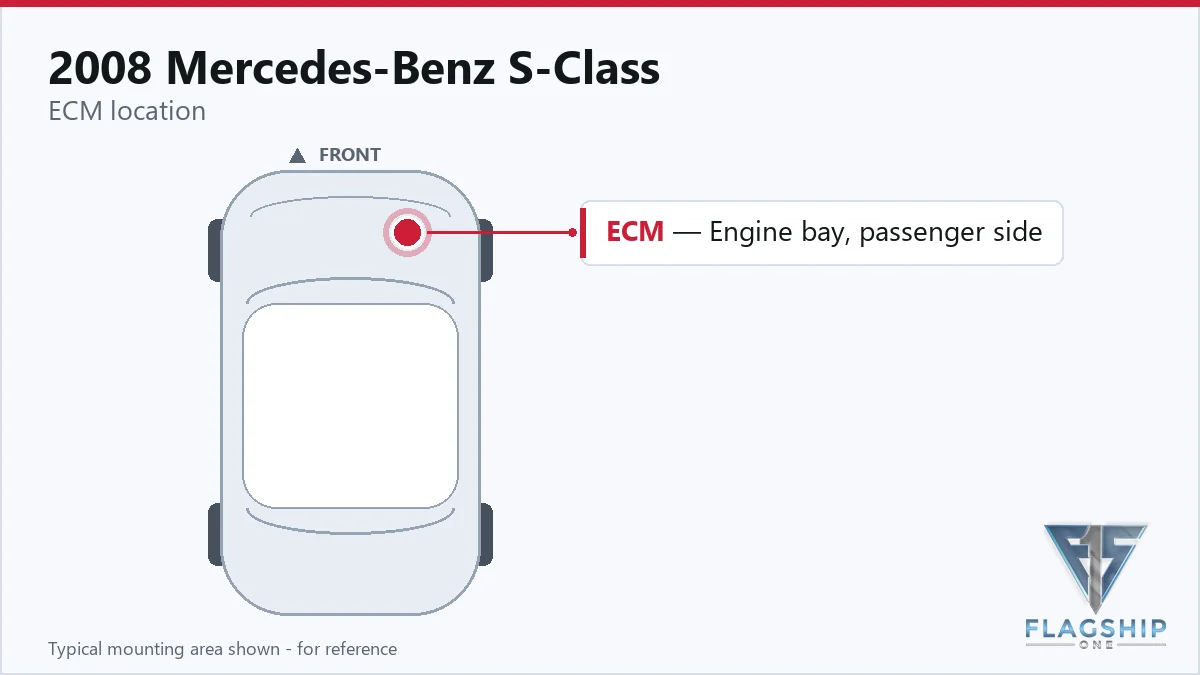
Work with the ignition off, and treat the module as static-sensitive: avoid touching the connector pins at any point.
| Operation | Configuration | Book Time |
|---|---|---|
| Engine Control Module R&R | All configurations | 0.6 hr |
| Engine Control Module Relearn | All configurations | 0.5 hr |
| Powertrain Control Module R&R | All configurations | 0.6 hr |
After a new engine control module is installed, the factory service bulletin S-B-07.61/89a and S-B-54.21/244a requires that the unit be flashed with the latest software and coded to the vehicle. This process typically involves connecting the car to the manufacturer’s diagnostic system, downloading the correct calibration files, and performing a series of initialization routines. The bulletin applies to all model years and addresses the engine control module (N3/10) specifically. When you order a pre-programmed replacement unit from Flagship One, this programming is already completed, so you can skip the dealer-level flashing and relearn procedures. The module arrives configured to your vehicle’s VIN and ready to install, which means the 0.5-hour relearn labor time noted in the factory guide is no longer necessary. This eliminates the need for specialized scan tools and the associated expense, allowing you to complete the job in your own garage with only the mechanical swap required.
A failing engine control module in the 2008 Mercedes-Benz S-Class can produce a range of symptoms that often mimic other problems, making diagnosis challenging. One of the most common signs is an engine that cranks but refuses to start, especially when the module fails to trigger the fuel pump or ignition coils. Intermittent stalling at idle or while driving may occur as the module loses its ability to process sensor data reliably. You might also experience misfires, rough running, or a noticeable loss of power under acceleration, because the air-fuel ratio and spark timing are no longer being optimized. Since the ME-SFI unit communicates with the transmission control module, shifting issues can arise—harsh engagements, delayed upshifts, or the transmission staying in a single gear. Another telltale indicator is a complete lack of communication with a scan tool; when the module goes offline, diagnostic equipment cannot retrieve codes or live data, effectively blinding the technician. The check engine light may illuminate steadily or flash, and multiple warning messages can appear on the instrument cluster. These symptoms often worsen as the module heats up, then temporarily improve after the vehicle cools down, a pattern that strongly suggests an internal electronic fault rather than a simple sensor or wiring issue.
Mercedes-Benz issued service bulletin S-B-07.61/89a and S-B-54.21/244a to address the need for software flashing of the engine control module (N3/10) across all model years. This procedure updates the module’s firmware to resolve potential driveability concerns and ensure compatibility with other vehicle systems. The bulletin outlines the steps required to reflash the module after replacement, which typically involves connecting the vehicle to the manufacturer’s diagnostic system and loading the latest calibration files. Following this update, the module must be coded to the specific vehicle, a process that synchronizes it with the anti-theft system and other networked control units. Ignoring this step can result in a no-start condition or persistent warning lights.
| Bulletin | Subject | What It Addresses |
|---|---|---|
| — | S-B-07.61/89a S-B-54.21/244a: Engine Control Module (N3/10) Flashing MY-All Models All | — |
The most frequent indicators include a no-start condition where the engine cranks but does not fire, intermittent stalling, and rough running. You may also notice transmission shifting problems, a check engine light, or a scan tool that cannot communicate with the vehicle. These symptoms often appear after the engine warms up and may temporarily disappear when it cools down.
No, they are separate units. The engine control module (ME-SFI) manages fuel, ignition, and emissions, while the powertrain control module handles broader functions. Both are located in the engine compartment, and each has a factory replacement time of 0.6 hours.
The module must be flashed with the latest software and coded to your vehicle’s VIN to communicate with the anti-theft system and other control units. Without this step, the car may not start or could exhibit warning lights. A factory service bulletin outlines the required flashing procedure for all model years.
Flagship One pre-programs each unit to your specific VIN before shipping. This means the module arrives ready to install, eliminating the need for dealer-level software flashing and the 0.5-hour relearn procedure. You simply swap the module and drive.
The factory relearn, which takes 0.5 hours, typically includes throttle position adaptation, idle speed calibration, and other initialization routines. When you use a pre-programmed unit from Flagship One, these steps are already completed, so no additional relearn is necessary.
For the 2008 S-Class, you can choose between repairing your existing module or installing a refurbished replacement. Repair services may address specific faults but can leave underlying wear. A refurbished unit from Flagship One is fully tested and comes pre-programmed to your VIN, offering a plug-and-play solution that avoids the complexity and cost of dealer programming. This approach restores factory performance without the wait or uncertainty of a repair.
Flagship One stocks a refurbished, VIN-programmed PCM for the 2008 Mercedes-Benz S-Class with a lifetime warranty, free shipping and no core charge. The full Mercedes-Benz S-Class module lineup covers other engine configurations as well.
Addressing a faulty engine control module in your 2008 Mercedes-Benz S-Class doesn’t have to be overwhelming. With a pre-programmed replacement from Flagship One, you can skip the dealer visit and complete the job in your own garage. The factory book time of 0.6 hours for removal and installation means a straightforward swap, and our team ensures your unit arrives ready to perform. Reclaim the luxury driving experience your S-Class was designed to deliver.