
Last updated on August 25th, 2026 at 12:39 pm
If your 2007 Mercedes-Benz SLK-Class has developed starting problems or runs poorly after a battery disconnect or electrical intervention, the ME-SFI control module may have sustained damage. This sophisticated engine computer manages critical functions including fuel injection, ignition timing, and emissions systems for the 3.0L V6 engine. Control module failures in this vehicle can occur without warning, sometimes triggered by voltage spikes from jump starts, battery disconnections, or connector issues. Understanding what this module does, where it is located, and what the replacement process involves will help you make informed decisions about repair options. This guide covers the function of the engine control module in your specific vehicle, common failure symptoms, labor requirements for replacement, and the programming procedures required after installation.
The ME-SFI control unit in your 2007 Mercedes-Benz SLK-Class serves as the primary engine management computer, controlling the ME-SFI (Mercedes Sequential Fuel Injection) system unique to Mercedes-Benz powerplants. This sophisticated module monitors inputs from numerous sensors throughout the engine bay, including mass airflow sensors, throttle position sensors, coolant temperature sensors, and oxygen sensors, then calculates the optimal fuel delivery and ignition advance for each operating condition. The control unit maintains communication with other vehicle modules through the CAN bus network, coordinating with the transmission control module to ensure smooth shifting and optimal power delivery. In a 3.0L V6 engine, the ME-SFI module must precisely meter fuel to six injectors while managing spark timing across three ignition coils, creating a complex calibration challenge that only the factory software can properly address. When this module fails or becomes corrupted, the engine may revert to limp-home mode, run roughly, stall unexpectedly, or fail to start entirely. The ME-SFI system represents an integrated approach to engine management, meaning the control unit handles multiple functions that would be separated across different modules in many other vehicles. Replacement engine computers for the SLK-Class must be programmed with the correct vehicle identification number and calibration data to restore full functionality.
Flagship One keeps Mercedes-Benz SLK-Class replacement engine computers in stock for exactly this failure pattern.
2007 Mercedes-Benz SLK-Class
OEM programmed ECM for your 2007 Mercedes-Benz SLK-Class — plug & play, no dealer visit.
Free shipping · Lifetime warranty
The ME-SFI control unit is located at the center of the intake manifold, requiring significant disassembly for access on your 2007 Mercedes-Benz SLK-Class. This central placement within the engine bay exposes the module to heat cycling and vibration throughout its service life, factors that contribute to eventual failure in some vehicles. The replacement process involves removing the intake manifold assembly to reach the control module, then carefully disconnecting the electrical harness and removing the mounting hardware. Book time for engine control module removal and replacement is 0.7 hours, while the powertrain control module removal and replacement requires an additional 0.7 hours of labor. These labor estimates reflect the time required for a professional technician to complete the physical replacement work, though actual times may vary based on vehicle condition and tooling availability. After the new module is installed, the mounting hardware must be torqued to specification and all connectors must be properly seated to ensure reliable operation. The intake manifold must be reinstalled with new gaskets to prevent vacuum leaks that could cause drivability issues after the repair.
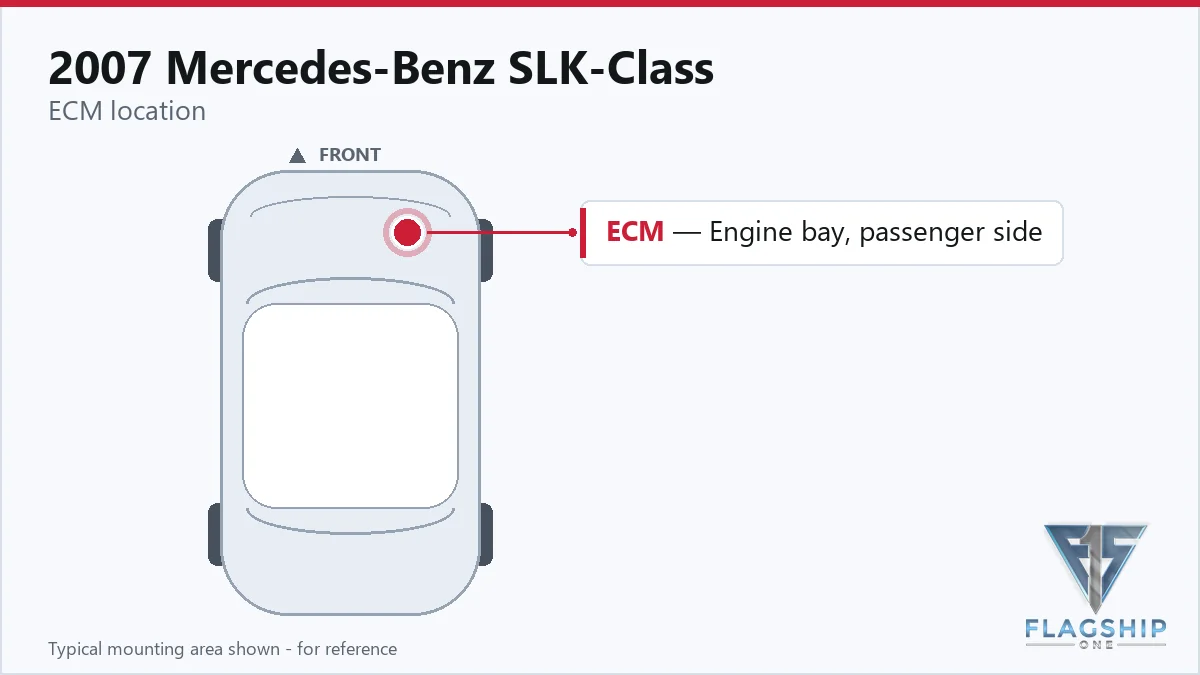
Work with the ignition off, and treat the module as static-sensitive: avoid touching the connector pins at any point.
| Operation | Configuration | Book Time |
|---|---|---|
| Engine Control Module R&R | All configurations | 0.7 hr |
| Engine Control Module Relearn | All configurations | 0.5 hr |
| Powertrain Control Module Relearn | All configurations | 0.5 hr |
| Powertrain Control Module R&R | All configurations | 0.7 hr |
Following module replacement, your vehicle requires a relearn procedure to establish communication between the new control unit and the rest of the vehicle’s network. The engine control module relearn procedure requires 0.5 hours of book time, while the powertrain control module relearn procedure requires an additional 0.5 hours. These procedures involve the scan tool communicating with the new module, programming the vehicle identification number into the replacement unit, and performing idle speed and fuel trim adaptations. Without completing these steps, your vehicle may exhibit poor idle quality, reduced power, or illuminated warning lights. Flagship One units arrive VIN-programmed so those steps are already done, meaning your technician can install the replacement module and immediately proceed to the relearn procedures without additional programming overhead. The factory procedure requires the scan tool to verify that all sensors are reading correctly and that the module has properly learned the characteristics of your specific engine. Some technicians report that multiple relearn cycles may be necessary to achieve optimal results, particularly if the new module has not learned the specific fuel injector characteristics of your engine.
Every VIN-programmed replacement unit from Flagship One arrives with these steps already completed.
When the ME-SFI control module in your 2007 Mercedes-Benz SLK-Class begins to fail, you may experience several distinct symptoms that indicate the engine management system is not functioning properly. The most dramatic symptom is a no-start condition where the engine cranking normally but fails to fire, often leaving the driver stranded with a vehicle that shows no obvious mechanical problems. Some owners report that the engine starts briefly then stalls, suggesting the module is not maintaining fuel delivery or ignition timing consistently. Illuminated check engine lights frequently accompany module failures, with diagnostic trouble codes such as internal memory faults being stored in the control unit. In other cases, the vehicle may start and run but exhibit severe drivability problems including rough idle, hesitation under acceleration, and reduced power output that makes the vehicle feel sluggish. Communication failures between the scan tool and the engine control module represent another common indicator of module problems, as the damaged electronics may not respond to diagnostic requests. Some owners have reported that their vehicles entered limp-home mode, operating in a reduced-power state designed to allow driving to the nearest service facility. Transmission shifting issues may also manifest when the control module cannot properly communicate with the transmission control module, as these two systems rely on continuous data exchange to coordinate gear changes.
A used module would require dealer programming to match your specific vehicle identification number and calibration. This programming service often costs as much as or more than purchasing a new or refurbished unit, and used modules carry no warranty coverage for your specific application.
If the vehicle is running, you may be able to drive it, but you should expect reduced performance, poor fuel economy, and potential stalling. The vehicle may enter limp-home mode at any time, limiting your ability to accelerate or maintain highway speeds. Having the vehicle towed to a repair facility is often the safer choice.
The new module must learn your specific vehicle identification number, the calibration data for your 3.0L engine, and the characteristics of your specific fuel injectors. Without this programming, the module cannot properly control fuel delivery and ignition timing, resulting in poor operation or no-start conditions.
Common causes include voltage spikes from battery disconnections or jump starts, heat damage from its location on the intake manifold, moisture intrusion through connector seals, and normal wear of internal electronic components over time. The central location exposes the module to significant heat cycling that accelerates component degradation.
A qualified technician can connect a scan tool to verify communication with the ME-SFI module. If the tool cannot establish communication or if internal fault codes are present, the control module requires attention. Other diagnostic steps can rule out sensor failures and wiring issues before concluding the module itself has failed.
When your 2007 Mercedes-Benz SLK-Class requires engine control module repair, you have two primary options: professional repair using new or refurbished components, or purchasing a replacement unit from Flagship One. Professional repair at a dealership or independent shop ensures proper installation and programming but typically involves higher costs and longer wait times. Purchasing a VIN-programmed replacement unit allows your preferred technician to perform the physical replacement while you handle the programming aspects separately. Consider your budget, timeline, and comfort level with the repair process when deciding which approach best suits your needs.
Flagship One stocks a refurbished, VIN-programmed PCM for the 2007 Mercedes-Benz SLK-Class with a lifetime warranty, free shipping and no core charge. The full Mercedes-Benz SLK-Class module lineup covers other engine configurations as well.
The ME-SFI control module in your 2007 Mercedes-Benz SLK-Class is a critical component that manages your 3.0L engine’s fuel and ignition systems. When failure occurs, understanding the replacement process and programming requirements helps you make informed decisions about repair options. Whether you pursue dealer service or a VIN-programmed replacement unit from Flagship One, addressing control module issues promptly restores reliable operation to your SLK-Class.