
Last updated on August 25th, 2026 at 12:39 pm
The Engine Control Module (ECM) in your 2005 Mercedes-Benz C-Class manages fuel injection, ignition timing, and emissions systems. Failures may cause erratic engine behavior, poor fuel economy, or complete no-start conditions due to corrupted software or internal circuit issues.
If your 2005 Mercedes-Benz C-Class has been stalling unexpectedly, refusing to start, or throwing cryptic engine codes, the Engine Control Module (ECM) may be the culprit. This small but critical computer manages everything from fuel delivery to ignition timing, ensuring your 1.8L engine runs smoothly. When it fails, symptoms can range from subtle performance issues to complete immobilization. Replacing the ECM isn’t just about swapping a part—it involves precise labor steps and post-installation programming to restore full functionality. Understanding the process helps you avoid unnecessary dealer visits and ensures your vehicle gets back on the road without delays. Whether you’re diagnosing a persistent issue or preparing for a replacement, knowing what to expect can save time and frustration.
The Engine Control Module (ECM) in your 2005 Mercedes-Benz C-Class serves as the brain of the engine management system. It continuously monitors sensors for air intake, throttle position, and exhaust composition, adjusting fuel injection and ignition timing in real time. This ensures optimal performance, fuel efficiency, and emissions compliance. Without a properly functioning ECM, your vehicle may experience rough idling, hesitation under acceleration, or even fail to start. The module also communicates with the transmission control unit to coordinate shifting, which is why some failures may affect both engine and drivetrain behavior. When the ECM degrades, it often triggers warning lights on the dashboard and stores diagnostic trouble codes. For owners of the C-Class, replacement engine computers for the C-Class are designed to restore factory-level operation, but proper installation and programming are essential to avoid recurring issues. The ECM’s role is particularly critical in turbocharged models, where precise air-fuel ratios prevent engine damage.
2005 Mercedes-Benz C-Class
OEM programmed ECM for your 2005 Mercedes-Benz C-Class — plug & play, no dealer visit.
Free shipping · Lifetime warranty
In the 2005 Mercedes-Benz C-Class, the ECM—referred to as the ME control unit—is mounted on the left side of the engine bay, adjacent to the air filter housing. Accessing it requires removing the air filter box and disconnecting the electrical connector, which is secured with a locking tab. Once exposed, the module is held in place by two bolts or clips, depending on the specific variant. Replacement labor is typically minimal, with book time set at 0.9 hours for removal and reinstallation. After the new unit is installed, the electrical connector must be firmly seated to ensure proper communication with the vehicle’s network. No specialized tools are required beyond basic hand tools, but care should be taken to avoid damaging the connector pins during handling. The location is designed for serviceability, though working in tight engine bays may require patience to avoid snagging nearby components.
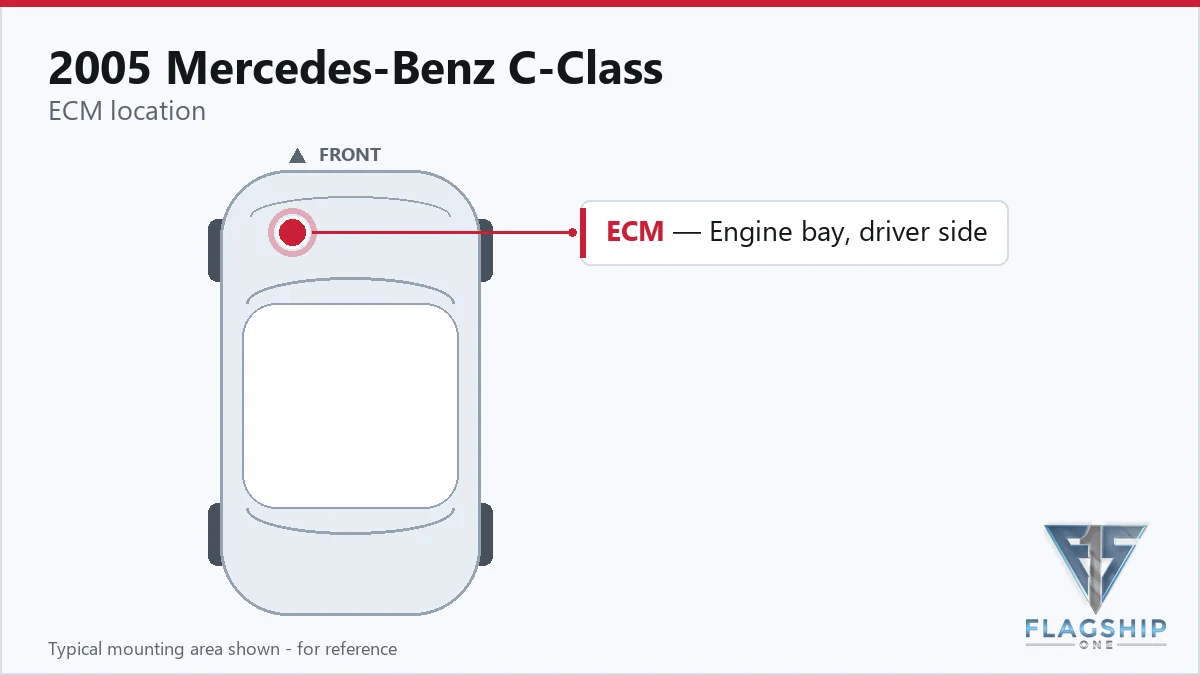
Work with the ignition off, and treat the module as static-sensitive: avoid touching the connector pins at any point.
| Operation | Configuration | Book Time |
|---|---|---|
| Engine Control Module R&R | All configurations | 0.9 hr |
| Powertrain Control Module Relearn | All configurations | 0.5 hr |
After installing a new ECM in your 2005 Mercedes-Benz C-Class, the factory procedure requires a powertrain control module relearn process, which typically takes 0.5 hours. This step ensures the module synchronizes with the vehicle’s sensors and transmission, preventing issues like erratic shifting or poor throttle response. However, a VIN-programmed replacement unit from Flagship One arrives pre-configured to your vehicle’s specifications, eliminating the need for this additional step. The module is already matched to your C-Class’s engine and transmission calibration, so you can drive the vehicle immediately after installation. This not only saves time but also reduces the risk of programming errors that can occur during dealer flashing. If you opt for a non-programmed unit, the relearn process must be performed using a factory-level scan tool, which may not be available at all repair shops.
When the ECM in your 2005 Mercedes-Benz C-Class begins to fail, symptoms often start subtly before escalating. You may notice the engine idling roughly, hesitating during acceleration, or stalling unexpectedly at stoplights. Some drivers report intermittent no-start conditions, where the engine cranks but refuses to fire. Misfire codes, such as internal control module memory checksum error, may appear on the scan tool, indicating the ECM’s memory has become corrupted. In some cases, the vehicle may enter a limp-home mode, limiting engine power to prevent further damage. Communication issues with diagnostic tools are another red flag, as the ECM may fail to respond to scan requests. Shifting problems, particularly harsh or delayed gear changes, can also stem from ECM failure, as the module coordinates with the transmission control unit. If you experience multiple symptoms simultaneously, the ECM is a likely suspect, especially if other components like sensors and wiring have been ruled out.
Mercedes-Benz issued service bulletin S-B-07.61/27a addressing software updates for the Engine Control Module (ME-SFI 2.8) in the 2005 C-Class. This bulletin outlines a flashing procedure to correct calibration issues that may cause drivability symptoms, such as rough idling or poor throttle response. The update is performed using a factory diagnostic tool and is typically recommended during routine maintenance or when specific symptoms arise. If your vehicle exhibits persistent issues, checking for applicable software updates may resolve the problem without requiring a full ECM replacement.
| Bulletin | Subject | What It Addresses |
|---|---|---|
| — | S-B-07.61/27a: Software Update via Flashing Engine Control Module (ME-SFI 2.8) | — |
The ECM controls fuel injection and ignition timing in real time. When it malfunctions, it may send incorrect signals to the injectors or coils, causing the engine to stall. This is often accompanied by rough idling or hesitation during acceleration. A failing ECM may also lose communication with the transmission control unit, leading to erratic shifting.
Driving with a failing ECM is risky. While the vehicle may start and run intermittently, it can stall unexpectedly or enter limp-home mode, severely limiting performance. Prolonged use may also cause additional damage to sensors or the catalytic converter due to incorrect air-fuel mixtures.
If the ECM stores codes related to internal memory corruption or communication failures, replacement is often the solution. However, if the issue is related to software calibration, a factory flash may resolve it. A diagnostic scan can help determine whether the module itself is faulty or if an update is needed.
A used ECM from another vehicle will not be programmed to your C-Class’s VIN, which can cause drivability issues or trigger immobilizer faults. The module must be matched to your vehicle’s engine and transmission calibration, either through dealer programming or by using a pre-programmed replacement unit.
While the ECM primarily manages engine functions, it communicates with the transmission control unit to coordinate shifting. A failing ECM may cause delayed or harsh gear changes, as the transmission relies on engine data to adjust shift points. This is why some ECM failures affect both engine and drivetrain performance.
If your 2005 Mercedes-Benz C-Class is experiencing ECM-related issues, you have two primary options: repair or replacement. While some software glitches can be resolved with a factory flash, persistent internal failures often require a new module. Opting for a pre-programmed replacement unit eliminates the need for dealer programming, saving time and reducing the risk of installation errors. Whether you choose a refurbished or new ECM, ensure it’s matched to your vehicle’s specifications to avoid compatibility issues.
Flagship One stocks a refurbished, VIN-programmed PCM for the 2005 Mercedes-Benz C-Class with a lifetime warranty, free shipping and no core charge. The full Mercedes-Benz C-Class module lineup covers other engine configurations as well.
The ECM in your 2005 Mercedes-Benz C-Class plays a vital role in engine performance and drivability. When it fails, symptoms like stalling, misfires, or no-start conditions can disrupt your daily routine. Understanding the replacement process, from labor time to programming requirements, helps you make informed decisions. If you’re facing ECM issues, a pre-programmed unit can simplify the repair and get your C-Class back on the road efficiently.